No Myth Here
To walk into the current exhibition by Khajistan, Office of War Information, on view at Pioneer Works until August 9, feels a bit like slinking into your dad’s office circa 2003 when he’s not home. In the corner, a rerun of Friends is playing and Phoebe’s voice is met with a laugh track, that familiar sitcom hum from my adolescence. The ambient, soft propaganda. Cigarettes are stubbed out in ashtrays next to multiple desks with boxy, grey computers from the late ’90s. Printers and filing cabinets are in disarray. Hundreds of American war leaflets that were distributed over Afghanistan, Libya, and Iraq between 1990–2022 are spread all over the floor. A drop tile ceiling is installed above you, the windows are dirty and unwashed. A fan blows. A banner, printed on a towel, hangs in the room that states “CAUTION STAY 100 METERS BACK OR YOU WILL BE SHOT” in English and Arabic, signed by Operation Iraqi Freedom.
“Caution?” I ask myself.
The whole place feels abandoned, bureaucratic, male, and the psychological dimension of the space is unsettling—a deliberate choice, says Joey Chriqui, the creative director of Khajistan, whom I have known since he was two years old. The viewer is in the backroom, which is also the front room of a bygone department called the Office of War Information—a bureau responsible for disseminating news about U.S. military activities to both U.S. citizens and American “foreign targets.” But as Khajistan argues, these materials are really about justifying these wars “in advance.” And the exhibition seeks to demythologize the perpetrators of this messaging, to not allow them to become abstracted or anonymized. As Saad Khan, the founder of Khajistan says in our interview: “No myth here.”
What Khajistan is escapes me, escapes a neat definition, and this is part of what makes it utterly visionary. I can best describe Khajistan, named after a ninth century village in Afghanistan, as a social imaginary, an archive, and a publisher that is concerned with censorship, the dissemination of (mis)information, propaganda, kink, humor, film and periodical ephemera, internet habits, and daily life. Of course, even this narrowing impoverishes what Khajistan both contemplates and refuses, which is a radical reconceptualization of what deserves to be saved and witnessed. Khajistan’s gaze is disinterested in the West’s violent need for both legibility and compartmentalization; it favors something more complicated, contradictory, disassociative, and dreamlike, truer to what it feels like to be alive under fascist and imperial conditions.
Tell me how Khajistan began, the genesis of what is now a press, an archive, an art installation, and a kind of social imaginary, as I see it.
It was officially established in 2021, so it’s been five years, but as Joey says, Khajistan has existed forever. I’ve been collecting since I was a kid: newspaper clippings, or whatever else I could gather to contextualize my existence in a suppressive environment. That’s what Khajistan is: a patched-up assembly of whatever was not supposed to survive, whether it’s print or audiovisual. In my case, I got glued to media early on, and it was also about what I did not see in media about the life I was living, the life the people around me were living. That was part of the impetus, gathering whatever you can. It’s a gaze, too. A very specific gaze, with different components.
So, Khajistan, 2021. We made a film called Showgirls of Pakistan, where we were dealing with a lot of livestream and meme material back in 2016, 2017. This was the early years of livestreaming. Apps like TikTok and Bigo Live weren’t even in the U.S. yet, but were blowing up in South Asia and the Middle East. For two or three years I was recording livestreams and memes and putting them on Instagram. I kept getting banned, because the content didn’t fit the guidelines. That’s how Khajistan started. We created it to contextualize, at least initially, my existence, and then Joey’s. Whatever we do—books, memes, whatever—is basically for friends and for us, people we can touch who live around us. And then the community just gathered around it.
The geography of Khajistan is very particular, and that’s represented in the literal physical distance between Pakistan and Morocco, where my family is from. That’s a big part of what built this world. Saad used to say, maybe less now, that our lives are so profoundly different that it’s kind of a miracle we were able to find each other, just considering the physical geography of it, but also how disparate our lives are. My response is always the same: That’s not how divinity works. That’s not how the divine works. Saad’s the practical one; I’m the dreamer.
Lee Kava, the Tongan poet, says that one can have many different kinds of literacies. One might be literate in their hometown street. The corner laundromat. Their bus commute or bodega or childhood friend group. Literacy is linked to intimacy and routine. Seeing the Khajistan exhibition materials at Pioneer Works, I was struck by what might be legible and to whom, and how these various literacies produce distinct viewers. Khajistan brilliantly centers the way that peripheral subjects have been made peripheral by the West. And for those to whom the materials will feel familiar, it’s perhaps a literacy they never saw “formalized” at an art institution before. For others, it will appear estranging and hopefully, show a viewer their own illiteracy in forms of knowledge outside the West.
Our job is to bring vernacular knowledge from the streets of the region into this gestalt of knowledge we all live inside, both in the West and in the westernized spaces within the region itself. Right now knowledge trickles down from the Ivy Leagues to the streets we come from, so much so that people around you start seeing you through that regurgitated Western account of who we are. It starts there. We learn about our own people, say in Pakistan, through American and Western books written about them and taught back to us. So it matters to put a gash in the knowledge base where we live. That is what we do: take the vernacular, translate it, put it into books, and inform the record in the West that is otherwise stuck on surveillance, Islam, and the elite, weird narratives of reformation, modernity, and the clash of civilizations, as well as the American foreign policy scripts that are either projected onto us or extracted from us. Everything else that goes on, the life of people on the land and how they relate to each other, what they call themselves, what makes them laugh, gets rendered illegible, because it is in another language, or too specific, or comes from the street, so who cares, it's just "kitsch" or "low" or "vernacular" or some other Western label that invisibilizes the inherent meaning of the thing with its own imperial meaning.
And what disappears is life itself. It is in small things. Squatting to shit. Washing with water. Men keeping pigeons. Loving in silence or through poetry. There is a handshake between men where you rub a finger inside the other person’s palm and, without saying a word, ask whether they want to fuck. It is on the cover of one of our books. A gesture discussed nowhere in the official record, which is exactly the point.
But what does life actually look like under these oppressions? Life goes on. It even goes on during war. That life is what Khajistan is trying to show, regardless of the oppression and despite it. And humor is often the only way to engage with the material. It is disturbing, but eventually you have to make fun of it or see it as part of the play.
Installation view of Khajistan: Office of War Information at Pioneer Works. Courtesy of the artists and Pioneer Works.
Photo: Dan BradicaInstallation view of Khajistan: Office of War Information at Pioneer Works. Courtesy of the artists and Pioneer Works.
Photo: Dan BradicaYes, let’s talk about humor and theatricality in the exhibition. And this could also be a time where you both talk about what your roles are in and for Khajistan. I love what you said earlier, Joey: “I’m the dreamer.”
That’s certainly still the case, and has been from the beginning. For me, again, I’m the dreamer. My responsibility is to thrust us forward.
Being in New York matters a lot—it granted me the capacity to live larger than I had imagined possible before, which I know you’re probably intimately acquainted with too. Basically, my job has always been a translator, in a sense. I take all these disparate materials and put them together. Saad is primarily the one who does the collecting; I’m the one who takes that collection and then we compile it into publications or installations.
He’s the creative partner. I try to tell him business things, and he’s not interested.
He’ll ask me to fill out a form, and I just click the button.
I have to run the business and do the collecting, the vision thing as well, but Joey puts all of it in front of people and makes it digestible, provides context. A lot of the time, when I’m bringing information in, I assume some things are already translated contextually. An example would be Homosexual Desires in Madrassas, one of our books. When we put it out, I didn’t want to add any framing. I don’t want to add framing to things; things should exist as they are. But we got a little hate from some bookshops saying this is homophobic material. I mean, it is homophobic material, but I think just putting it in print should be fine. Anyway, now we add more framing.
We catalog things that are ugly and violent, and also things that are funny. They run through the same strata for us.
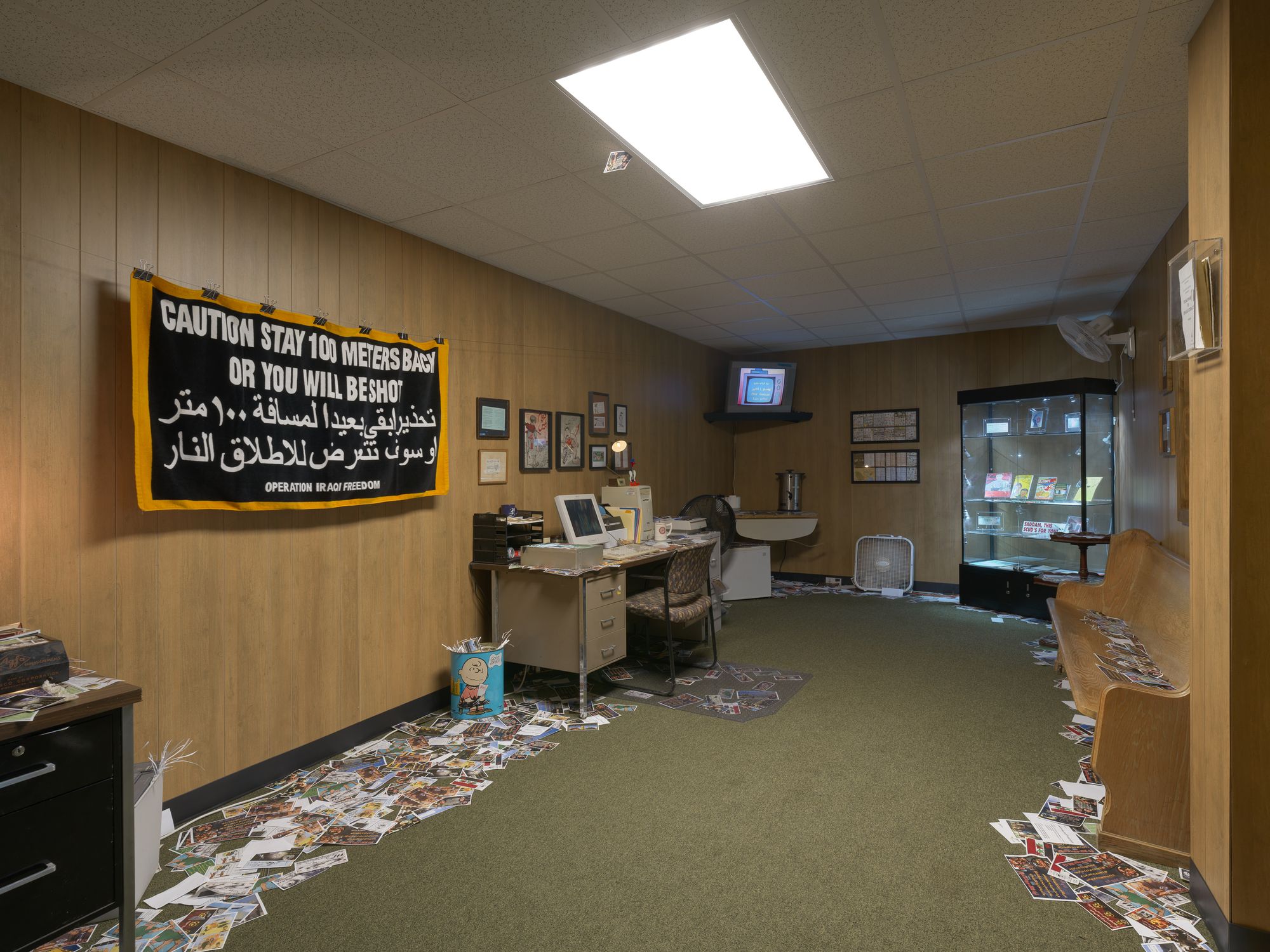
Installation view of Khajistan: Office of War Information at Pioneer Works. Courtesy of the artists and Pioneer Works.
Photo: Dan BradicaEven what you just said is funny to me—that they didn’t want to take it, because to acknowledge homophobia is somehow to sanction it? Homophobia is the air we breathe; it needs to be studied as the construction that it is so it doesn’t appear inevitable.
Exactly, but they expected the book to be a contemporary tract on gay rights, which is not what we do. You will not see us imposing modern acronyms like "LGBT" or "queer" onto these lived experiences unless the subjects used those words themselves, like in Karachi After Midnight, where the author explicitly identifies as gay.
That was a real point of contention for Saad at first. In the text, Shams referred to himself as a "gay," and we had to ask: Do we use that word? We have to be incredibly precise about translation. We want people to exist in their own words, whether or not those words are palatable to a contemporary Western audience.
People struggle to grasp how expansive this world of Khajistan is. Some people struggle to place someone like me in that landscape: the product of a Jewish family from the Maghreb. But that is precisely why we do this. We want to show the people, not a state-sanitized history rewritten to separate us along ethnic or religious lines.
Honestly, the hardest part of this work is just existing in it. We publish, we exhibit, we do so much, yet we constantly move through spaces where people simply cannot make sense of our creative partnership or even our catalog. For me, navigating that cognitive dissonance is actually the hardest part.
People don’t understand how conflicting things, in this part of the world, sit on the same page, the same interface, the same exhibition. That is how life exists on the ground, all conflicting things together. I went to a Christian school. I was in a Shia neighborhood. My dad was Wahhabi-adjacent. I grew up watching American TV. It’s all of these things together that make life what it is. And technologies change so fast that those conflicting worlds around us don’t get translated authentically into these new technological worlds we’re building. The Internet; AI.
I’m curious, one of you said the conflicts are together, simultaneously on the ground, and within the imaginary. What I’m observing, having seen so many of the materials, is that this intentionally highlights this cognitive dissonance for the audience. That place in-between, like the bookstore saying “it’s homophobic,” as if our everyday is not homophobic. I think it says something about people’s desire not just for cohesion, but for something answerable? Which I think is the fiction of an archive: that it’s supposed to give you causality, an idea of how things arrive at what they are. And I think there’s an anti-causal gesture in your curation, showing the way that conflict, and what’s between conflict (it can be humor, it can be love, because people are falling in love during war, people are having sex, people need to make money, people are getting in tiffs with their friends) is life. The scale of the small and intimate and petty and benign, alongside all these other things—that’s the “at-risk” content that Khajistan is trying to preserve, or at least display.
Our archival methodology is largely intuitive. We're not going to put a three-inch photo on a large, glossy white page. I'm not interested in sterility. We don’t want to pretend that we have no agency here. Our childhood is in this work. Even with the Office of War Information, a number of those things came from my dad’s office.
I walked in there and was like, “What is going on here?” It was uncanny. It really took me back to your childhood home, your dad’s office.
I am highly intentional about building spaces that feel familiar, both to us and to others, without trying to dilute them. Office of War Information is built around a very specific collection of American war propaganda. It’s a different energy from our show at SculptureCenter last year, where we took over the lower level of the building with a massive selection from the archive. Even though that was only a fraction of the entire archive, it held everything: memes, religious media, propaganda, porn, and erotica, all living together on the same plane.
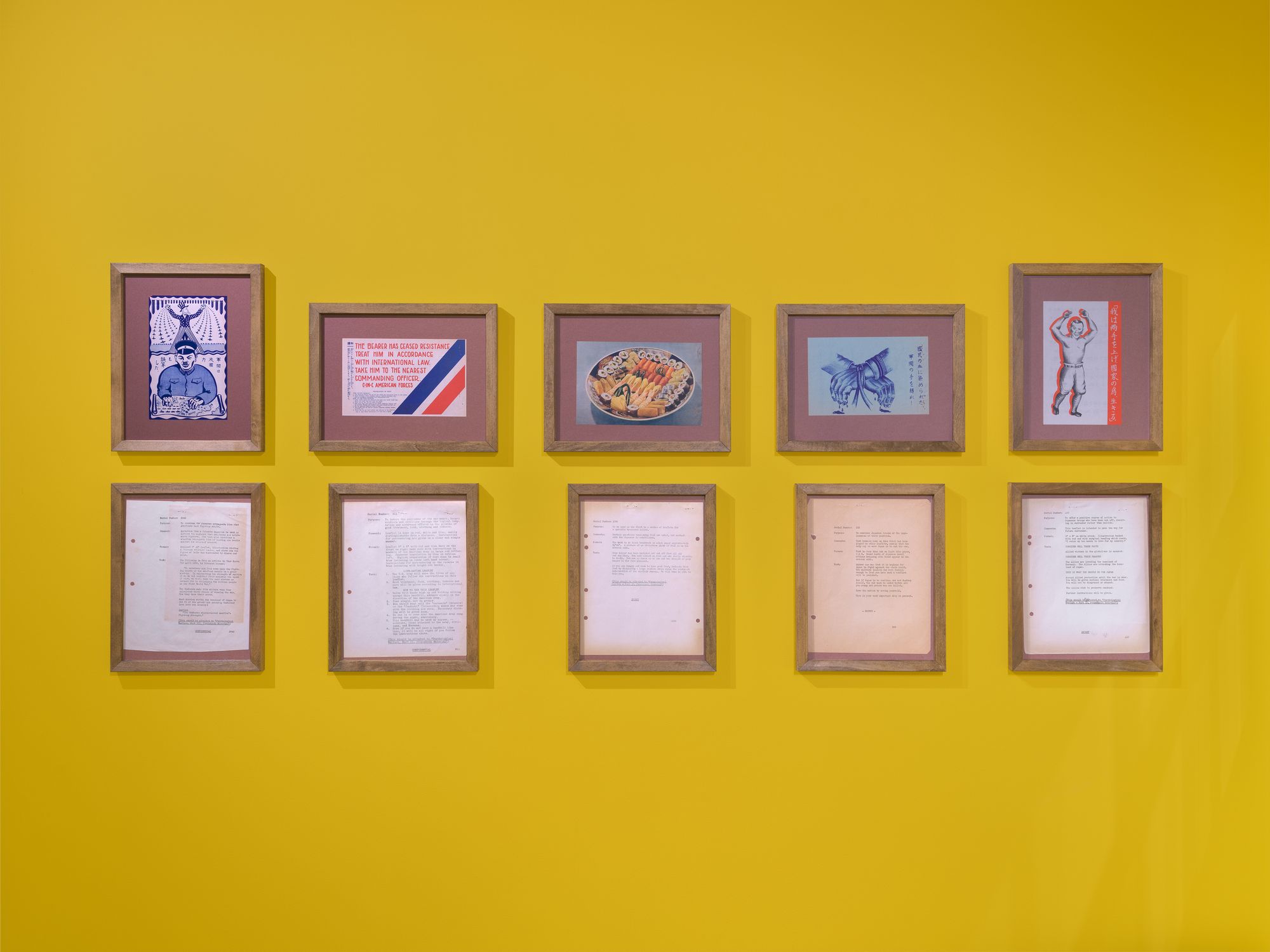
Installation view of Khajistan: Office of War Information at Pioneer Works. Courtesy of the artists and Pioneer Works.
Photo: Dan BradicaI wanted to talk about childhood and adolescence, not just in this exhibition, but also the three books the press published, Karachi After Midnight, this coming-of-age narrative in the early 2000’s of a young gay man, 21, living in Karachi. You had a beautiful event at Printed Matter this past year where a bunch of us read these moving excerpts from “journal” entries. This ephemeral address into the abyss of the Internet by this young person in the confessional blog era. The writing is electrifying, desperate, looking for connection and at the same time, disavowing family and city. In other words, it captures the moods and epiphanies of youth. And then in entering the space of OWI at Pioneer Works, I reverted back to childhood, because our generation could have easily known this office as a room in our houses growing up. The office furniture has this time-travel effect. It depends whether an Uncle is walking into that space versus somebody in our generation. Anything you can say about that?
It was meant to feel uncanny, in this way that everyone has traversed through this space at some point. Everyone has sort of touched propaganda, American propaganda, in some capacity, whether or not they’re aware of it, or care to be aware of it. The space was designed very much to feel like your uncle’s basement. It’s a viscerally masculine space. There’s a kind of weight to everything: the color tone, the heaviness of the steel tanker desks. And it’s also worn and degraded. Like a metal cabinet that’s rusting from the bottom, about to collapse, but still standing somehow.
I felt a strong sense of having been here before. But the before is any space of banal authority.
I want to expand on what Joey said about how everyone has touched propaganda. I don’t know about people here touching propaganda, but it has definitely flowed toward them through their environment, air, their parents, the television, the school. The best propaganda is when you don’t question it. People who live here have had that kind of protection from things, and this propaganda is also for overseas, it’s not for the locals. Americans are trained to think that whatever America does is with benevolence. First the bombs and then the nonprofits, but before the bombs are the leaflets. The leaflets, then the bombs, then the nonprofits.
These are systematic things we’re talking about, but the more real, more personal thing is that whatever we’re doing, Joey as well, and in my case, is trying to give love to the misunderstood parts of our fathers. I think their inner worlds have felt ostracized by “global speak,” powered by technology which is a form of Western ways of being. When your inner world does not feel in sync with whatever people are telling you is the “present,” it creates disconnect.
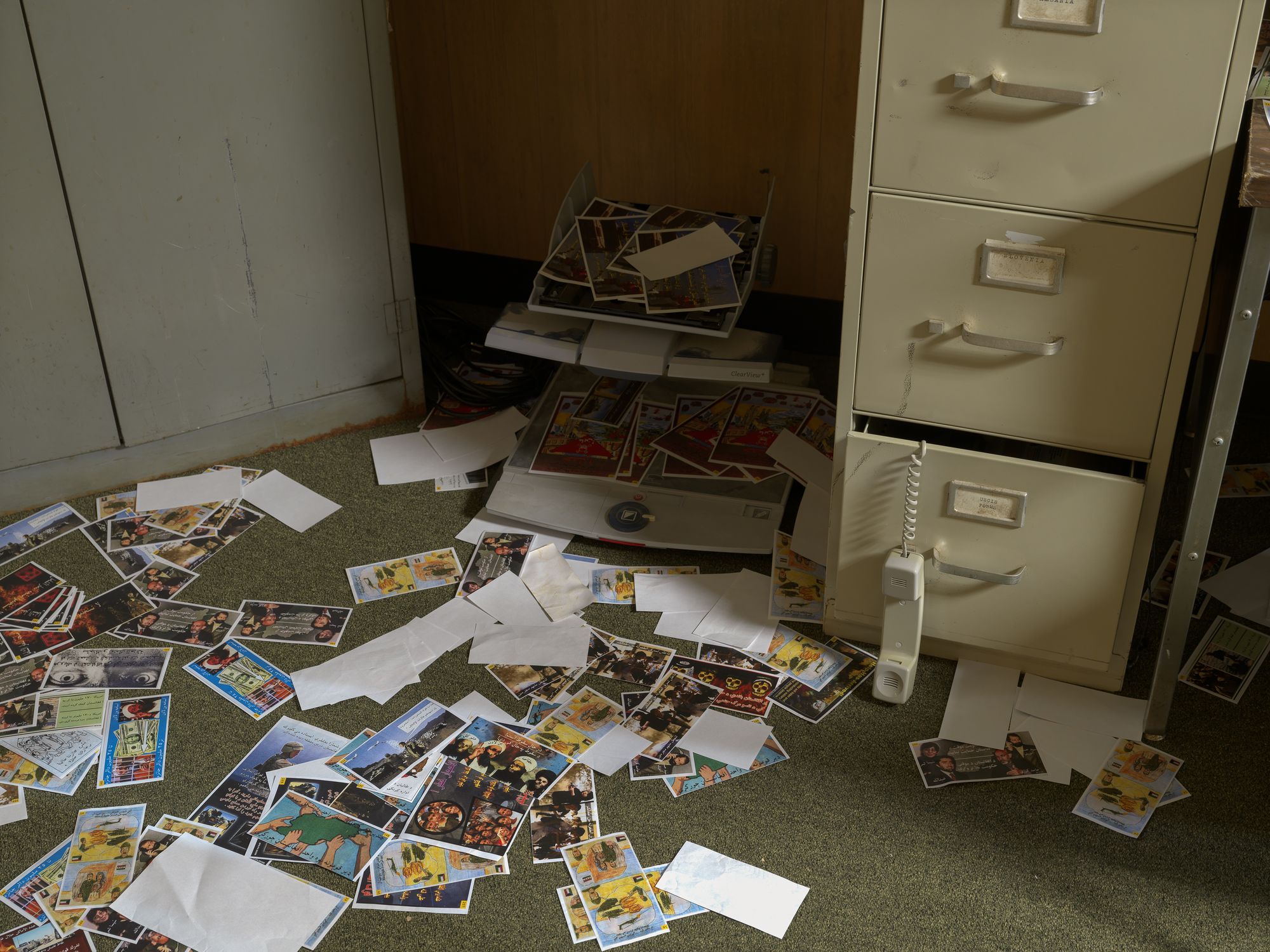
Installation view of Khajistan: Office of War Information at Pioneer Works. Courtesy of the artists and Pioneer Works.
Photo: Dan BradicaThat’s a big part of why [we do this work]. And also to understand the way in which our tech overlords will inherit the earth. Khajistan is more than just preservation.
Because we’ve been catching up. Western stuff is digitized and represented on the Internet, and now in AI, but we’re still catching up with materials that are 100 years old. In the universities you’ll find manuscripts from the 1600s, 1500s, 1400s in this beautiful Islamic Arabic script. But what’s happened in the last 150 years, with these modern technologies, from the camera to TV to Internet to AI, is that so much was created that remained undigitized, including print. And that’s also when the oppression from the new nation-states existed and changed.
You were speaking of your fathers and also about this imagination that begins with: nowhere was I told this by any institution. And I was thinking, with great compassion, of the people who have raised us, all our fathers, who of course have been shaped by these institutions. These institutions are not necessarily a reliable knowledge base, but even the people closest to us are not always reliable narrators. We had to understand, growing up, in my family too, who was talking when they were talking.
And who was talking through them. The reason I’m so motivated by this work, and Saad too, is in response to that awareness that something is being withheld, or that there is more to the story. When you’re younger, you just think you’re alone in the world, for whatever reason—your sexuality, your physicality, the way you express yourself. From the very beginning I had a very strong aversion to authority, because my dad seemed very in favor of it. So that’s where a lot of these worlds are born from: not just in response to, but also out of a curiosity to place ourselves in the world we live in right now.
I’m also trying to explain the experience of walking through Khajistan’s exhibitions. Pioneer Works and SculptureCenter. They were such emotional experiences. There’s something kind of cavernous about both the spaces, a sense of intimacy, and these pop-up domestic spaces, the living-room area at SculptureCenter that I remember, and then the office space. And then your apartment, Saad, is in so many ways . . .
A gallery . . .
It’s a gallery and it’s your home. It’s where you eat and think.
It’s about surrounding yourself with objects that contextualize your existence. Amassing objects and things around you, not only to understand yourself, or be connected to yourself, but also for other people to connect with themselves. A lot of the diaspora from the region connect with this work because it is showing them multiple versions of life on the ground that their parents could never show or never knew existed.
My question is about rooms. Joey, you were saying you designed that entire space at Pioneer Works, floor to ceiling, to create that office. And at SculptureCenter you had this basement living-room feel. Anything you can say about where these archives belong? The kitchen is a space where a certain type of learning happens, but the office and the basement are these highly intimate spaces where people have experiences of hiding out or being hidden. They’re spaces of alienation, and also of solitude.
With OWI, the feeling people have when they walk in is: “Oh my god, it’s like my uncle’s office.” But your uncle could have been the one printing these leaflets, because these people were uncles. They are your regular people. There’s no myth here.
Right. We imagined the kind of people that would inhabit this space. If you look at the tables, there are different kinds of cigarettes for each desk. The desk on the left-hand side is Marlboro Lights, and the one on the right is a Scotch cigarette, and the empty packets are shoved into the desks.
Office of War Information is like a makeshift printing press assembled by a battalion of older, middle-aged men whose job would be to whip something up overnight to drop on people before the bombs did. Because at the end of the day, when the war is over and the general is summoned before Congress, he has to say, “We dropped the leaflets before the bombs were dropped. We did our due diligence.”
The British came to us in South Asia with a stick: they say they build the railroads, but they also called us bad names and did the lathi charge. American imperialism comes with this fake benevolence: leaflets, bombs, nonprofits. They have to save face.
So it’s also about understanding your oppressor, and the ways they try to influence and control, and that includes what is on TV: Friends, Everybody Loves Raymond, and The Simpsons.
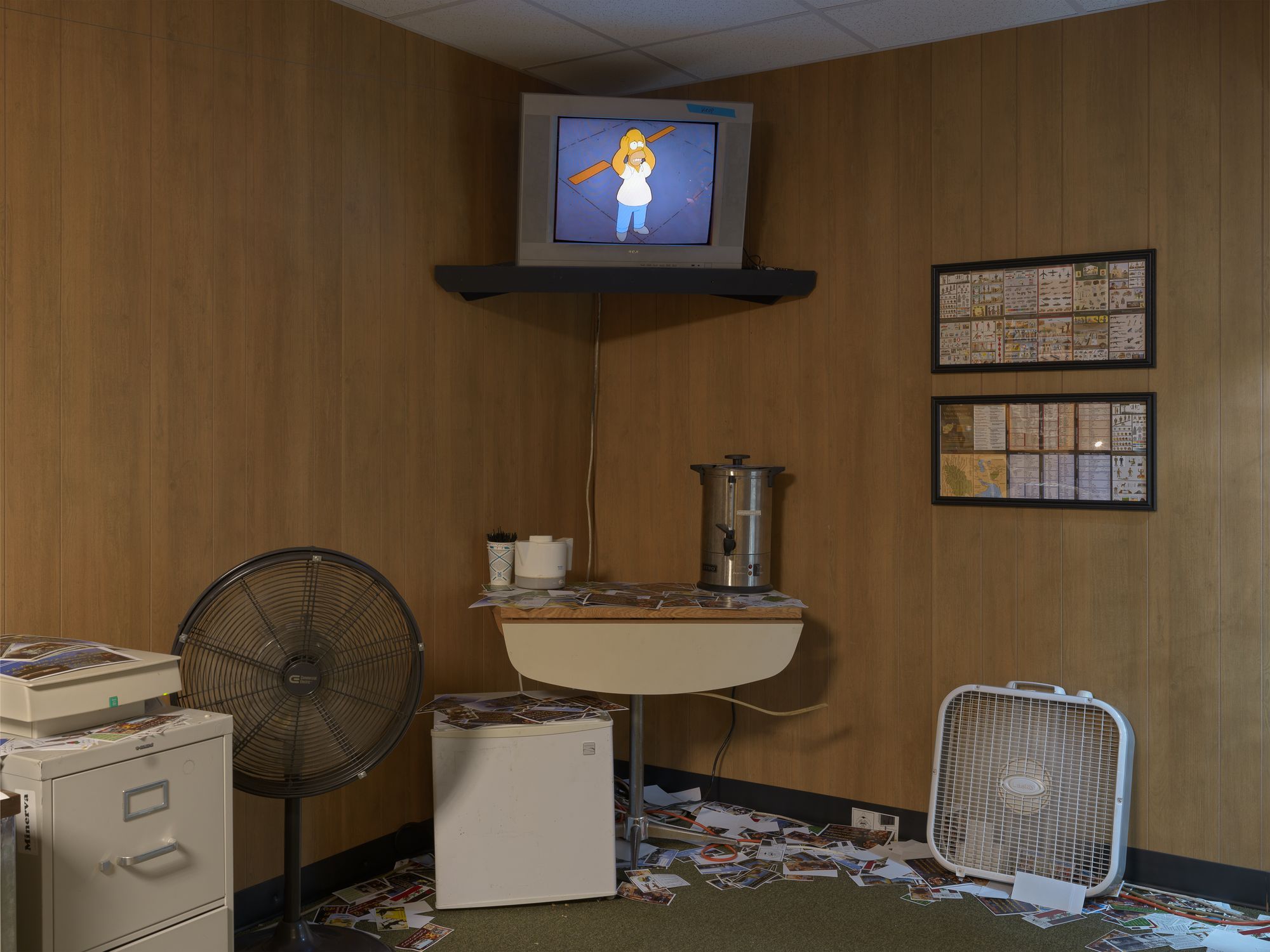
Installation view of Khajistan: Office of War Information at Pioneer Works. Courtesy of the artists and Pioneer Works.
Photo: Dan BradicaSoft propaganda.
I remember you talking about having to look through a lot of footage, maybe for Showgirls of Pakistan. You’re processing a lot of visual material, and some of it might catch your eye for one reason or another. I was wondering what that has been like. Some might use the word researching, some might use the word consumption, but I don’t think those are the right words. I don’t even know if looking is the right word. But in the finding, the searching . . . what protective mechanisms have been part of that? Because you’re parsing through so much, in the words of your own website: the unwanted, unnecessary, unusual, and unsavory.
We don’t have to look for it, because it exists, and it’s in the periphery, and always has been. I grew up under the War on Terror. It’s been part of the air. All of this is just facts. Personally, I would rather show a hairy Afghan butt in an exhibition. OWI is legible to the general public; it relates to the West and the lives people are living, and their shame. But I would rather talk about what I’m interested in, not what I’m being asked to show. We have our own trajectory, and I see these as diversions. Of course they’re part of our history, but leaflets being dropped onto people, first of all, it’s a racist thing, that you think you can just influence people by dropping paper on them.
I’m also thinking about how much of the erotic exists alongside, and in conflict with the fact of the terror.
Actually, they inform each other. The terror, the fear, and the erotic exist together.
I think one of you, maybe Joey, said something about internal worlds. If interiority is made up of the disparate, then it seems like Khajistan is reflecting that disparate interiority back to the viewer, saying this is actually what you are made up of . . . and it’s not something cohesive, legible, not something that can be framed. It’s anti-utopian, which I think is also . . . what’s the phrase . . .
Not corrective. We don’t want to understand [ourselves] within Western frameworks of identity only. We grew up in a world where East was in the West and West was in the East, and you had the Defence Housing Authority in South Asia, which could be [like] any suburban neighborhood in the West.
So many people who came to the exhibition opening are part of the South Asian diaspora living in Queens and Brooklyn and had an emotional experience because it is about our dads. It does feel like it’s about our families. It might be the first time we’re seeing something recognizable to how we grew up, and it’s such a sensory experience of a beforelife, or an afterlife. I mean, it’s like a grave, honestly. That office feels like a grave.
That is 100 percent correct. Even the windows we have there, I made sure they weren’t cleaned. There’s a sense of: This site has been abandoned, and all that’s left is a shadow of death. And that’s not in just the leaflets themselves, it’s the whole experience of the room. There’s an internal conflict people have, where they understand we have a sense of humor about really horrific things, because of the nature of our upbringings and our families, and then also seeing the materials for what they are. That’s a tough thing for people to reconcile. The specter of death, and the sense of humor about it, still intact through every bomb that’s been dropped, every home or family destroyed by war.
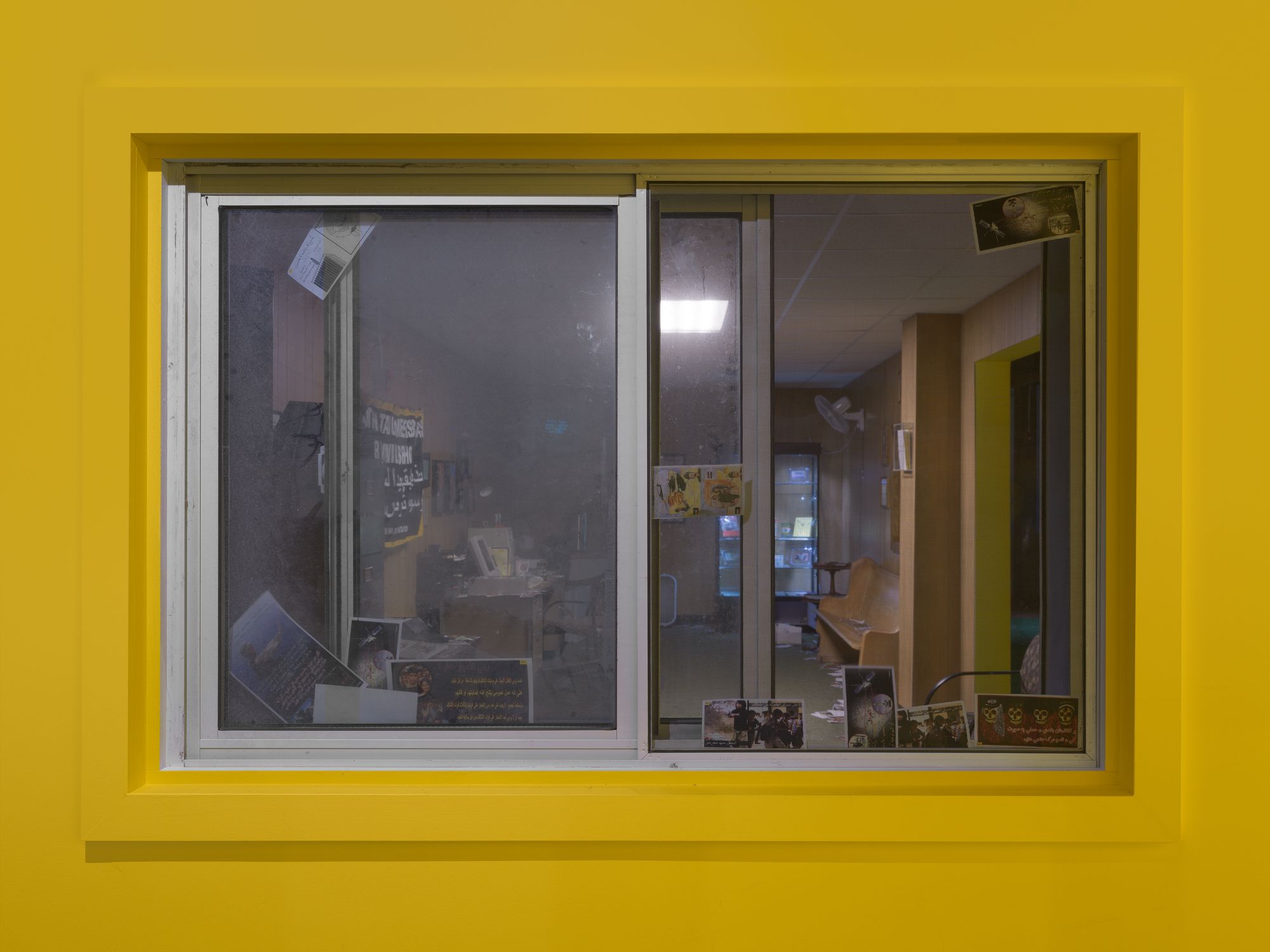
Installation view of Khajistan: Office of War Information at Pioneer Works. Courtesy of the artists and Pioneer Works.
Photo: Dan BradicaYou guys can think about it, but I think this article should maybe be called, We Do It for Our Dads.
The name of the article is We Did It for Our Dads.
We did it for our dads. I was just thinking about visiting Tanzania with my parents. My parents are 12 years apart, and my mom was like, “This was my school, my classroom,” and I said, “Dad, where was your classroom?” And he said, totally seriously, “Do you see that tree? That tree. I had lessons under that tree.” You went to school under a tree, and I am where I am now. Not a narrative of progress, but this narrative of . . . well, Dad, your entire engine, which has now become my entire engine, has something to do with all these different sites. The tree. The office. What must be continually abandoned in order to live here.
My dad wanted us to go to the tree school, to sit under the tree. And because we went to a Christian school, he thinks I’m a Westernized, capitalist person who knows all of what the West did, and yet chooses to live there. There’s another layer to that survival and guilt, all of it flows through the work, to be honest.
We didn’t really talk about survival, but it feels like a big part of Khajistan, and how you approach the work.
[We work] so fast, because I think we’ve been raised to think there’s no tomorrow, or the tomorrow is very short. People are like, “Do one f***ing book a year.” No, I want to do one every week.
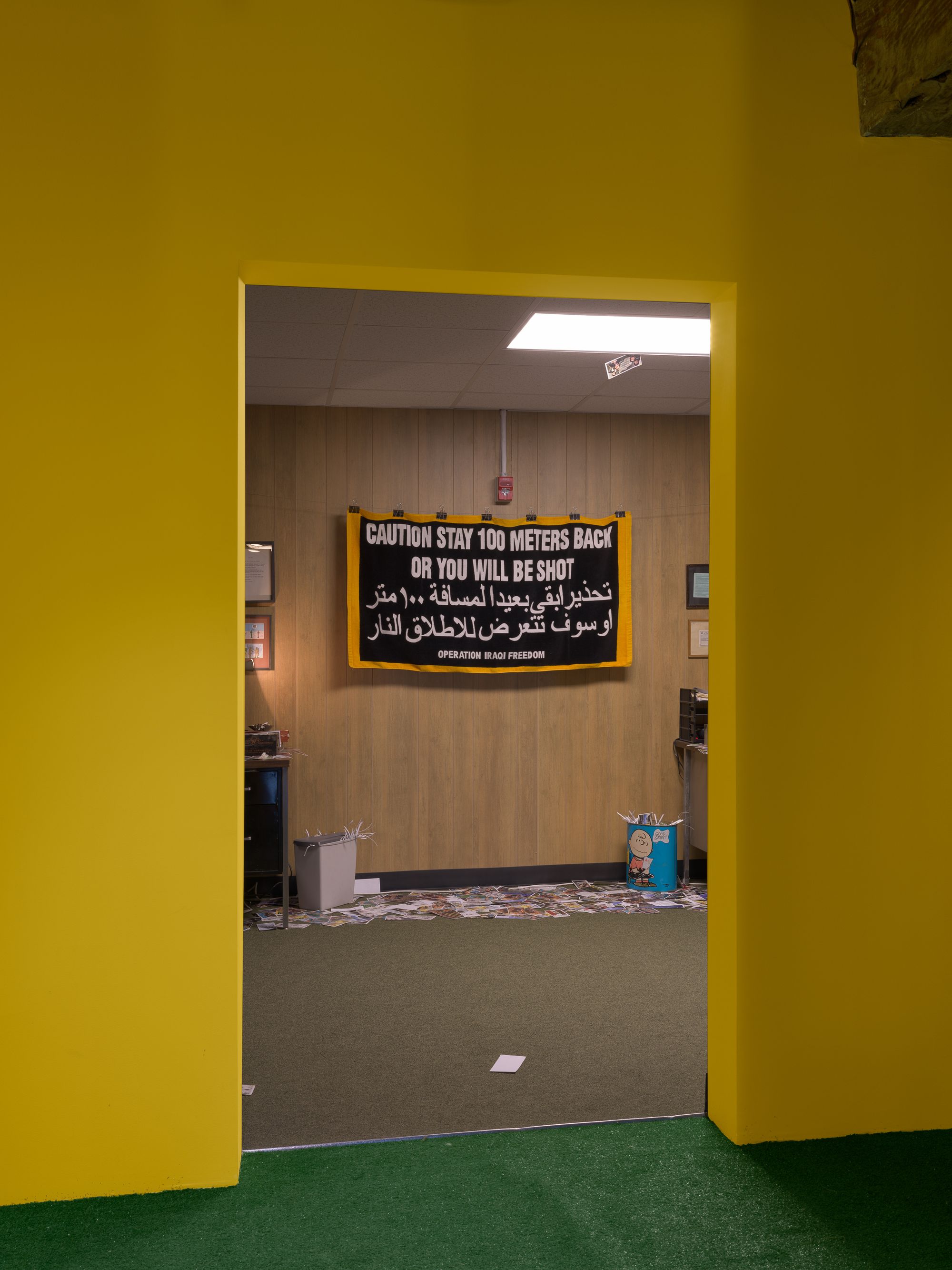
Installation view of Khajistan: Office of War Information at Pioneer Works. Courtesy of the artists and Pioneer Works.
Photo: Dan BradicaThere’s a lot of catching up we feel we have to do, and part of that feels like survival. The materials won’t survive, and we won’t either, unless the materials do. So there’s a relationship.
The materials are not surviving, by the way.
They’re not. And it’s not just censorious governments or climate change that’s actively taking away or destroying the materials that help contextualize the lives of many. This whole time I’ve been thinking about our basement, and my dad’s collection of canned food and glass bottles filled with water, hundreds of them. That was his modality for survival. And this is ours. ♦
Subscribe to Broadcast