Sex, Blood, and Baseball
Installation view of Jordan Eagles: BASES LOADED at Pioneer Works. Courtesy of the artist and Pioneer Works.
Photo: Dan Bradica“Baseball: a game that comes up from the youth. That means the boys!” My father used to say that in an old timey voice that he attributed to his childhood vinyl record of Lou Gehrig. Gehrig was the Yankee that epitomized consistency, holding the record in his day for 2,130 consecutive games. He never missed one for over 15 years, until his 36-year-old body succumbed to a mysterious disease, forcing him out of baseball and ultimately killing him. The quotes and lives of baseball heroes imprint a certain type of national message, and also a paternal one. The game’s rules are passed from fathers to sons, between teammates and fans, and they’re all filtered into the muscle memory of the American male. My father’s closest friend Ritchie Kaplan came to live with us in the early ’90s as he was dying of AIDS. I went with my brother to the National Mall as the quilt remembering fallen family and friends of victims of that disease were laid out on the field. Each piece of quilt was the size of a human body, three by six feet. My younger brother made one for Ritchie, and my parents still have pictures of us with it, 12 and 13 years old, wearing baseball hats.
The artist Jordan Eagles is a lifelong Mets fan, and his solo exhibition Bases Loaded casts uncanny light on the game we both love. The themes of his show are universal, if not universally American, and extremely personal to me. Working with blood, his signature medium, he riffs on the stuff we’re made of, probing stigmas against HIV and gayness to question who’s allowed to belong: to a team, a family, a nation. In baseball, the game operates as its own clock: nine innings, 27 outs. It has always been a great way to experience timelessness. Jordan’s sculptures layer the past and present with a precision that seems to transcend time. Sports have always let us to feel our most intense emotions on training wheels. All these ideas swirl around his resin home plate obelisks, full of his father’s blood, his own, and of friends, strangers.
We're ready to play ball. The crowd goes wild. I’d love for you to tell me about your show as if we were on the radio. Let’s start with the name.
“Bases Loaded.” The show consists of sculptures and wall-mounted works utilizing blood and baseball as a way to look at identity and belonging and policy.
Most of these sculptures are home plates, would you say?
They're all in the shape of a home plate, except at various heights. Home plates are always embedded into the ground. So they're at various heights that relate to different facets of baseball.
I never think of home plates as buried.
They are. They're flat. So there's three sculptures that are three inches high, relating to first base, second base, and third base. There are two sculptures that are nine inches tall, which relates to the nine innings of a baseball game. There are two sculptures that are seven inches tall and relate to both the seventh inning stretch and a baseball player named Joel Youngblood, who got a base hit for two different teams on the same day. His second hit took place in the seventh inning. There are two sculptures that are 18 inches in height, and those relate to the idea of a double header.
It's interesting that you talk about Joel Youngblood. I was looking at your piece Blood Feud, trying to remember everything between Mike Piazza and Roger Clemens. There's a lot about Pedro Martinez hitting Mike Piazza when he was in an exhibition game or in an interleague play game between the Red Sox and the Mets. And then having to be on the team together where Mike Piazza was catching Pedro Martinez.
Right.
When you're on a team, it's really exactly a blood feud. Explain how you think about blood feuds and teams in the context of this show.
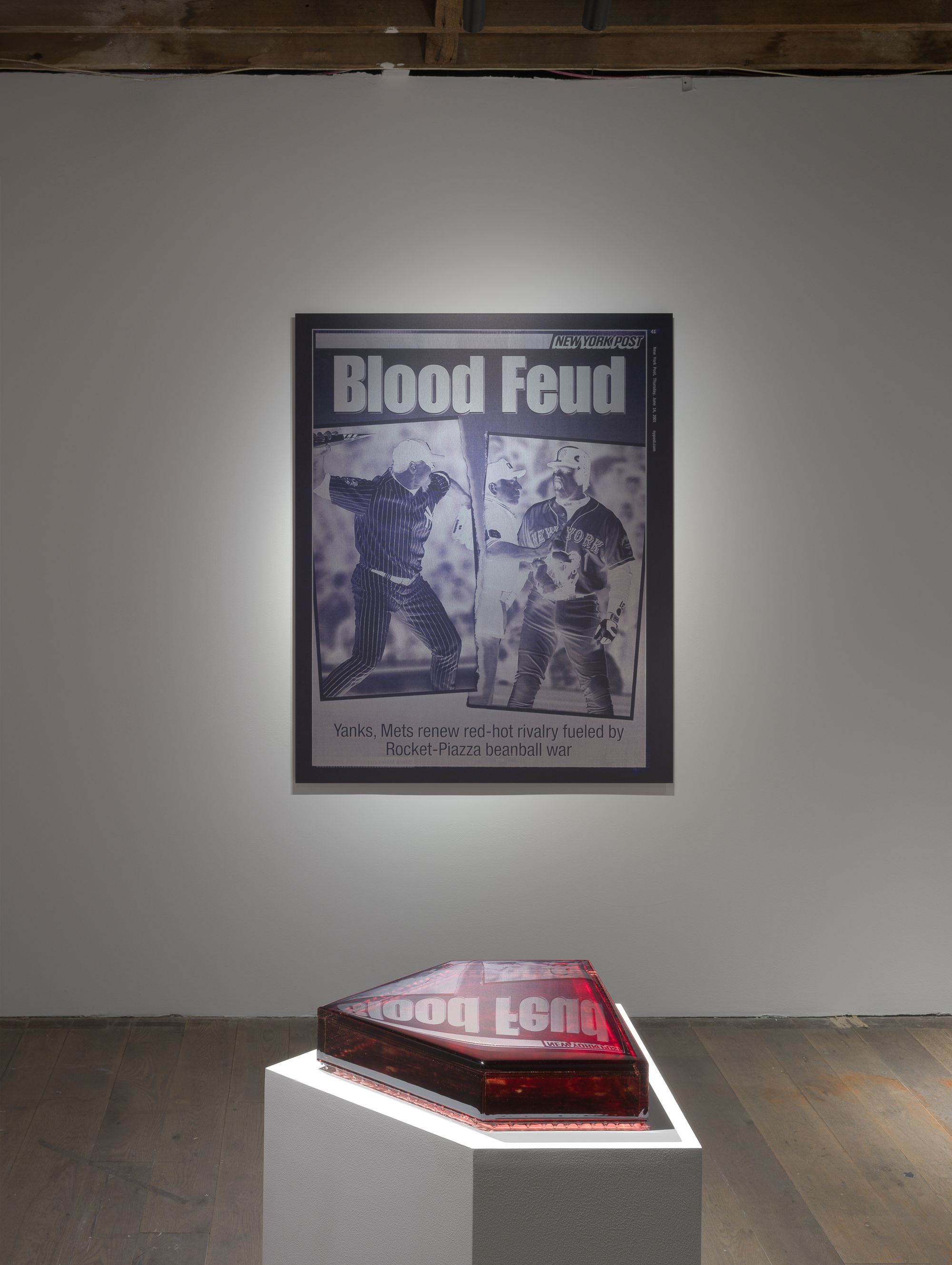
Installation view of Jordan Eagles: BASES LOADED at Pioneer Works. Courtesy of the artist and Pioneer Works.
Photo: Dan BradicaPart of what I'm looking at is language and how specifically the word “blood” is sometimes used as something that is divisive. For example, the T-shirts that are part of the installation say, "The Mets are in our blood." When something is in your blood, it signals a deep connection, which can be prompted by team spirit or something very literal, like HIV. Through all my research with this project, this newspaper cover that said “Blood Feud” was really impactful. The date is June 14th, 2001. June 14th is World Blood Donor Day, which is recognized by the World Health Organization, except it wasn’t anointed until 2005. So this newspaper cover predates that day by four years.
Wow.
There was something a bit mystical for me in that. And it was right before 9/11. The history of the work behind the “I'm Not Gay” [headline] is that Mike Piazza was the one who hit the winning home run for the very first baseball game that happened after 9/11. He had to hold a press conference in 2002 to declare his heterosexuality after rumors that he was gay, which ultimately he's not. There was such a media spectacle around it, which ultimately stigmatized the possibility of others being gay. We don't have any out baseball players.
But it is an all-male environment, obviously. Statistically speaking, there must be gay baseball players.
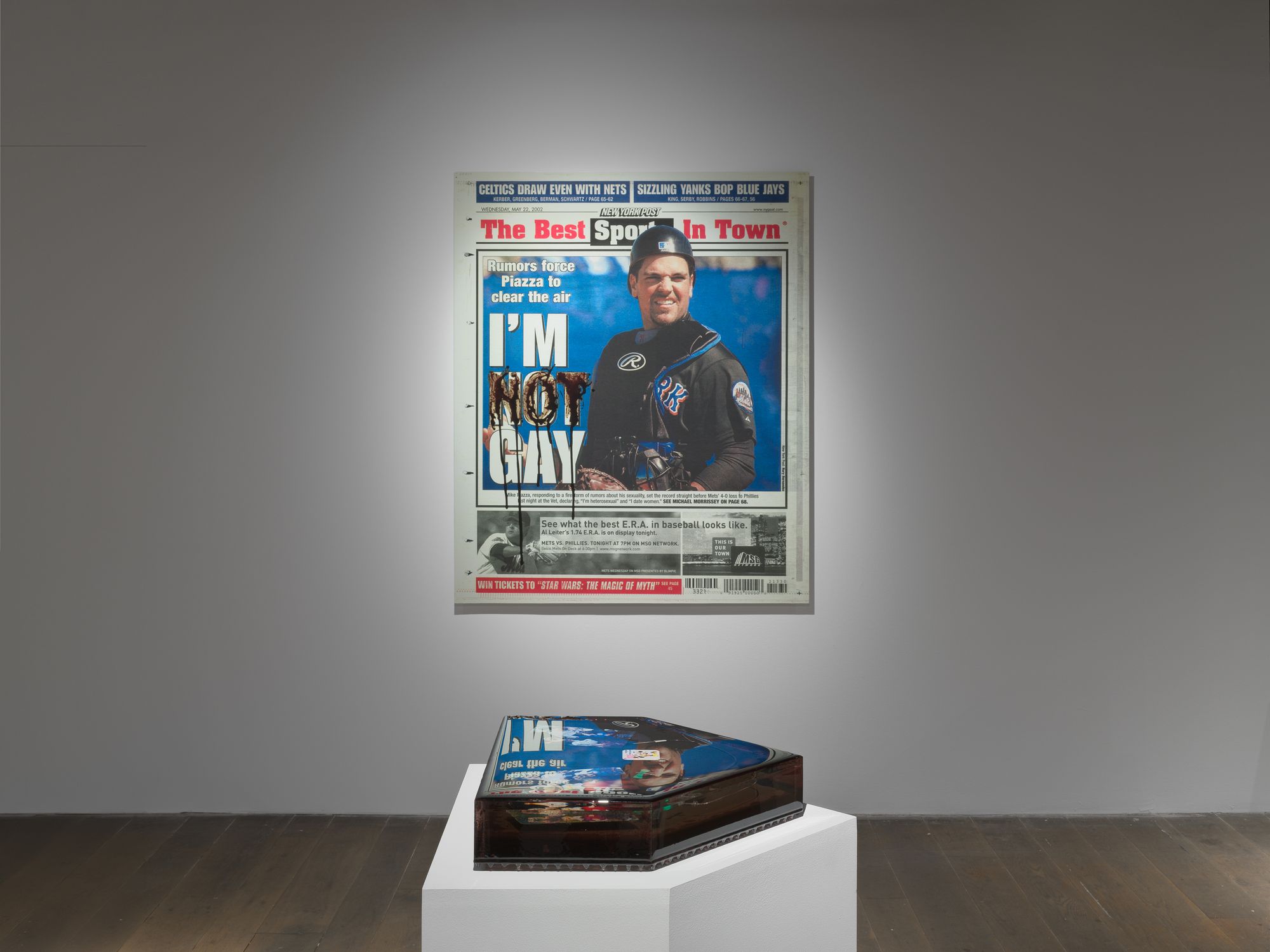
Installation view of Jordan Eagles: BASES LOADED at Pioneer Works. Courtesy of the artist and Pioneer Works.
Photo: Dan Bradica[Laughs] Of course.
Gay professional athletes.
Absolutely.
But it is really one of those things that is incredibly quiet. Even the military isn't as quiet as professional sports. People still say, "What team do you play for?"
One of the reasons I wanted to think about baseball is that when I was growing up, terms for sexual exploration were framed around the game. First base meant making out with someone. Second base meant something else. Third base was penetrative of sorts. And, you know, "Did you score?", "Oh, I hit a home run." That meant going all the way. Of course, it was always framed within heterosexual sex.
Yes.
In gay culture, there was, "Are you a pitcher? Are you a catcher?"
Right.
There has always been this sexual nature to baseball, or the sport had this outsized influence on language of sex.
Mike Piazza was a catcher, and he's one of the nine players that was coded in gay language.
That's a good observation.
The jumping-off point for this whole entire project were these Mets giveaway T-shirts that were given at Citi Field during blood drives. So when you donated blood, you got this T-shirt that said, "The Mets are in our blood."
My blood type is Mets positive.
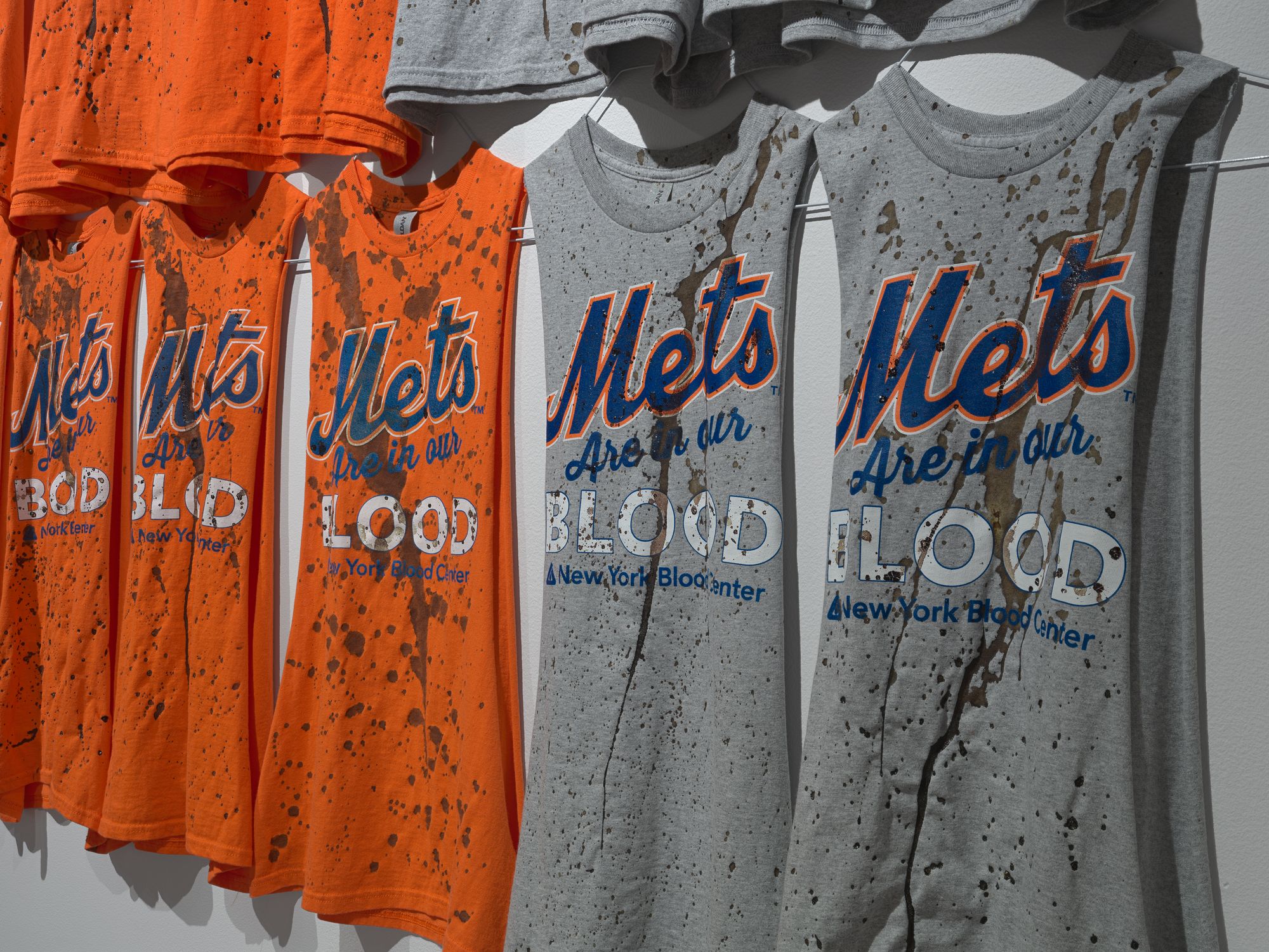
Jordan Eagles, BASES LOADED (detail view), 2024. Courtesy of the artist and Pioneer Works.
Photo: Dan BradicaSo the T-shirts got me to this place where I was thinking about what it meant for something to be in my blood, and in the context of donating blood, where I'm unable to actually earn this shirt because I'm on PrEP. People on PrEP are deferred from donating blood, which got me thinking deeper about HIV stigma. Meanwhile, my mother had been saving my father's blood for many years from medical procedures that he had. Sometimes they would draw more blood than necessary when they were testing him. She would ask the nurses, "Oh, well, I have a son, and he's an artist who makes art with blood. Can I have it?" She said to me, "Jordan, just letting you know, I have quite a bit of your father's blood if you ever wanna make something with it." And I was like, "Oh my God, Mom, that's brilliant and amazing of you. Thank you." So when I am thinking about "The Mets are in our blood" or what is in our blood, it is also family.
You've worked with blood for a long time?
Yeah, I've been working with blood since 1998.
Oh, wow.
Half the work I do is with animal blood, dealing with more spiritually oriented themes: regeneration, life cycles. Around 2013, I started exploring human blood, specifically from gay, bi, and trans men to create works that would focus more on blood donation policies, destigmatizing HIV, and LGBT equality issues. But I had never used blood from my father. I didn't know it existed. And then I started making these T-shirts. There are a total of 13 T-shirts: nine of them are orange, representing the defensive team. Someone's on first base, second base, third base, shortstop, catcher, pitcher, left field, center field, right field. And then there are four gray shirts for the offensive players, making it "bases loaded." They're different colors, but it's the same team. They were all hand cut to become gay boy muscle shirts.
Part of all the work I do is preserving the medical waste from blood donation processes—needles, tubes, medical scrubs. I also preserve the blood of a close friend who's also HIV positive and undetectable.
My father used to say baseball is a game that comes up from youth. These photographs of you in Little League, there's obviously a prepubescent moment where you're learning the rules and playing the game with others. The baseball bat is obviously a pretty phallic object, and balls are testicular objects.
There's a sculpture in the show called BALLS.
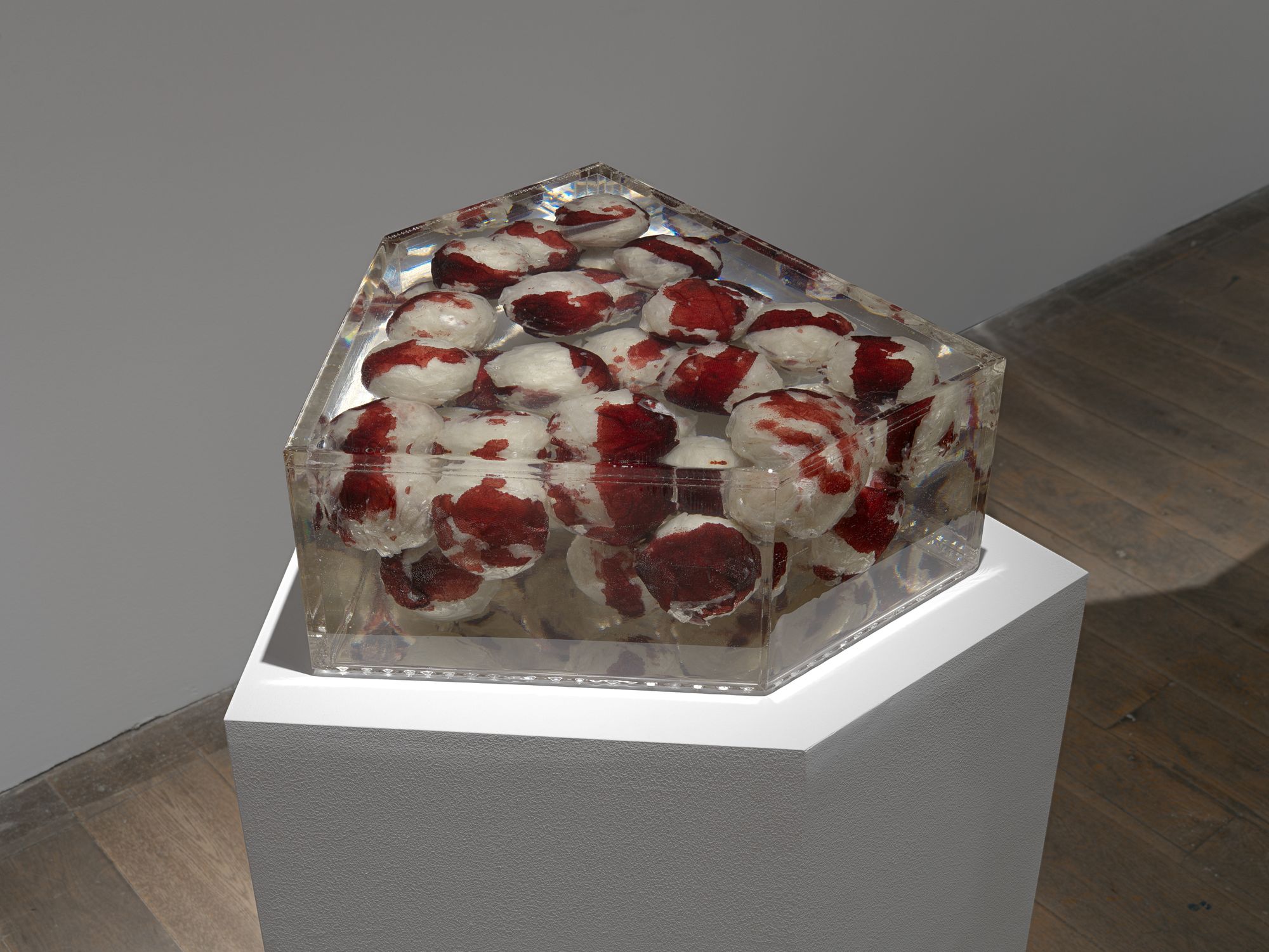
Jordan Eagles, BALLS, 2024. Courtesy of the artist and Pioneer Works.
Photo: Dan BradicaThere's an aspect of being at bat that seems parallel with art making. A pitch comes in and it could either be a fastball or a changeup. You're aware that there's a count, and you try to predict the outcome based on the player’s constraints.
One day, I was at the gym, working out at the squat rack, and all of a sudden, I was like, "Wait, today is Good Friday." Suddenly, I couldn’t stop thinking about how [because I can't donate blood], I would never earn that shirt. I had to buy it if I wanted to wear it. I started thinking about Jesus as potentially the world's greatest blood donor, having shed his blood for the sins of all man, and the title, Opening Day, Good Friday, just popped into my head. I'm not allowed to have this shirt, and it made me realize that it actually needed to be an artwork.
PrEP is something people who are HIV negative take in order to protect themselves from ever contracting HIV. The irony of it all is that someone who is actually taking this medical intervention to prevent themselves from getting HIV is banned from donating blood and also further perpetuates the stigma of HIV. This is one of the reasons I started working with blood donated by members of the LGBT community.
You know, you get one shot to make these pieces. You have a certain amount of blood, and there is no room for error; there's no redoing it.
I guess that made me think of the AIDS quilts as these gravestones or markers.
Years ago I found these blood donation pins that were given away at Disneyland when they had blood drives there. I did a whole series of work in 2018 utilizing references to blood donation found in pop culture and comic books, or pairing Americana imagery with that theme. I did a piece where Superman needs a blood transfusion from the people of Metropolis, and I splashed the blood of a queer man on PrEP on top of that image, blown up. But I also acquired these Mickey Mouse blood donation pins and just kinda tucked them aside. As a whole, this project unraveled organically. I ended up finding these photographs of myself as a two-year-old playing at Disneyland with Mickey Mouse wearing a New York Mets jacket. I remembered I had these blood donation pins [to work with].
I thought about how that young boy, innocently playing with Mickey Mouse, might feel as an adult unable to earn those pins. And so I ended up making these two sculptures—THE REAL YOU and I’M A BLOOD DONOR—with the needles used to have my blood drawn for the work, and applied the remaining blood to make the photographs look like eyes and the needle look like a smiley face, with the pin floating as though it's the nose.
Jordan Eagles, INNINGS, 2024. Courtesy of the artist and Pioneer Works.
Photo: Dan BradicaJordan Eagles, I'M A BLOOD DONOR, 2024. Courtesy of the artist and Pioneer Works.
Photo: Dan BradicaAnd that's like a comic book style.
Yeah, a bit. There's one where the needle is a smiley face, and then there's one where the needle is a frowning face.
Do you have to ask people for permission to use blood? I mean, they don't usually keep teeth at the dentist, for example. Do you have to get special permission from a doctor?
I work with doctors, medical supervisors, nurse phlebotomists.
That's cool. And how did you decide to lay the order of [the plates] out?
Well, the curator Gabriel Florenz and I worked on the layout of the show together, and the positions of a baseball field. Home plate, the pitcher's mound to third base, third base to first base, second base.
That's a shortstop. That's the outfield.
Yes, and it's not proportionate to a baseball field, but they're placed with the same orientation in mind.
Right. And you used your blood and your father's blood?
Yes, mixed together along with images of my father and me together, and me growing up in Little League.
Is your father still around? What did he think of this work?
Yeah. He, unfortunately, hasn't seen it in person yet. He's almost 86. I'm hoping that I'll be able to get him here before the show is over.
Oh, wow. It's very beautiful.
Thank you.
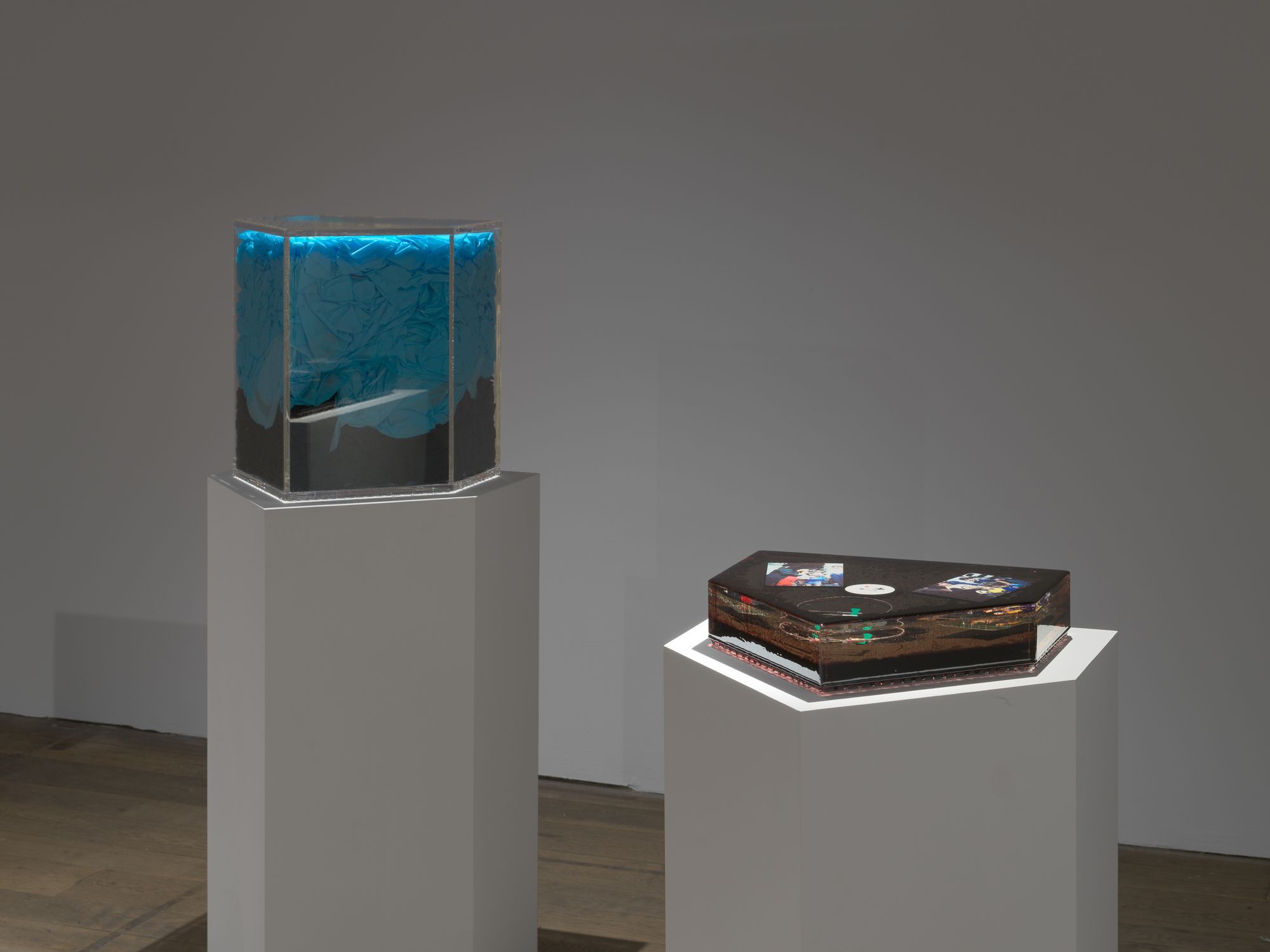
In your piece, Kill the Umpire, I love that the scrubs mirror an umpire’s uniform.
Installation view of Jordan Eagles: BASES LOADED at Pioneer Works. Courtesy of the artist and Pioneer Works.
Photo: Dan BradicaWell, the home plate umpire often has either a baby blue shirt or black or gray pants. Or they have the trim in their collar with a little bit of a baby blue.
The medical gear that I wear, the black nitrile gloves, and then the blue isolation gowns, mimics those colors. There are also the face guards that my assistant and I wear, along with all of the Personal Protective Equipment we wear while we're working with blood.
It's dry inside, right?
If you were to shake the sculpture, the contents would move around, yet it's all fully encased, so you can't actually access it. And the title, Kill the Umpire, comes from the baseball poem, “Casey at the Bat.” But it is also a reference to this idea of the umpire being the person who enforces the rules.
Totally. Calls balls and strikes. The arbiter.
And in a way, this makes them not unlike the policymakers who are determining the policies for blood donation.
Right.
So there's this connection to the arbiters of the rules and policymakers and the colors and again, a play on words.
Have you exhibited any of this work before?
No, this is the first time. It was so important to me to share this project in New York City first and foremost. And you know, Gabe and I have been talking about working together for, gosh, it's been about five years. We just kind of couldn't land on the right project, and then I made this body of work and felt really compelled to show it at Pioneer Works.
That's great.
This piece, called 1, is also made with my blood and my father's blood mixed together. The difference is that the photographs are inside and covered in black. It's as though the memories are incubating on the inside of the piece. And there is blood and light that go through it.
[The piece] BALLS is made of the used paper towels in the studio as I'm cleaning. I don't throw anything away. I save it all. So I took all those blood stained paper towels and fashioned them into what looked like baseballs, with the blood stains acting as the classic red stitching of the balls. And obviously like you'd mentioned before, the word “balls” implies—
Absolutely, testicles and this and that.
It has an infinity ball situation, and also this feeling of floating, like when a ball is midair. There is a little Jeff Koons here . . .
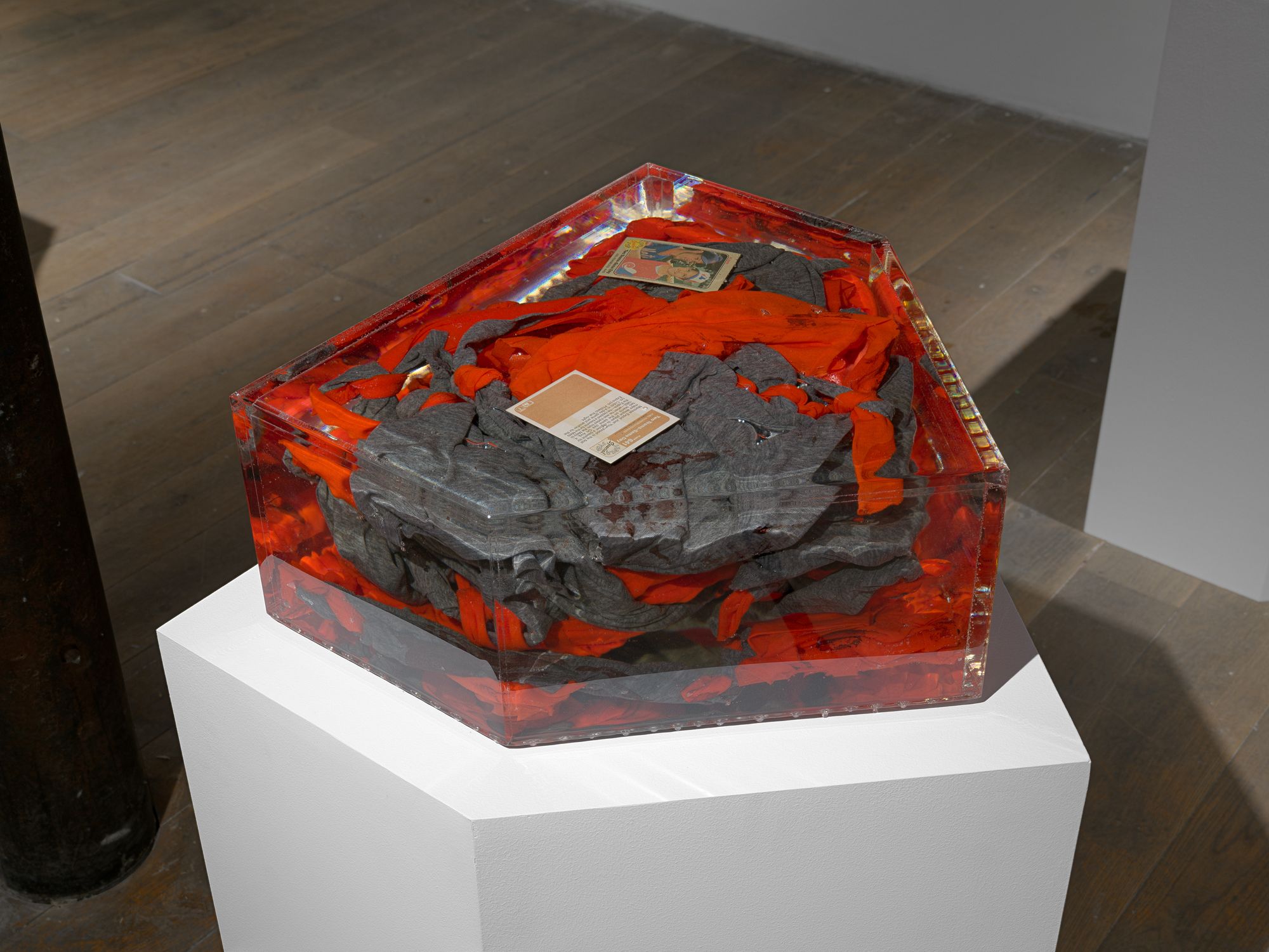
Yeah. I have a piece here called YOUNGBLOOD (TUG OF WAR). I took all the sleeves from the T-shirts, and knotted them together to make a giant rope, symbolic of the idea of pulling on a rope for tug of war, with two teams pulling. And there's knots all through it.
Joel Youngblood is a Met, and the fact that his last name is Youngblood is almost too neat.
Jordan Eagles, YOUNGBLOOD (TUG OF WAR), 2024. Courtesy of the artist and Pioneer Works.
Photo: Dan BradicaYoungblood. It's just too much.
Again, it's those coincidences.
Well, that's what's cool about when you get symbolic. It allows you to get really into the details of ephemera. Youngblood’s name, his team, and the date of his two base hits. I like the skin prick specificity of the dates and numbers. Do you like numerology?
Yeah, I definitely think the number nine is something that I go back to a lot in my work. The very first queer blood project I ever did was called “Blood Mirror,” and there were nine donors involved in the first iteration. Ultimately, there were 50 more added to it, but the first go was nine people. The largest work I ever made is a 32-foot-long multi-panel piece called BAR 1–9. It's nine panels that create this long installation. So nine is definitely something that I've come back to, and obviously in baseball, you have nine players on the field.
Totally. There are nine innings in a baseball game.
Lots of nines. And your piece, BLOOD FEUD—these teams met in the World Series, right?
They did meet in the World Series the year before, and the Mets lost.
That's pretty crazy. The negative you use feels like it's part of a printing process.
It's printed, the image is inverted and then printed on metal.
Mm-hmm. But it makes it feel like a plate. I know we're too deep in word puns. But that’s part of the process of printing a newspaper.
You know, there's the civic space, but also this is news. This is info. Mike Piazza had to say, “I'm not gay” in the newspaper.
Well, it's not just that he had to say it. It's also the media's role in creating sensation out of the idea of blood. That “I'm not gay” becomes a headline and the media has responsibility in perpetuating that message. And, you know, Mike Piazza actually was a really great sport about the whole thing.
Yeah. I read it in his biography. He was like, "I found it a little insulting that people thought that I was the type of person who would pretend to go on all these dates with women. If I was gay, I'd be gay all the way."
Yeah. But just seeing the words like, "I'm not gay" as this headline in these big, bold words . . .
You feel like gay is bad.
That's what it's suggesting. That's what the Post is suggesting.
And that's not what Piazza is trying to say.
No, the piece isn't a critique on Mike Piazza. It's a critique on how we view homosexuality. How we view being gay. Language plays a big role in this show. Just from seeing the words “blood,” seeing the graphics of the Mets, seeing “blood feud,” “I'm not gay.”
Was Billy Bean gay? Is that what you're saying?
Billy Bean was gay.
I didn't know that.
Didn't he pass away?
He did pass away. I mean, I can go on about the things that I am emotional about in Major League Baseball. I don't like the pitch clock because I like the game being totally long and suspended from time; I love the showdown between the pitcher and the batter. The idea that the pitcher is being hurried or rushed in any way to me is like an antithesis of the headspace of the pitcher. The reason why baseball is so transcendent to me is that time really does cease to exist. It's like saying we're all agreeing on this piece of music that we all play together where there's an alternative clock.
When I look at a baseball field, I think of an alternative clock, which was popular before wristwatches in the 1800s. Whenever they made a new town, they had to put a big clock in the main square because people didn't own clocks. When they had to check in and check out of an industrial situation, they had to go and look at the big clock to make sure that they were in sync with their surroundings. But then baseball is its own clock with nine innings, 27 outs. You just always do it, you play it together. It's okay to take a long time.
The endlessness is something that's appealing to me about it. It's kind of anti-capitalist, the endlessness, and more humane, I think. It's actual leisure time. It reminds me of the spirituality of your earlier work, and I feel it in this room too.
This is definitely my most personal project because it involves family and a close friend. I think there is this certain spirituality in it that is different from some of the other queer blood projects that I've done.
This isn't even fully a queer blood project, because my father is not gay. The fact that I'm a gay man, and that my friend is an HIV positive gay man, puts LGBT and HIV stigma issues at the forefront. But there is this other element about family and what it means to be part of a team in your blood.
It also seems to be about what it means to go from being a boy to a man. There is a boyness to baseball. You're playing Little League before you've passed through puberty. I don't know if you always felt like a gay man when you were a kid. Did you feel like there was a moment when you were coming of age? I guess it's a journey for everybody.
I don't think I was fully aware of it until my mid to late teens. I always felt a bit different from the straight boys, you know?
And you played baseball when you were a kid.
I did. I played Little League. I was an avid baseball card collector growing up.
Me too.
I still have baseball cards in my apartment. Just a couple. You know, Dwight Gooden's rookie card, Darryl Strawberry's rookie card, a Roger Maris card from 1961, the year he broke Babe Ruth's record. In that photo, he's just so unbelievably handsome. And his eyes are just so piercing and sparkly. I just was so attracted to that baseball card for how handsome he was, and also how historical that year was for him.
Numerologically, I'm sure you were happy that he was breaking the record of 61 in 1961.
Yeah. That's a big deal.
Something preordained about that. ♦
Subscribe to Broadcast