The Village Beneath the Waves
Sperm whale calf Aurora from Unit A swims alongside her mother, Lady Oracle. Dominica, Caribbean Sea. Photograph by Brian J. Skerry.
Courtesy of CETI and National Geographic“Holy fucking shit!” I exclaimed from the port side of CETI-1, a 40-foot research vessel, while sailing off the island of Dominica. Behind me, the writer Elizabeth Kolbert, who was serendipitously reporting on our whale research that morning for The New Yorker, overheard my awestruck expletive. I am not a frequent public F-bomb dropper. But this occasion seemed like an appropriate exception.
I’m a marine biologist and the lead of Project CETI (Cetacean Translation Initiative), a transdisciplinary nonprofit and National Geographic Society program dedicated to translating the communications of whales. My team and I were doing what we normally do each morning: locating sperm whales to understand how they communicate and conduct their social lives. Our lead whale biologist, Dr. Shane Gero, has studied these creatures for over two decades. That morning we came across 11 whales, two family lines known as Unit A. They had gathered unusually close together, moving up and down in a marguerite formation—a tight, flowerlike circular grouping whales used to protect one another, often by keeping calves or vulnerable animals at its center—without making their usual deep dives. Their behavior seemed more defensive than usual.
In a sudden change of behavior, there was intense thrashing and blood appeared in the water. The fear across the CETI team was palpable. We thought that perhaps a member of the whale unit was in grave danger.
Then, among the turbulent and foaming waters, a tiny sperm whale head appeared in the middle of the commotion.
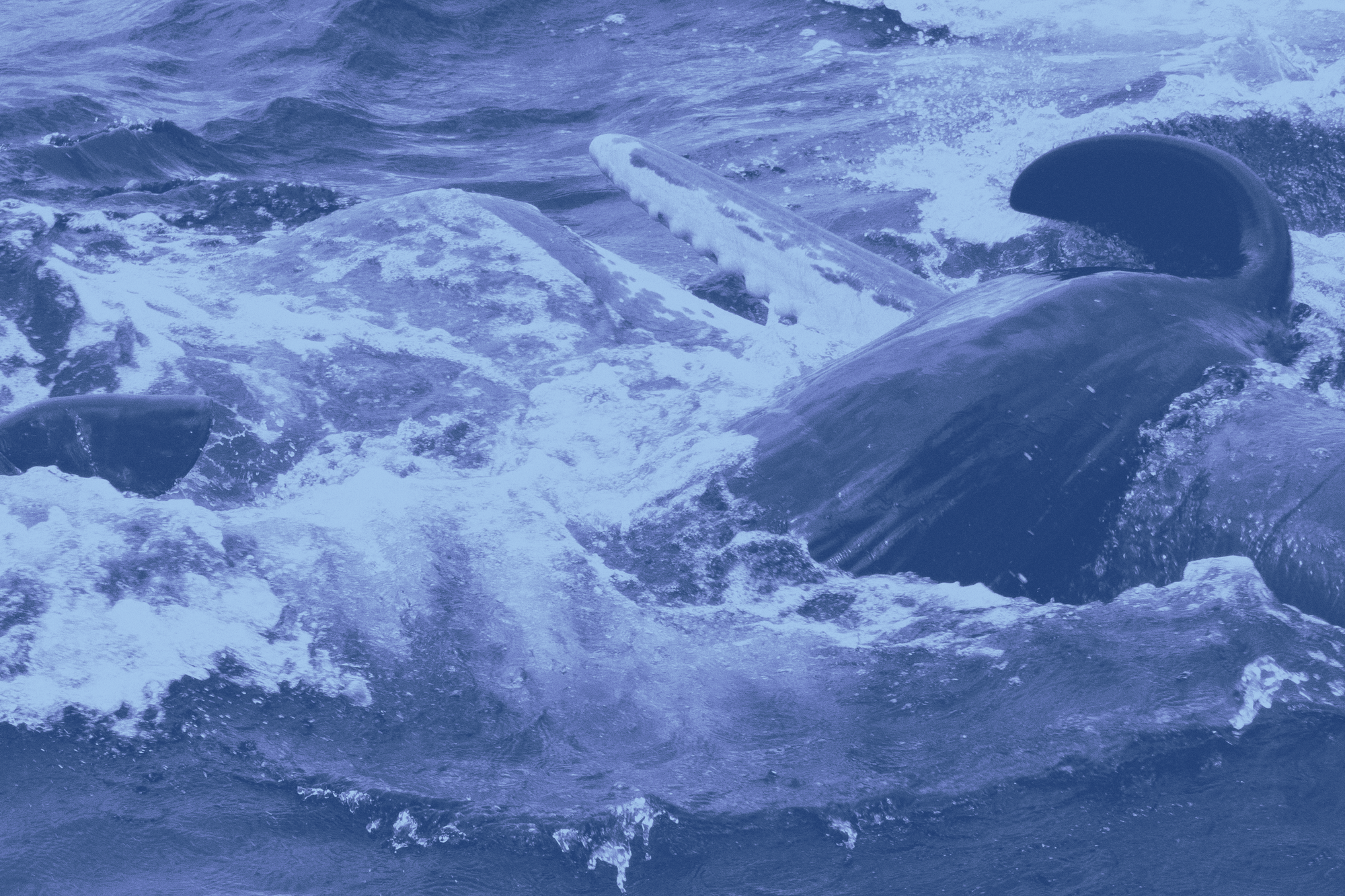
An up-close image of the newborn sperm whale.
Courtesy of Project CETIBefore now, I've never written about what was behind my exclamation—what emotions and reflections passed through me as I watched the incredible scene unfold—and how it would decisively change the course of my work. (For extensive details of what happened that July 8, 2023, I’d encourage you to read Kolbert’s well-reported pieces, “Talk to Me” and “What Happens When A Whale is Born?” The CETI team also published two scientific articles—one on shifts in coda vocal styles and another on cooperation by non-kin—on this whale birth.)
Soon after the birth, the whales held the newborn above the surface, drifting toward CETI-1. They came so close that the baby passed within inches of us. I remember thinking, This baby would not make it without assistance from the other whales. Its fluke was still folded, leaving it unable to swim properly. Being negatively buoyant, the baby could sink in the mile-deep water. But kin and non-kin were supporting the newborn, bound only by the promise of fulfilling their duty to their close whale unit. I remember thinking that in whale societies, there is no known monetary currency, like dollars, Euros, Yen, Yuan, bits of gold. Perhaps, I thought, these sperm whales instead trade in acts of service, care, and cooperation.
The birth itself lasted 34 minutes and then, for nearly six hours, we witnessed whales working around the ~1,000-pound newborn, taking turns lifting its body on their heads and backs. The mother, who we call “Rounder,” was surrounded by her family—her older offspring Accra was there; her mother Lady Oracle was there; even Allan, her half-brother, had returned for the birth after beginning to separate from the group years earlier. All 11 members of Unit A participated in the arrival of this new life.
In a text that inspired Melville’s Moby Dick, the British surgeon Thomas Beale’s 1839 The Natural History of the Sperm Whale, notes that female sperm whales “are very remarkable for attachment to their young, which they may be frequently seen urging and assisting to escape danger with the most unceasing care and fondness.” We were witnessing what Beale saw aboard a whaling ship, 184 years later—while on a very different mission to understand and learn from sperm whales. This tension has stayed with me: these creatures, with the largest brains on Earth, have been treated as commodities—hunted for spermaceti oil used in fuel, lubricants, and lipstick—yet they also enact one of the most caring, collaborative entries into the world across all life.
It also reminded me of the role that luck and happenstance play in life as well as in science, especially in my career as a marine biologist. Years ago, while filming biofluorescent corals in the Solomon Islands, a hawksbill turtle swam directly into my camera. It resulted in the first observation of a biofluorescence in sea turtles. My swim buddy and I followed the “glowing turtle” for several minutes before it disappeared down a deep coral wall. That short encounter revealed a visual world that humans hadn’t known to look for. The following few years of my scientific career were devoted to building a turtle-eye camera to learn more about how sea turtles perceive the world.
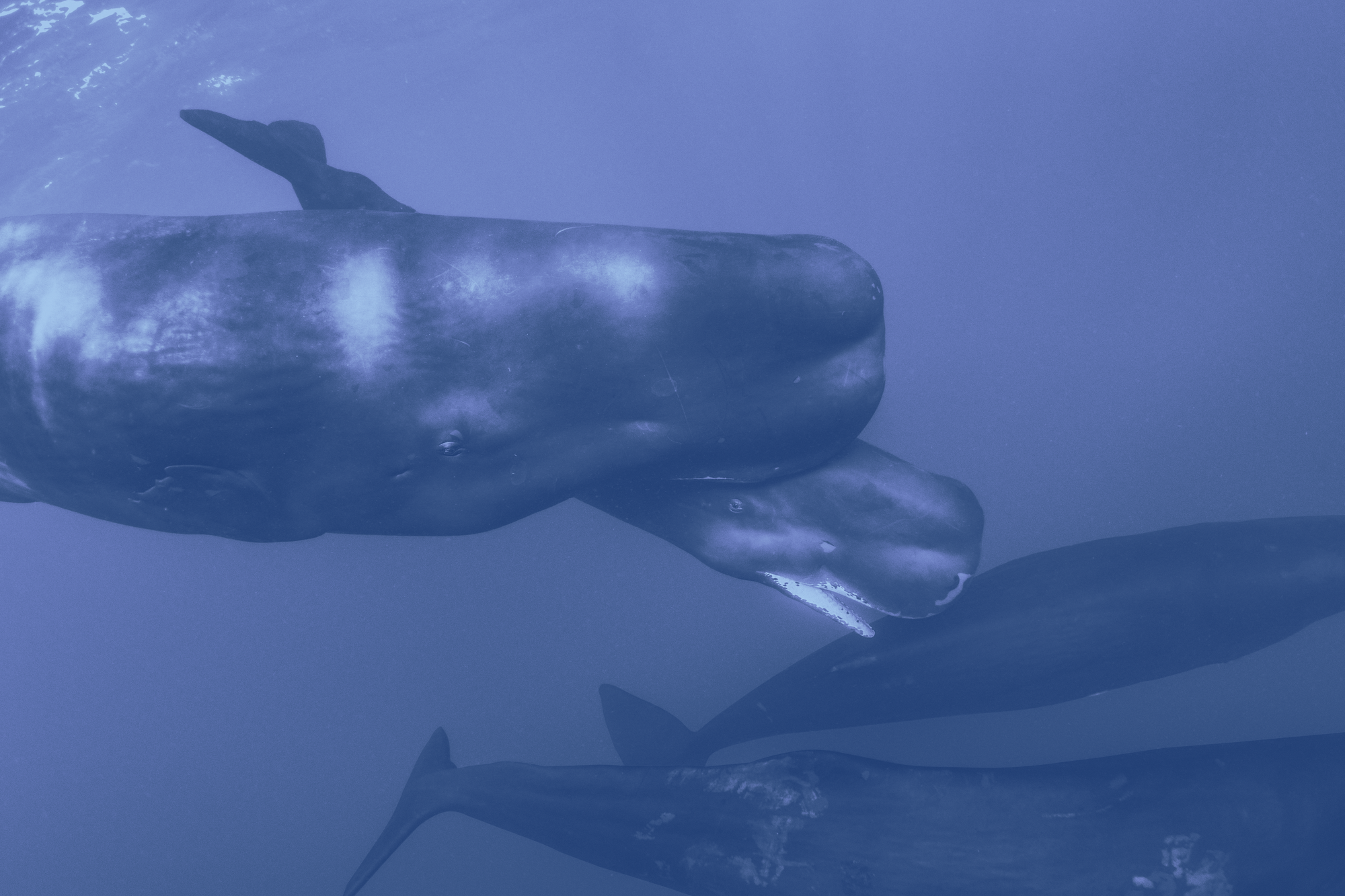
Members of the sperm whale family Unit A—Aurora, Atwood, and Accra—near the Caribbean island of Dominica. Each clan communicates in its own dialect of click patterns, like Morse code. Photograph by Brian J. Skerry.
Courtesy of Project CETI and National GeographicSimilarly, the unexpected whale birth captured CETI’s attention. It became the center of our team’s efforts in ways we hadn’t anticipated. We kept returning to the underwater audio and aerial drone footage, asking each other what we might’ve missed. Who was there? Who touched the calf? Who moved first? Why did they form that particular configuration? What happened when the pilot whales and Fraser's dolphins arrived? What were the whales saying? We had calls week after week trying to decipher this moment. We consulted CETI’s network of experts in machine learning and linguistics. We especially leaned on Shane as our biology lead to identify each of the 11 whales and determine whether we could turn the video and audio into analyzable data. Eventually, we developed a custom computer vision software designed specifically to help us understand this remarkable moment.
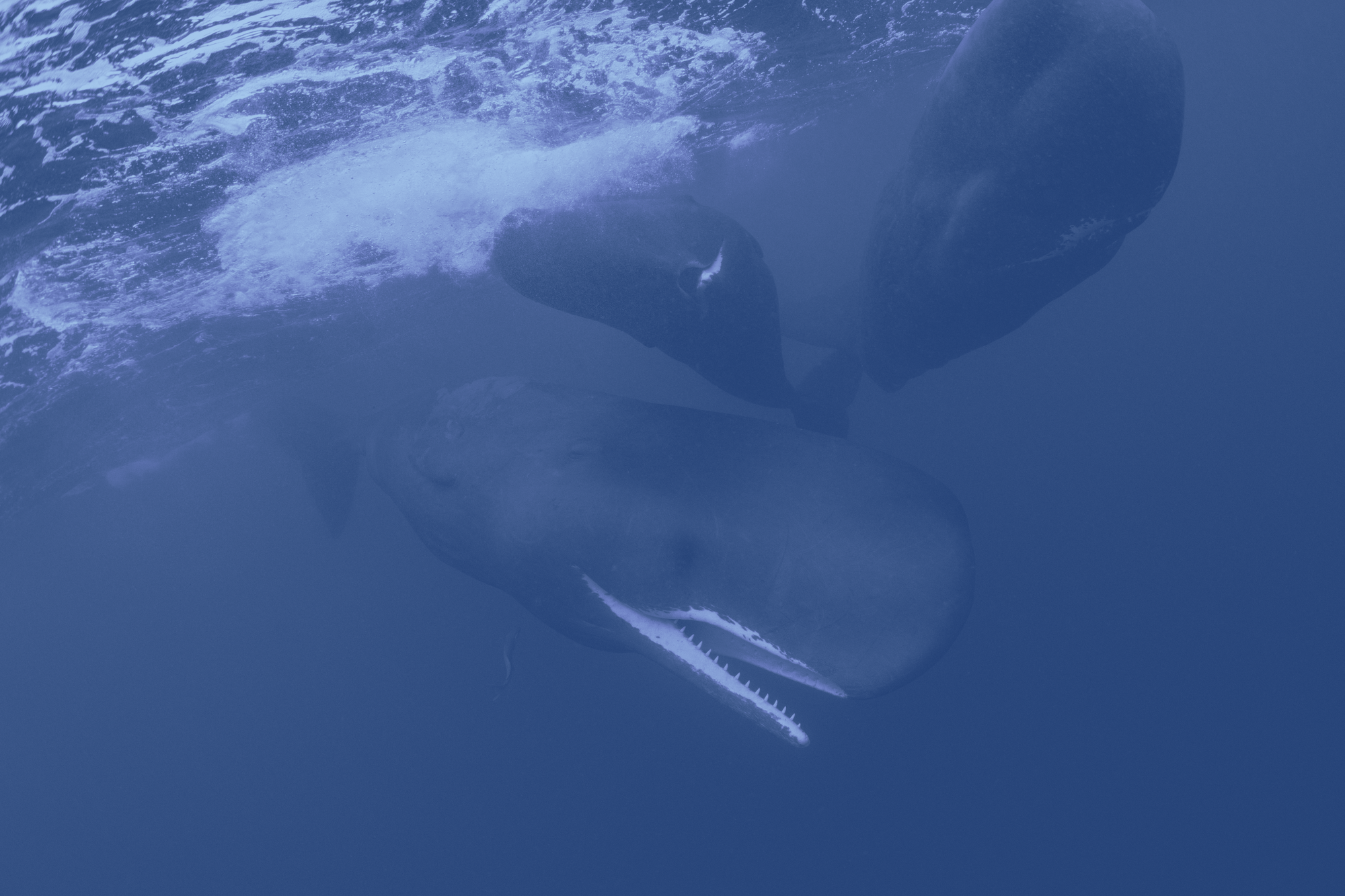
Members of the sperm whale family Unit A—Lady Oracle, Accra and Aurora—swim together as part of a culturally distinct clan. Dominica, Caribbean Sea. Photograph by Brian J. Skerry.
Courtesy of Project CETI and National GeographicWitnessing that birth and experiencing the subsequent years of analysis fundamentally transformed us as a team. It deepened our fascination with the whales and sharpened our commitment to better understand their inner lives, ultimately in hopes of better protecting them. It also highlighted the immense value of long-term ecological studies. With Shane’s decades of observations, we were able to see them as mothers and grandmothers, with siblings and non-kin connections. We considered each whale as an individual, identified by a human-given name and understood through a personal history, rather than simply as an animal in a dataset.
Years before my encounter with the glowing turtle, I also built a “shark-eye camera” by studying the pigments in a shark’s eye and then assembling a camera attuned to their vision. I then filmed the sharks underwater—an attempt to see them as accurately as possible, by way of technology, from their own point of view.. With sperm whales, the work is not simply to listen to them, but to listen as closely as possible from their perspectives. At the core of CETI’s journey is a question I keep asking: Can technology bring us closer to nature, rather than separating us from it? Can the combination of bioacoustics and AI open up the world of whale communication as the first microscopes revealed the hidden diversity of life? Can our newfound understanding of whale voices be applied to better protect whales and other marine life?
Ultimately, during the whale birth, our machines didn’t offer us meaning to make sense of what happened—but they gave us a way to stay with the scene, to get closer to it, and provided tools to help us learn better from the whales. The technology offered a deeper glimpse into the care, cooperation, and service found among sperm whales. As Copernicus revealed that Earth was not the center of the cosmos, we hope our work can help mark a similar shift—a deeper recognition that we are not the only beings with rich internal and communal lives. That the implications from this could be heard across species, from sea to shore. ♦
Join CETI’s Listen to the Whales campaign and contribute what you may want to learn from the whales in the years ahead.
Subscribe to Broadcast