Like Tomato Soup
Roger Revelle using a sextant aboard the research vessel E. W. Scripps, 1940. From the Roger Revelle Papers.
Courtesy of the Scripps Institution of OceanographyThe American chemists at Bikini Atoll treated their laboratory like a toilet. Broken beakers and dirty flasks decorated the field office. Inside, a general dampness pervaded, with evidence of sand and seawater, plates of unfinished food, and sweat-soaked clothing draped against tables and chairs. Coral souvenirs, emptied from the scientists’ khaki pockets, littered the space. This was certainly not up to the standards of a military operation, but that was partially the point. Bikini was late to the total war of the 1940s. The American and Japanese armies had fought their Pacific campaigns on different atolls, and though encircled by military supply lines, Bikini experienced none of the exploded ordinance or brutal killing of Kwajalein or Enewetak. Miraculously, it had been preserved for thermonuclear experimentation.
This at least was the impression held by Roger Revelle, the imposing six foot four American oceanographer the U.S. Navy dispatched to Bikini in 1946 to oversee initial lab teams for Operation Crossroads, the first nuclear test after the Second World War. Revelle and his team were charged with making geophysical and hydrographic surveys for the 23 nuclear weapons that would come to be tested on Bikini and its ecosystem of living coral islets between 1946 and 1958. His work on the atoll, and then later as the director of the Scripps Institution for Oceanography, propelled Revelle into the spotlight as one of the Cold War’s most recognizable advocates for science as a public vocation. Originally trained as a geologist at the University of California, Berkeley, early in his doctoral studies he became enchanted by the sea. He would often write and lecture about himself as a modern-day Ulysses, personifying the world spirit of ancient mariners seeking truth and homeland from saltwater. It was from his studies of the sea and the irradiated lagoon at Bikini that, remarkably, Revelle would develop one of the first scientific theories of how fossil fuel emissions impacted the planetary carbon cycle, published in a foundational co-authored paper on greenhouse warming in 1957. Later at Harvard in the 1960s, Revelle taught a young Al Gore, becoming a mentor to the future senator and inspiring Gore’s 1992 senatorial tome, Earth in the Balance: Ecology and the Human Spirit.
On Bikini in the late 1940s, though, Revelle was still looking for his own Manhattan Project. While he longed for the storied work discipline achieved at Los Alamos, he believed good oceanographic science required freedom of imagination as much as the rigor of experiment. This was especially true if these units were to lead the United States into what Revelle called the “push-button warfare” that was coming to the Pacific and the world: an age of automated mass death measured in laboratories and tested on islands, oceans, deserts, and Japanese cities. For Revelle, the cyan-blue water and encrusted coral bands of Bikini were canvases for conjuring all sorts of grand and disturbing images of the future. He saw the thrilling potential for a planet transformed by nuclear annihilation, and, from within that, the outlines of a coming climate crisis.
Why did the ocean hold such visions for Revelle? The history of climate science does not tend to begin in places like Bikini Atoll, nor do we often associate our understanding of the climate with mid-century projects of nuclear warfare. The story that gets told narrates the gradual discovery by professional scientists working in chemistry, physics, and the earth sciences after the Second World War, culminating in the legislative debates of the 1980s in the lead-up to the Rio Earth Summit of 1992, before the highly-politicized “climate wars” of the 1990s and 2000s when muddled climate policy and the disinformation campaigns of the oil industry derailed more ambitious climate agendas. In this account, many of the physical places, animating concerns, and wider historical contexts in which the climate emerged as an object of global concern become abstracted into scientific categories of time and temperature. Earth systems, planetary boundaries, carbon cycles, and weather anomalies appear part of an enclosed toolkit of experimentation and discovery. The coral at Bikini recedes from view.
The problem with telling the story of climate science in this way is that it reproduces a naive separation between science and the social world that produces it. Climate science was not born outside of the mechanisms of planetary destruction it came to warn us about. Figures like Revelle understood the social and political implications of climate change through the prism of a postwar world of American war-making and fossil-fueled mass consumption already pushing violently, deliberately, towards the death of the planet. It was out of this terrible reconfiguration that the notion of atmospheric warming caused by fossil fuel combustion became thinkable, revealing how these earliest iterations of postwar climate science became a means of reckoning with a global society increasingly organized by the threat of apocalyptic war and the reality of endless economic growth. For Revelle, civilization’s impulsive drives and the narrow prospects of taming them were best understood by following their impacts into the seemingly boundless sea.
*
Revelle wanted to be known as a professional sailor. His doctoral training in geology in the early 1930s required him to be shorebound at first, exposed to a world of earth science professionalization bound up with American oil companies and corporate philanthropies. His mentor at Berkeley, the geologist George Davis Louderback, had conducted studies on escarpment formation in the Great Basin, though he had made his career from public stratigraphic work on earthquakes and in private consulting. Between 1914 and 1916, Louderback worked as a petroleum geologist for Standard Oil in China and the Philippines. Petroleum Magazine featured a profile of him in 1920. A previous post as a research assistant to the Carnegie Institution during its first years of operation brought Louderback into circles for big philanthropic research funding, which ultimately provided the opportunities for his student Revelle to study the ocean.
Andrew Carnegie’s philanthropy had funded an oceanographic vessel, the Carnegie, under his foundation’s Department of Terrestrial Magnetism. The 155-foot two-masted yacht constructed with lumber harvested from Oregon’s great pine forests undertook seven pioneering voyages across the world for collecting data on the Earth’s magnetic field. On its final trip in 1929, the Carnegie was docked in Apia, Samoa, refueling with 55-gallon drums of gasoline when an explosion broke out below deck. The force of the blast destroyed the ship and killed its captain. Much of the data collected onboard had already been sent back to Carnegie’s headquarters in Washington, D.C, but the foundation needed geologists capable of analyzing the “bottom sediments” scraped by the vessel. With his professor’s recommendation, Revelle was picked for the job and sent to the Scripps Institution in 1931, then a La Jolla-based field station for the University of California, where he began analyses of the samples.
This was Revelle’s journey into “mud” as he would later call it. He was meant to be analyzing the sediment samples, but spent his time studying the chemistry of seawater and learning to sail and take water samples off the Scripps, a retrofitted fishing boat. Weekly journeys 100 miles off the California coast were Revelle’s first exposure to professional oceanography and a life at sea. When he submitted his dissertation to Louderback in 1936, he then headed off for a second education as a researcher at the Geophysical Institute in Bergen, Norway, the center of cutting edge oceanography since the late nineteenth century.
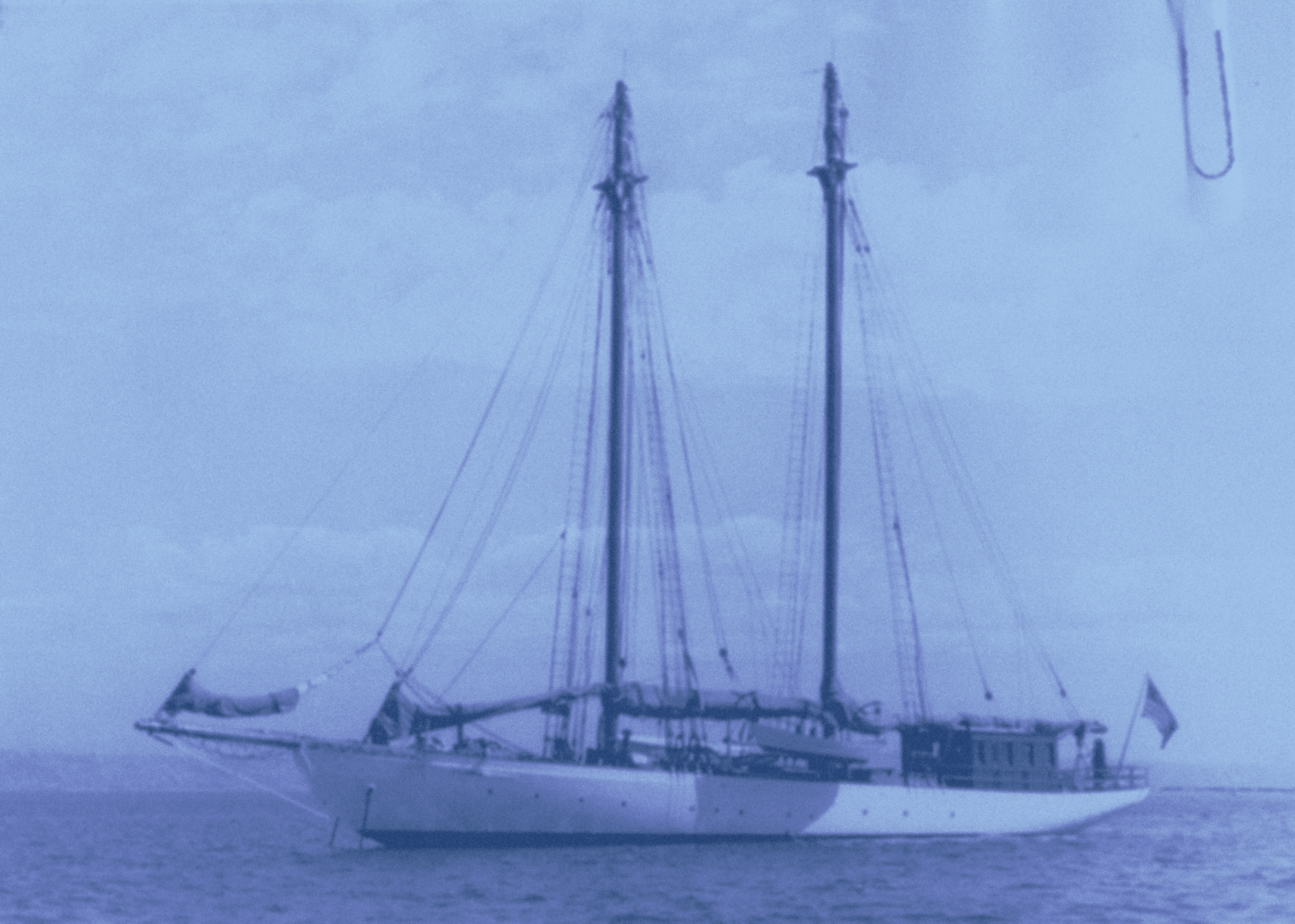
The E. W. Scripps, 1939.
Courtesy of the Scripps Institution of OceanographyIn Bergen, Revelle learned what was called “physical” oceanography, a mathematical model-building science that applied principles of hydrodynamics to the planetary circulation of the oceans and the atmosphere in dynamic interrelation. The Scandinavians had been especially focused on the problem of currents and circulation, but their interests were not motivated by pure theory. It was the sudden reappearance of herring schools in the last decades of the nineteenth century in fisheries long thought exhausted by Scandinavian fishermen that led Norwegian scientists to search for the patterns of oceanic currents, systems of wind and storms, and the surprising depths within which marine life could still be found. The principles of theoretical physics applied to these concerns would lead to the predictive models of modern oceanographic and meteorological science. For Americans like Revelle, material considerations similarly animated their search for the physical laws of the sea. Not herring, but the technology and instruments of offshore oil exploration, would ultimately open portals for Revelle to see the ocean as an integrated data field for scientific study.
When Revelle returned to Scripps from Norway, he was intent on transforming the institute into a kind of “Bergen West.” Beginning in 1939, Revelle and his colleagues organized expeditions on the Scripps for the hydrographic survey of the Gulf of California in the Sea of Cortez. Their work was funded by a grant from the Geological Society of America for studying Pacific sediments, but was conducted with interest from the Pasadena Hydrocarbon Company for coastal marine surveys of potential petroleum-bearing geology. The connections here again flowed back to Carnegie, which had established a seismological laboratory at Caltech that would become a central research outpost for the burgeoning science of petroleum geophysical exploration.
Much of what the Scripps team planned to do in the Sea of Cortez had to be called off by the war. Revelle would still publish an account of the role of underwater bacteria in the formation of marine organisms for petroleum deposits. Studies of megascopic paleontology, marine stratigraphy, paleobotany, and Revelle’s cursed specialty, “sedimentation,” filled out the ledger of other published research activities. But the significance of the Sea of Cortez expeditions went beyond these publications. The people on Tiburón Island, the Seri or Comcáac, became a peculiar source of Revelle’s fascination. He kept several photographs the crew had taken of them. “Very wild,” “very primitive,” he would remember in an interview decades later. The photographs reflected a fearful attraction for Revelle. The Seri dressed in cured sea-lion skin and hats woven from torote roots. Lacking access to abundant freshwater, they subsisted on cactus seeds and harpooned fish with paddle boats that moved through the shark-infested channel between the island and the Mexican coastal mainland—Infiernillo, “little hell.”
Revelle was aware that the Seri had been studied previously by leading American anthropologists. There were many theories for their presence on Tiburón Island, with some scholars suggesting that they were not a single linguistic community, but a band of primitive refugees who escaped the Spanish coastal mission system and conquistador violence by fleeing into the sea. Revelle’s interest in the Seri embodied an imperial scientific gaze that would reappear throughout his career meditating on the destructive tendencies of human history and the inner darkness of humans. Anthropological knowledge about the Seri had been cultivated through selective readings of conquistador writings, which concluded that the community were cannibals. They practice “the vice of those called anthropophagi, who eat human flesh,” a seventeenth century Jesuit missionary wrote. For the crew of the Scripps, shortly off to the bloodlettings of the Second World War, the Seri came to represent a form of primitive violence they believed was foreign to themselves. What kind of a society eats its own?
The Sea of Cortez is named after the conquistador Hernán Cortéz, whose soldier, Francisco de Ulloa, called the sea “Mar Bermejo,” the Vermillion Sea. The water’s reddish color comes from the abundant life within it—the enormous plankton blooms that in the spring dye the water red. Revelle thought it looked like tomato soup. “If you went out in a small boat at night,” he remembered, “and dipped your oars in the water, the whole sea would light up for hundreds of yards around the ship, light from luminescent organisms.”
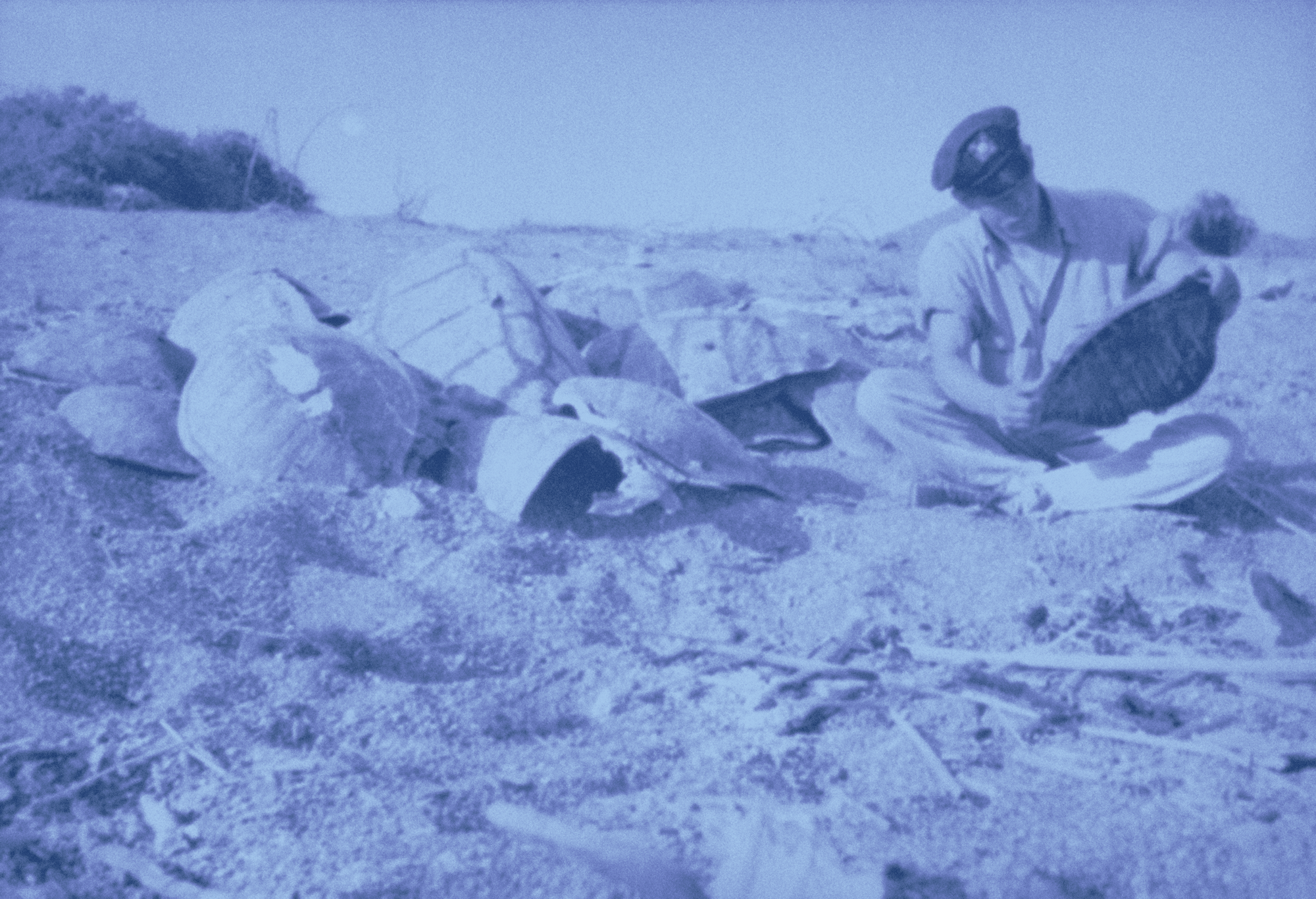
Turtle shells scattered across a beach on the southwestern end of Tiburón Island, remnants of feasts held by the Seri people, 1939. From the Roger Revelle Papers.
The red life in the sea refracted death on the land. Iberian conquest of the Americas after 1492 unleashed a new world of genocide and enslavement. More than 50 million people were killed over the course of the century that followed, largely by the European transmission of smallpox and other diseases. As conquistadors discovered the vices of the indigenous, their pious brutality opened a pathway towards true apocalypse. Earth system scientists now point to the mass death event of the Columbian Exchange as a geological “golden spike,” or a specific chemical or biological change observable in geological sediment for dating transitions between geological eras. When Columbus arrived in the Caribbean, its islands’ Taíno inhabitants were living under the Holocene, an interglacial period of the last 11,700 years characterized by a stable climate. The collapse of indigenous societies in the Americas led to such an extensive return of forest cover over former farmland that new tree growth removed enough carbon dioxide from the atmosphere to cool the Earth a final time before the burning of the planet’s carbon stores that was to come.
For another American coincidentally sailing in the Sea of Cortez the same year as Revelle, the red waters encircling Tiburón inspired a similar meditation about destructive human drives. For the author John Steinbeck, then onboard a sardine boat, the Western Flyer, the drives that concerned him were not the racist anthropological fantasies of the cannibalistic Seri, but an epochal crisis of industrial society. Steinbeck was in Cortez collecting marine specimens with Ed Ricketts, the Monterey-based marine biologist and author of Between Pacific Tides, the book that inspired Rachel Carson’s The Sea Around Us. In the novelist’s published logbook, Steinbeck wrote that he could feel, when steering the boat, the manifestation of a Hegelian dialectic, symbolized in the physics symbol for continuous oscillation, √-1, or the external influences of nature constantly overcome and rechanneled by human will.
“Man is the only animal whose interest and whose drive are outside himself,” Steinbeck wrote. It was these drives, where humans began to see their own subjectivity in the “houses and cars and grain elevators” that comprised material life, that caused humans since the industrial revolution to become a collective subject whose only organizing models were either “Marx or Hitler or Henry Ford.” It was the potential for earthly extinction that this society had at last brought into the world, Steinbeck wrote, gazing out on the thickening plankton blooms beneath his ship.
*
Revelle was a creature of the industrial society identified by Steinbeck, but he would find himself constantly attempting to humanize the forms of science and technology that were becoming capable of destroying the world. After Cortez, it was the war in the Pacific that enchanted him—the manifestation of an unprecedented military power on the sea and the affordances of scientific research under the conditions of emergency power. When he was dispatched to Bikini he believed he was undertaking a man-made experiment without comparison in the history of the species. For Revelle, the nuclear tests held an opportunity to examine an energy release “more comparable to those of large-scale geophysical phenomena than any previous man-made event.”
This zeal was joined by suppressed doubts. Revelle would offhandedly worry that the extent of the disturbances of the nuclear tests would mean a fundamental breakdown of the equilibrium between the water, geology, and living creatures of the atoll. He wrote of a fascination with Bikini’s coral reefs, several thousand feet thick. With help from borrowed oil drilling equipment, he was able to see that the reefs originated as “skeletons of coral and other animals” that had grown up over a million years surrounding the volcanic core of the non-submerged land mass. These calcareous remains of living organisms—“tremendous bone piles overlying volcanic rock”—were for Revelle the “largest structures ever made by living creatures.” They made the pyramids of Egypt and the Empire State Building appear “microscopic.”
More dead matter would join them—fallout from the “geophysical phenomena” of the bomb. The 23 nuclear weapons tested on Bikini after 1946 resulted in the displacement of around 167 Marshallese islanders and the radioactive contamination of the atoll. On March 1, 1954, the U.S. Army conducted the largest thermonuclear test in American history, causing the physical vaporization of much of the reef structure and the oceanic spewing of radioactive material into high altitudes. The detonation exceeded the yields initially predicted three-fold, resulting in a 15-megaton explosion with stratospheric radioactive contamination spreading to four continents. Public outcry from this event partially led to the 1963 Nuclear Test Ban Treaty. For Marshallese people exposed to these tests, the ban was too late. The effects of radiation lived on after displacement, causing high rates of miscarriage, stillbirths, and deformities in newborns.
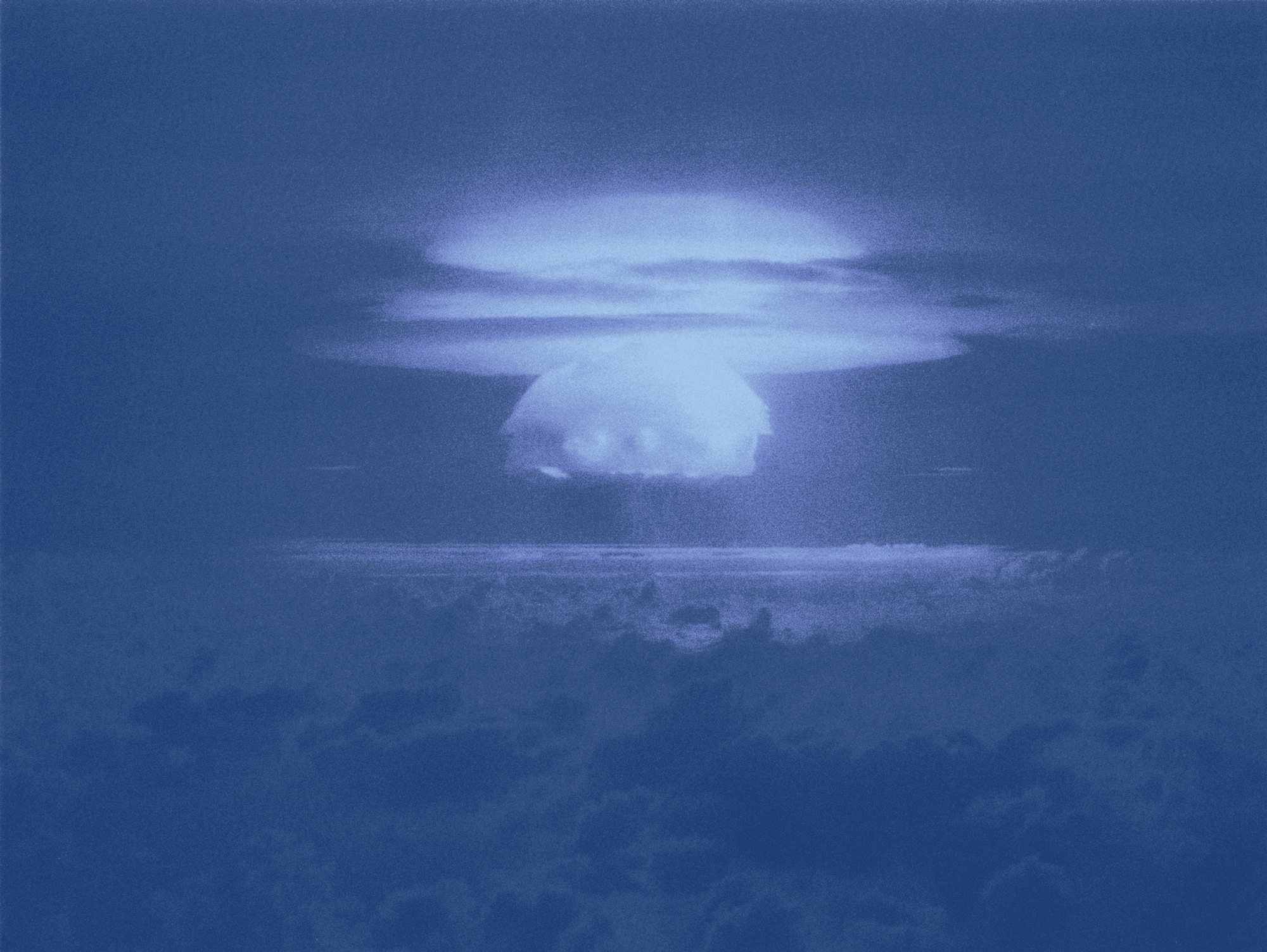
Castle Bravo blast, 1954.
Courtesy of the United States Department of EnergyBy the time these effects materialized, Revelle had already moved on. In 1950, he led another Scripps and U.S. Navy oceanographic mission, the Mid-Pacific or MidPac expedition, a 29,000-mile voyage for exploring the geological formations of the Earth’s largest ocean. Seismic refraction borrowed from the oil industry and echo-sounding borrowed from the military recorded the sound pulses of the ocean bottom. The problem of people and civilization continued to occupy Revelle’s mind. Staying with Polynesian seafarers in the South Pacific after MidPac, he admired their ancient sailing culture as an “attempt to be like Gods,” settling and discovering the trackless ocean. But in the aftermath of the war, and under the increasing global integration of American-led global power, he worried they were now unable to “cope with the white man’s civilization.” “There are no islands of escape,” he would write, even for these “wonderful human animals.”
Between voyages, Revelle’s work on Bikini had brought him back to the study of ocean chemistry, particularly the problem of how carbonates dissolved and produced what he would call the “equilibrium” of carbon dioxide exchanged between the atmosphere and the ocean. He would pair this work in the early 1950s with studies of radioactive contamination from the underwater nuclear tests on Bikini in which he noted the persistence of radioactive residues spread across the ocean in “thin sheets” resisting dilution. At the same moment, the Austrian chemist Hans Suess was working for the University of Chicago on radioactive carbon-14 for dating ancient artifacts collected by archaeologists and anthropologists. The U.S. Air Force had taken an interest in this “Egyptian mummy” project—not as antiquarians, but for detecting the radioactivity measures of Soviet nuclear test sites. Suess was continuing his work with the U.S. Geological Survey by measuring carbon isotopes in tree rings when he discovered carbon contamination in his specimens likely attributable to fossil fuel combustion. In 1955, Revelle asked Suess to join Scripps. Two years later, they published their research on the impact of fossil fuels on the carbon cycle.
Revelle and Suess’s work built on calculations that had been known since the 1930s. What was new were the implications of CO2 emissions for producing the “greenhouse effect.” Their work speculated that the oceans were not capable of absorbing increased quantities of CO2 indefinitely. These findings also caused Revelle to worry about the appropriate measurement for the carbon output of industrial production, which, with growing human populations moving toward ever higher degrees of technological development, could not easily be factored into his equations. Publicity preceding Revelle and Suess’s publication led to a Time magazine story, “Science: One Big Greenhouse,” in which Revelle invited the public to consider the potentially terrible effects of engines and furnaces pouring carbon dioxide into the atmosphere year after year. Revelle’s old Bergen colleague, Jacob Bjerknes, now the chair of the Department of Meteorology at UCLA, would write to him to ask for more data about long-range climatic effects. Revelle even testified before the U.S. Congress on what carbon-14 had shown him.
In presenting his findings, Revelle provided warnings, but also offered a cautious hedge. Industrial societies needed to change to prevent catastrophic warming, but it was still unclear what exactly the thresholds for such a breakdown were. The impossibility of certainty was not supposed to be a barrier to action, but was instead intended to motivate further studies of what Revelle took to calling the unprecedented “geophysical experiment” humans were conducting on the planet. Fossil fuels, like the bomb, like oil refraction seismology, were vectors of planetary response stimuli, allowing us to know more about a planet that only proved more complex the more society produced the technologies for its destruction. The results of the grand experiment were still rolling in.
*
Revelle’s success in promoting early climate science moved him away from experimental work and towards scientific and academic administration. The measurement of CO2 emissions would be left to another chemist Revelle had hired at Scripps, Charles Keeling, who after 1957 began measuring carbon dioxide at a new mountaintop observatory on Mauna Loa, establishing what would become the most significant time-series data on atmospheric increases in carbon concentration. Revelle meanwhile took up a role as the first science advisor to the Secretary of the Interior, Stewart Udall, in 1961. President John F. Kennedy appointed Revelle to head a water salinity and agricultural development project for the Indus River Basin in Pakistan. Suddenly, Revelle found himself at the center of global networks for technocratic problem-solving. His initial alarm at the rising trend of fossil fuel emissions was now directed towards global development, which he pursued by turning his attention to the dynamics of overpopulation, insisting that the problem of Third World birthrates were the driving force of a coming planetary crisis.
In 1964, Revelle formally left Scripps to develop these Malthusian hypotheses as the founding director of Harvard’s Center for Population Studies. Revelle’s work on population at Harvard focused on characteristic eugenic concerns of Third World poverty, fertility, and technologies for birth control, but he extended these analyses into the study of alternative energy use, which he believed could save the world from the greenhouse effect. Third World countries, where the postwar population boom was most acute, were also the places on Earth with the most minimal carbon footprint. Revelle pioneered studies of energy analysis exploring the burning of biomass, the potential applications of solar and wind technologies, and the large-scale implementation of integrated hydroelectric systems for tropical countries. “The number of human beings on earth,” he explained, was determined first and foremost by “the total energy available for food and material production,” which conscious scientific intervention could potentially control.
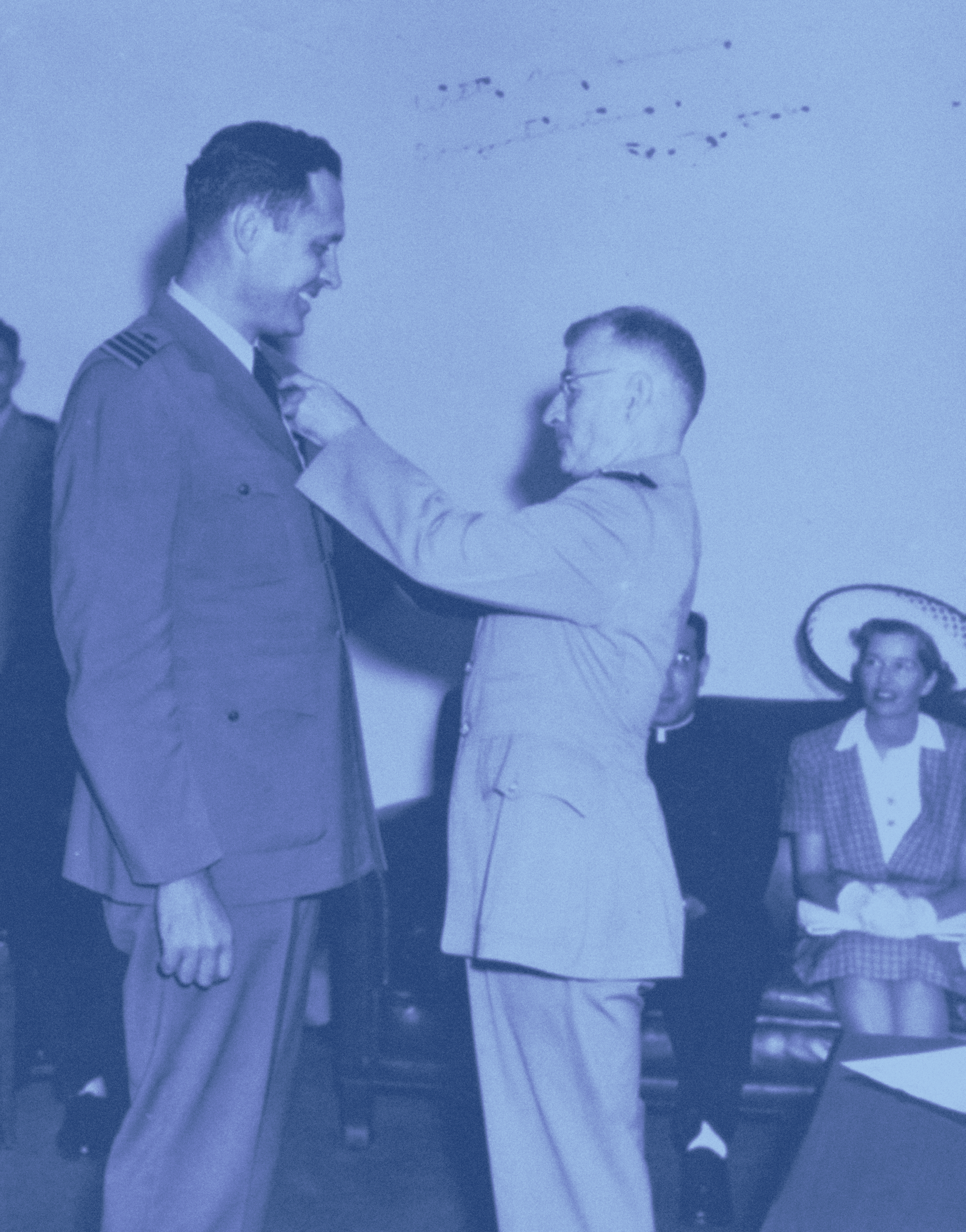
Admiral Paul Lee, chief of the U.S. Office of Naval Research, presenting Roger Revelle with a commendation from the Secretary of the Navy for his work on Operation Crossroads. Revelle’s wife, Ellen Clark Revelle, stands in the background.
Courtesy of the Scripps Institution of Oceanography.Shepherding the energetic divergences of the First and Third Worlds had become an urgent necessity for Revelle. India or Pakistan could not develop like fossil-fueled America if the planet was to survive. Countries in the Third World were already predisposed to vulnerability to climate change due to their agrarian dependencies on weather systems like the Indian Ocean monsoon. By the late 1960s, Revelle and others had begun to believe that climatic variability in South Asia had become “an increasing threat to the survival of people at the margins of subsistence.” At the same time, Revelle noted, both the societies of the west continued to pour carbon into the atmosphere, while countries in the Third World made plans for expanding their own fossil fuel footprints. What accounted for this intransigence of the fossil economy in the face of scientific evidence for the existential dangers of a disrupted climate system?
These were questions that had deeper cultural and behavioral causes, Revelle believed. He would argue that the root of fossil fuel dependency lay in the Judeo-Christian tradition, ennobling a belief in the control and manipulation of nature to human ends, helping individuals justify the ongoing destruction of the planet. He extended this analysis back to the Greek belief in the orderliness of the world and its conquest by rational understanding. Other societies approached nature without this conquering spirit, favoring instead “magic and ritual” and seeking harmony with nature.
Revelle identified an epochal turning point, outlined in an essay called “On Energy and Slavery,” in which he insisted that modern forms of economic rationality emerged with the abolition of the Atlantic slave trade and the rise of fossil-fueled industrial technology. Where once enslaved Africans had been relied on to supply forced labor, new industries now drove down the cost of mechanical work, making it cheaper to employ kilowatts of electric power or gallons of gasoline than the equivalent labor costs of maintaining the lives of unfree workers. “It is not because we are enlightened that we have abolished slavery,” Revelle lamented, “but because we can’t afford it.” Americans, he insisted, had no idea of the scale of the slave system that would be required to reproduce the material conditions of postwar abundance to which they had now become accustomed. It was the economic necessity of both human and ecological domination, Revelle believed, that would trump simple appeals to any greater environmental consciousness.
Revelle was able to push his thought to these extreme justifications, but would never consider whether the capitalist society he was describing—one born from the exploitation of chattel slavery and fossil fuel—was itself worth saving. How could he? Once he had identified the innate motor of human behavior in the crude ratio of relative energy costs, it was obvious that what was driving the planet into crisis was the simple arithmetic addition of more people on Earth making the same calculus as his postwar Americans. Revelle’s neo-Malthusianism was born out of this naturalization of capitalism, turning climate breakdown into a biological explanation of human drives.
During his time at Harvard, Revelle would pursue a variety of high-level connections to promote his virtuous pairing of climate, energy, and population policies. In 1965 he even contributed to the President’s Scientific Advisory Panel on the problem of fossil fuels and climate change. He met world leaders like Indian Prime Minister Jawaharlal Nehru. Networks of elite power ultimately led Revelle to seek membership in the Bohemian Club, the all-male secret society that continuously meets each July in Bohemian Grove in Monte Rio in Northern California. In 1973 Revelle gave a “Lakeside Lecture” at Bohemian Grove on continental drift theory. He followed up this performance in 1976 with another celebrated talk entitled “Population Explosion.”
The man who put Revelle up for membership in the Bohemian Club was Frederick Seitz, a founder of the field of solid-state physics who worked on the atom bomb and served as the president of the National Academy of Sciences. Richard Nixon, another Bohemian Club member, gave Seitz the National Medal of Science in 1973. Later a more infamous figure, Seitz would come to support junk science for both the American tobacco industry and climate denial. In 1998 he circulated a petition questioning the accuracy of scientific conclusions on the impacts of carbon emissions and calling for the United States to reject the Kyoto Protocol, justifying his position as an extension of longtime anti-communist commitments and his belief that such climate legislation represented a dangerous overreach by the state.
It might be hard in retrospect to imagine Revelle and Seitz as members of the same club. One, an early proponent of coordinated federal and international scientific research to document anthropogenic climate change. The other, an avatar of the scientific confusion that money can buy. Then again, maybe they are closer than they appear. Revelle’s legacy as a supporter of climate research would become slightly tarnished in the years just after his death at age 82 in 1991, when his name was controversially attached to a paper as a co-author with the conservative Austrian physicist Fred Singer refuting that urgent action was required to delimit fossil fuel emissions. A controversy of public recriminations, partisan news articles, and a libel lawsuit followed, spurred on by the importance that Al Gore had given to Revelle in inspiring the message of Earth in the Balance.
Before all of this, one might imagine Revelle and Seitz walking together beneath the redwoods along the Russian River in Monte Rio, quietly delighting in what the Grove’s invitation for 1976 called these “glorious happy gatherings,” whose rites included a “Cremation of Care” ceremony, when an effigy is burned to help club members release their attachments to worldly troubles. What could Revelle have been thinking about while the effigy burned? The bone piles of Bikini’s coral bands? Sheets of radiation spreading continuously in the sea? The gaze of Seri fishers turning away from the mainland? Perhaps, most anxiously, he mulled the quiet hum of Mauna Loa’s carbon dioxide monitors, chronicling ultimately for no one, year after year, the end of the world.
It would be wrong to think that Revelle’s presence in this company reveals an underlying cynicism. He was, if anything, an idealist, committed to a dominating project of scientific universality born of his fascination with the sea. The insufficient political and social diagnoses he derived from his understanding of climate change reflected his fidelity to this scientific temperament. There is a boundary here between description and transformation, the scientific delineation of causation and its meaning in the world. The oceanographer saw this boundary, but would only go so far. Men like Revelle and Seitz may have been able to dispute the social implications of climate data, but both would argue that the continued burning of fossil fuels was a natural outgrowth of a capitalist rationality, a Judeo-Christian worldview of the appropriate uses of nature by man. Revelle’s research into alternative energy was born out of a faith in the power of technology to potentially shift the parameters of economic and demographic necessity, never to question either the sources of this necessity nor whether society might be ordered differently. In the end, Revelle’s studies of the ocean and the carbon cycle proved to be a weak warning for a society pushing the planet to the brink. Humanity’s great geophysical experiment continues to yield the same results. ♦
Subscribe to Broadcast