Where Cities and Oceans Meet
New Orleans flood, April 1927.
Courtesy of the Times-Picayune archivesWhere does Louisiana end, and the ocean begin? And where will New Orleans end, when the ocean gradually swallows up the land around us?
In May, a study from environmental scientists including Torbjörn Törnqvist of Tulane, where I also teach, set off a storm in this diminishing city, which floats perilously above a bend in the Mississippi and the once and former Gulf of Mexico. The message was clear: New Orleans has passed a “point of no return.” If land here has always been the site of a pyrrhic struggle to dry an insatiably wet place, it is clear now that the waters are winning—have won—and that much of what is dry will disappear against the steady, forward march of the ocean. A relocation, whether forced or voluntary, is the only responsible plan, the scientists suggested, for this miraculous city that environmental historian Craig Colten called "an unnatural metropolis."
The study catapulted across world media. I first saw it, like many people, in The Guardian. But unlike many readers, I encountered it while sitting in an apartment where the floors dip toward the watery earth. Friends far and wide asked me what it felt like to live in a disappearing place. And what could I say? Just the day before, my partner and I had been finalizing an offer on a home in one of the neighborhoods that didn't flood during Katrina, a home beyond our means but within our universe of possibility. Yet water has a way of washing away possibility here, we’ve learned.
As did the early French colonists, whose utopian dreams of an Enlightenment-era tobacco capital in the swamps were repeatedly torn asunder by the ceaseless return of water where they didn’t want it to be. Keep the river and ocean safely cordoned: This has been the goal of New Orleans planners for nearly three centuries. Watery landscapes have also offered transformative opportunities, whether to generations of trappers and fishermen benefitting from the region’s rich biodiversity, or to the oil and gas firms whose rigs and pipelines crisscross the Gulf. Today, however, the shifting borders between water and land, between ocean and not-ocean, are taking on a more distinctly dystopian tenor. As fears over New Orleans’ potential disappearance mix with the arrival of vampiric tech firms to Louisiana, coming to take what little the land has left, the climate catastrophe continues to spiral unabated.
*
Another Tulane colleague, the writer Nathaniel Rich, has argued that New Orleans has a "striking advantage" in the age of runaway global warming: Residents know what has happened and will happen. The climate crisis is not an event in the future, Rich notes. It is our present, and people here are ready.
But from whispers over drinks to bitter discourse online, the predominant local reaction to the new study on our city’s dire fate seemed to be refusal. How dare scientists tell residents of a place with such deep culture and history, the most European and Caribbean city in the United States, to pack up and leave? Like a drunk who has stayed at the bar past closing? For many poor communities, who lost the most in past catastrophes but gained the least from post-Katrina gentrification, the report read like a prescription for deeper inequity. On Instagram, I saw posts about concerts and protests and parties—some at bars, past closing. If Los Angeles is the city that has been imaginatively destroyed again and again in film and TV, as Thom Andersen argues in Los Angeles Plays Itself, New Orleans is the one that has been destroyed countless times in reality. We have survived worse and rebuilt before, many insisted. We're staying.
It was a reaction as understandable emotionally as it was disconnected from environmental reality. But that gap is a feature of life in the Crescent City. As I watched my first Mardi Gras parade this spring, junk falling in never-ending torrents from brightly decorated floats, a friend sympathetically interjected, "This must be driving you crazy." What they meant was that as someone who teaches about environmental history but isn’t from here, I must be especially affected by the throwaway culture of the city’s most famous fête and its tons and tons of plastic beads, made from the same fossil fuels that are causing sea levels to rise around us.
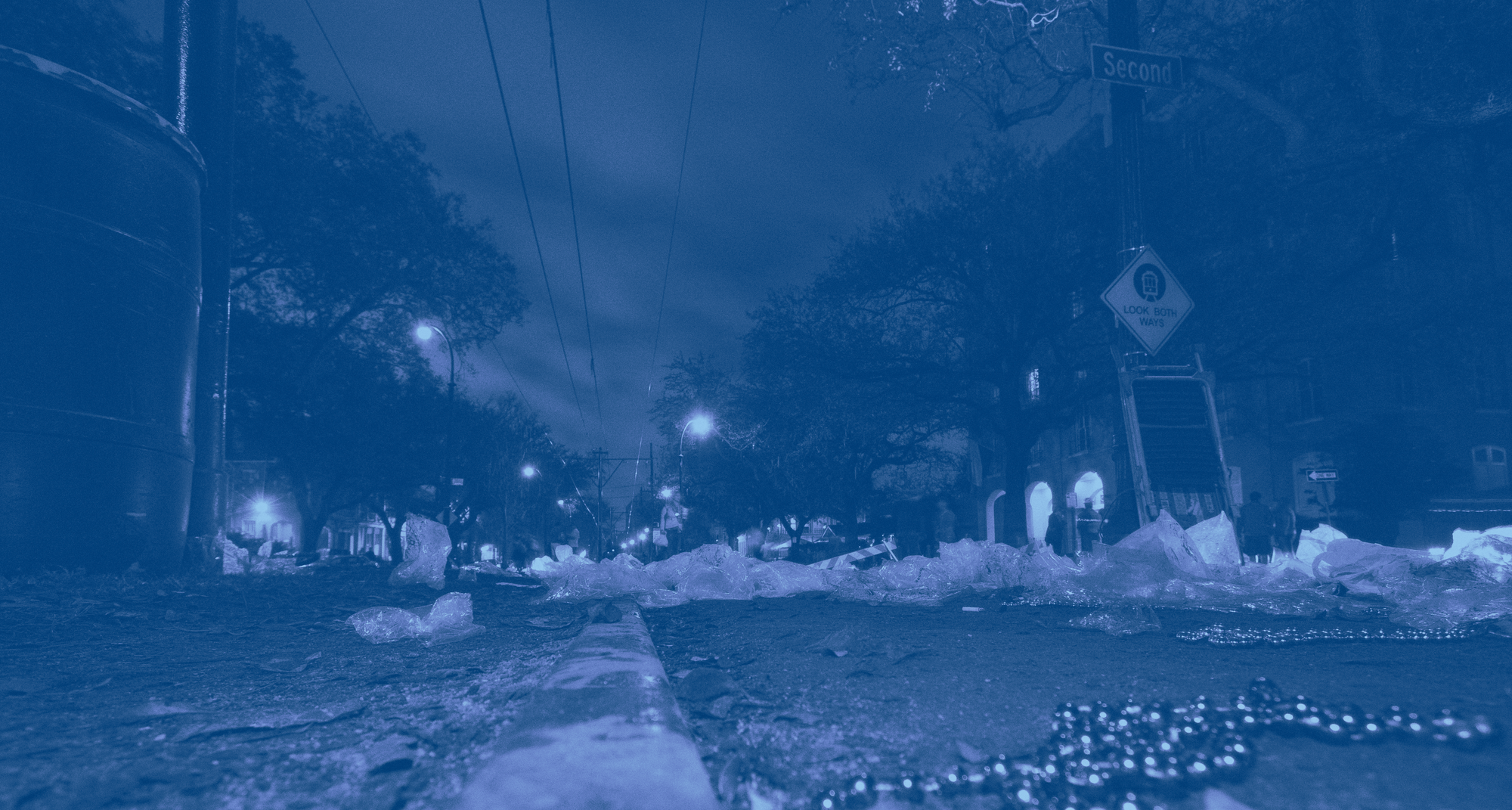
Beads and other detritus left over from Mardi Gras, 2011.
Photo: Derek BridgesIt’s true that my teaching has never felt more meaningful: Environmental history is not an abstraction in New Orleans; you can feel the weight of the past all around you. My students grasp it immediately. But what I kept wanting to say, as more and more long-term residents asked me more or less the same thing, was: "How could anyone get used to this?" How can we live this way, with the same fantasy of innocence that fuels hyperconsumption everywhere, in a place that such behavior is so obviously destroying?
Because the beads are wasteful, yes, and hard to dispose of, but even more than any of that, they exemplify the interlocking nature of modern consumerism and disregard for environmental harm. It is less commonly known, for instance, that the parts of New Orleans with the highest lead levels tend to be the green spaces near parade routes. Beads, often made partly from recycled e-waste, leach lead and more into the soil with every heavy rain. They threaten the health of kids who catch and often chew on them, in a city where over half of the playgrounds are so contaminated by historic lead pollution that letting children play in them is dangerous. Strings of beads hang from the limbs of young trees, straining the new branches we desperately need for shade in a city that has lost so much of its tree canopy. Others get caught in the drains, exacerbating flooding. Despite concerted efforts to replace traditional throws with compostable items, this year's parades were arguably the most environmentally disastrous in history.
Compostable beads won’t slow the oceans, and no one is pure in their environmental impact. But here, I think it’s sometimes easier not to think about the future, especially when the environment is involved. Among the newly elected mayor’s first actions, in the face of budget deficits, was a decision to gut the city’s sustainability office and eliminate our fully funded recycling pilot program. Those things can wait for a balanced budget, politicians seemed to suggest. But at this rate, how long will there even be a New Orleans in need of fiscal solvency?
Torbjörn Törnqvist sees his work as optimistic: We could lead the world in responding to catastrophic global warming. After a period of bitter and often personal criticism, he responded that he agreed with much of what his critics said. He loves New Orleans, and lives here, and would be the first to acknowledge it’s unfair that all of this should happen to a city which has already endured so much. He would like New Orleans to stay as it is. But, he argued, being clear-eyed about the problem was the only path to a genuine solution. “New Orleans is in a terminal condition,” explained Jesse Keenan, one of his co-authors, “and we need to be clear with the patient that it is terminal.”
*
Before there was a place called New Orleans, there were wetlands of unbelievable fecundity. The borders between land and water were blurry, and periodic flooding and drying enabled unique species to thrive—like the bald cypress, one of the only cypress trees to lose its leaves each year. Characteristically knobby knees push up out of the ground, sometimes 10 feet into the air and far from the trunk, anchoring great canopies down to withstand the elements. It is a miraculous tree, one that can thrive in both dry soil and submersion. Its reproductive process actually benefits from a combination of the two: Periods of temporary flooding spread seeds while staggering competitor plants. Bald cypress are exemplars of a wetland ecosystem that was once one of the most biodiverse in the world.
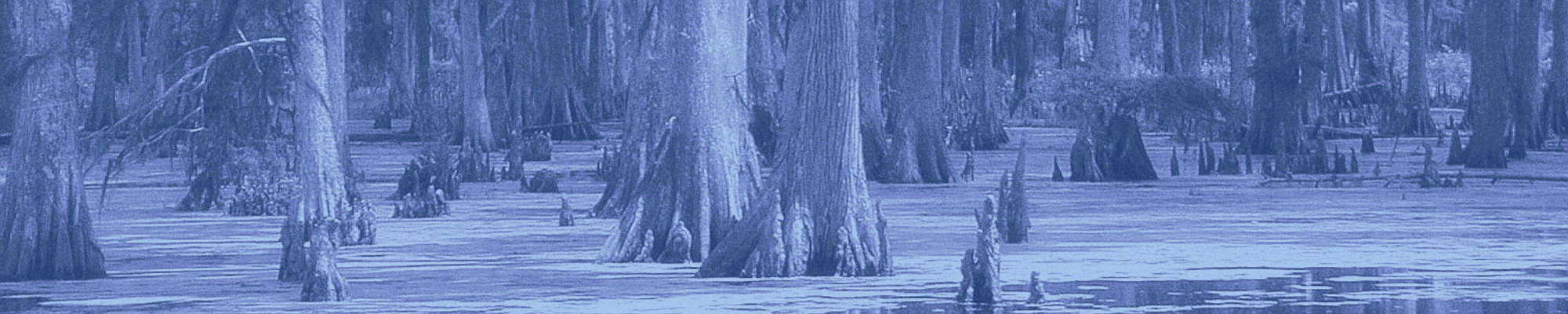
Bald cypress swamp in southern Louisiana, 2004.
Photo: Jan KronsellGreat, thousand-year-old giants: redwoods of the South. Before Europeans arrived, cypress grew thick and tall throughout the Gulf South. But colonists gradually recognized that the same adaptations that protected the trees from rotting in their swampy landscapes made them the bearers of a naturally rot-resistant wood. Old houses and fences and pieces of furniture that have survived a long time in Louisiana are often made from cypress. Without synthetic protection, most other woods crumble in the face of our heavy rains and choking humidity.
As scholar Adam Mandelman has shown in his fittingly titled The Place With No Edge, bald cypress harvesting grew remarkably quickly in the early twentieth century and rapidly reshaped the landscape. To log the trees effectively, canals needed to be dredged in soggy places. Barges could then cut down cypress by the thousands, in a hub-and-spoke pattern so destructive it is still visible from the sky or on Google Maps. They did this so quickly and irresponsibly that quite a few simply sank into the water, felled without purpose and awaiting actual use decades later.
But loggers soon learned something they had not initially realized. Bald cypress grows very slowly, and only its heartwood, which takes centuries to form, contains the magical, fungi- and insect-resistant properties. There had been few tree plantations, no careful stewardship. Nearly as fast as they emerged and made fortunes, cypress logging companies vanished.
Or, they became something else, as many loggers noticed another booming industry in Louisiana and switched their object. They became oil companies, using some of the same dredging technologies they’d used to fell trees to cut pathways through the wetlands and transport the liquid gold that flowed beneath Louisiana.
Both stages of this process were disastrous for the natural environment and upset the balance of power between land and ocean. Bald cypress, it turned out, played an essential role in anchoring wetland ecosystems. The trees also buffered against hurricanes and limited flooding. They drew a more than imaginary boundary between the salty beyond and the saltless here. But as more and more canals were cut to transport more and more oil, little stood in the way of the ocean's penetration into delicate wetlands. What seemed initially unimaginable soon became utterly undeniable: The landscape itself was vanishing, falling away into the watery depths. Today, the spaces where ocean and wetland meet are often thronged by towering, skeletal cypress, which cannot survive the intrusion of saltwater.
How can we live this way, with the same fantasy of innocence that fuels hyperconsumption everywhere, in a place that such behavior is so obviously destroying?
But it can also be hard to understand the porousness of the border between land and sea because one of Louisiana's great deceptions is cartographic. There is almost no map that accurately charts the territory, which is disappearing into the ocean as I write. One visualization of the process, prepared for the state’s now-thwarted Coastal Master Plan, skirted this problem by portraying what has already been lost and what will be lost by 2050 as one single, spreading redness. As if to say: Ours is a landscape of ghosts, torn between a lost past and a future that is already gone.

It’s true that coastlines across the United States are vanishing, as global warming raises sea levels around the world. But the coast here is disappearing faster than virtually anywhere. So much so that it is commonplace in environmental literature to turn to football metaphors to visualize the change: Nearly a field’s worth of land is lost roughly every hour, writers often stress—with a certain ironic cruelty, given local commitment to the Saints and Louisiana's love for the LSU Tigers. Aerial surveys had already confirmed this unfolding catastrophe by the late-twentieth century and it has only become more obvious over time. The land was vanishing, the ocean working its way ever inward. It's just that those in power had every reason to do nothing about it: There is no such thing as a “natural” disaster, argued Andy Horowitz in his authoritative history of Hurricane Katrina. Each one is the product of human history, millions of decisions made over centuries. We live in the aftermath of those choices.
*
What was perhaps strangest about the response to Törnqvist’s article this past spring was that the study hadn’t said anything fundamentally new. Six years ago, an article in the Times-Picayune quoted Törnqvist on the challenges facing the city. The headline ran, “We’re Screwed.”
At a campus discussion in August, Törnqvist added that the backlash was particularly surprising because, less than two years ago, Republicans in Louisiana had killed a centerpiece of the state’s Coastal Master Plan, a fully funded, last-ditch effort to repair the disappearing land by diverting river sediment to rebuild the wetlands—and received virtually no flak at all. The plan had promised to give New Orleans a few more healthy years, a bit like offering an exploratory new drug to a terminally ill patient. But canceling it had been equivalent to pulling the plug early. It was a death sentence for the city, Törnqvist said, and neither politicians nor the general public had seemed all that bothered. But then again, this is a place where wrongful convictions are common and death sentences rarely overturned.
Rather than committing to a sustainable future, the prevailing sentiment here, especially among politicians and business leaders, feels like a dedication to pillaging what’s left of the present. If Louisiana’s problem today is the too-muchness of water, why not invite businesses that require vast quantities of it to sustain their operations? Why not make this vanishing place home to places of vanishing jobs?
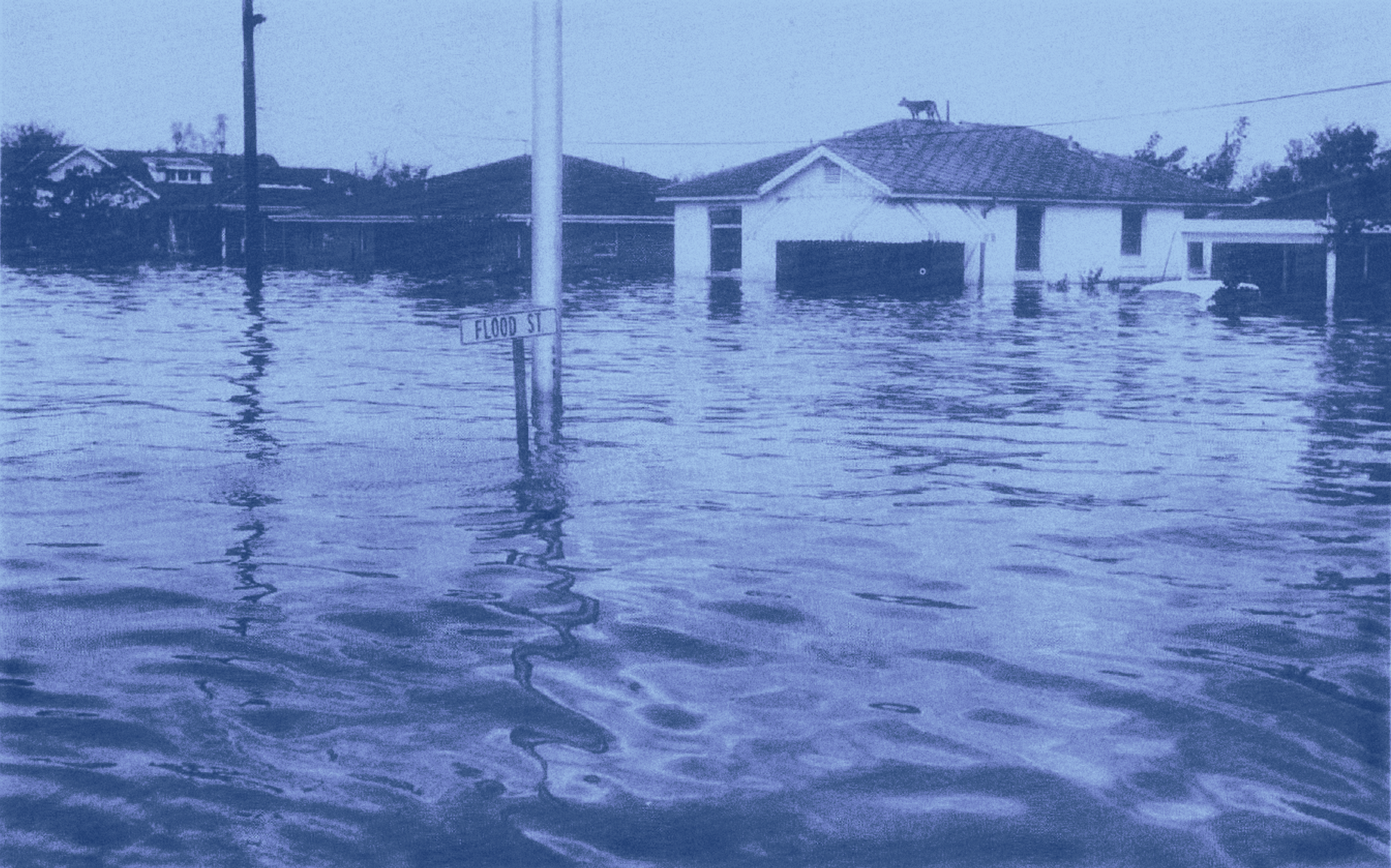
High tide flooding in New Orleans during Hurricane Betsy, 1965.
U.S. Army Corps of Engineers, New OrleansSo one could imagine conversations in state halls of power as plans were drawn up for Meta’s new Hyperion data center in northern Louisiana. A vast project, intended to grow larger than Manhattan, it has already significantly disrupted the lives of local residents as trucks ferry endless tanks of natural gas to slake the facility’s insatiable thirst for fuel. Estimates suggest that Hyperion will consume nearly seven times as much power as the city of New Orleans uses on a daily basis. To effectively keep the center’s spectral lights on will require the construction of at least seven new natural gas plants.
There are no adequate words to express what a self-defeating strategy it is to save Louisiana by tying it more deeply to an energy system that has already destroyed so much of it. Any new plants will be expected to run for decades to turn a profit, kneecapping dreams of a solar-powered state. But the truth is that Meta has learned the same dispiriting lesson that energy companies have known for a long time: Thriving local communities are hardly necessary for the continued accumulation of wealth. Floating rigs or LNG export terminals and data center ghost towns—papered over with some empty talk about creating jobs—are the flip side of an all-too-familiar coin.
If that didn’t sound bad enough, there’s also the fact that SpaceX, some days the most valuable company in the world, has announced plans to invest $100 billion into building new spaceports along the coast of southern Louisiana. A showy, high-definition announcement video on the company’s website begins with a small boat crawling through lush wetlands. Where there used to be oil exploration, there will now be space exploration, the ad enthuses: another turn of the screw for an already diminished coast.
Will there be land enough to sustain the undertaking? SpaceX promises that its operations won’t negatively impact local ecosystems. The company also insists it will fund coastal restoration—although the Master Plan’s sediment diversion was fully funded through oil industry legal settlements, and that did little to save it. Because a law signed by the governor exempts aerospace companies from public review, we may never know either way. (SpaceX’s record of protecting environments in Texas is, however, less than sterling.) But dreams of colonizing other planets seem to concede from the outset that the land here will disappear and that it’s time to start looking elsewhere. Perhaps it’s easier for some to imagine relocating humanity to Mars than relocating sediment to save New Orleans.
I’ve come to think that no matter how directly you look, you tend to see things askew down here: As roads and homes sink slowly downwards throughout the city, it’s rare to glimpse neat, parallel lines. We didn’t place an offer on the house. This summer, my partner was diagnosed with cancer, which put a hold on a certain kind of long-term thinking. Fortunately, her prognosis is a good one—and we wanted a bit more space for the dog anyways. But where will all of this end?
Maybe one day the residents of New Orleans, inhabitants of an island ringed by artificial levees, will look up to watch rockets firing off, ferrying adventurers to new planets, new solar systems. Maybe my children will drink hurricanes in the backyard, below sea level, in America’s sinking Venice, as spaceships reach for the stars. Many have suffered and toiled here for centuries to see far less.
But my own hope is a different one: What if we saw the ocean surging ever closer to one of the most remarkable and irreplaceable cities on the planet and found, instead of business as usual, a revolutionary clarity? That things cannot continue as they have, that we must be better than we hoped or expected to be, and that our work began yesterday. Cities have lifespans, we are learning, just like people. And the fact that we may lose them later does not mean we should love them any less now. Quite the opposite. We might have another century of New Orleans—maybe more, maybe less. Whatever the fate of this city, we should hope to tell future generations that we did not waste its lessons. ♦
Subscribe to Broadcast