The Secret Lives of Oceanic Manta Rays
An oceanic manta ray gliding effortlessly above.
Photo: Patrick JoyceForty-five feet below the ocean’s surface, we clutch at underwater rocks to avoid being swept away. The force of the Humboldt Current—the swift, cold, nutrient-rich underwater stream that flows north from Antarctica along the west coast of South America—is blasting us like a fire hose. Inches from our scuba masks, purple-and-orange striped starfish cling to the rock with thousands of suction-cupped tube feet. The faces of blennies, small fish with big eyes, pop from holes, gape at us, then dive back down. Bright fishes flash by—streaks of yellow, blue, orange, red, and black—and then disappear into a cloudy haze.
We can see only a few yards around us. Our vision is obscured by a blizzard of miniature algae and tiny animals: shrimp-like krill, shorter than pencil erasers; see-through baby jellyfish; Jell-O-like salps; and creatures smaller than motes of dust. These are the floating plankton that nourish everyone from half-inch anchovies to 40-ton humpback whales. We are literally immersed in a sea of life. The conditions that make scuba diving here so challenging—the cold, the murk, the current—are what draw to these waters some of the most extraordinary creatures on the planet.
Even in our neoprene hoods, gloves, and seven-millimeter-thick wet suits, we are starting to get cold. Still, we wait. I look for one of the scientists to signal us. Though they are only a dozen yards away, I can’t see them through the plankton soup.
And then, above me and to my left, somehow I feel it before I see it. From the edge of my vision, in the liquid fog, a dark shadow gathers itself into the flattened shape of a giant flying carpet. It’s bigger than our boat is wide. It weighs thousands of pounds. As it approaches, it looks like an alien spacecraft about to make a landing. With impossible grace, it seems to fly toward us in slow motion on triangular wings spanning maybe 15, maybe 18, maybe 20 feet. We gaze up at a white belly, flecked with dark spots and scored with the gill slits of a fish. A long, whiplike tail trails behind. The creature turns and disappears back into the watery mist.
But a moment later, the animal circles back. It flies in closer this time—close enough for me to observe that the strange paddle-like fins at the front of its head are furled, like a towel you twist to wring dry; close enough to spot two large, dark remoras—hitchhiker fish—attached by their suckers to the creature’s bright belly; close enough to see the two long, tubular structures near the tail called claspers, marking him as a male. And then something even more extraordinary happens. As he passes overhead, I see, at the base of his head fins, his big, dark eyes. I can see the eye closest to me swivel in its socket and lock on to my face.
Contact—with an oceanic manta ray: one of the largest, most mysterious, and most endangered creatures in the ocean. The scientists who study them were right. Once you meet one, your life will never be the same.
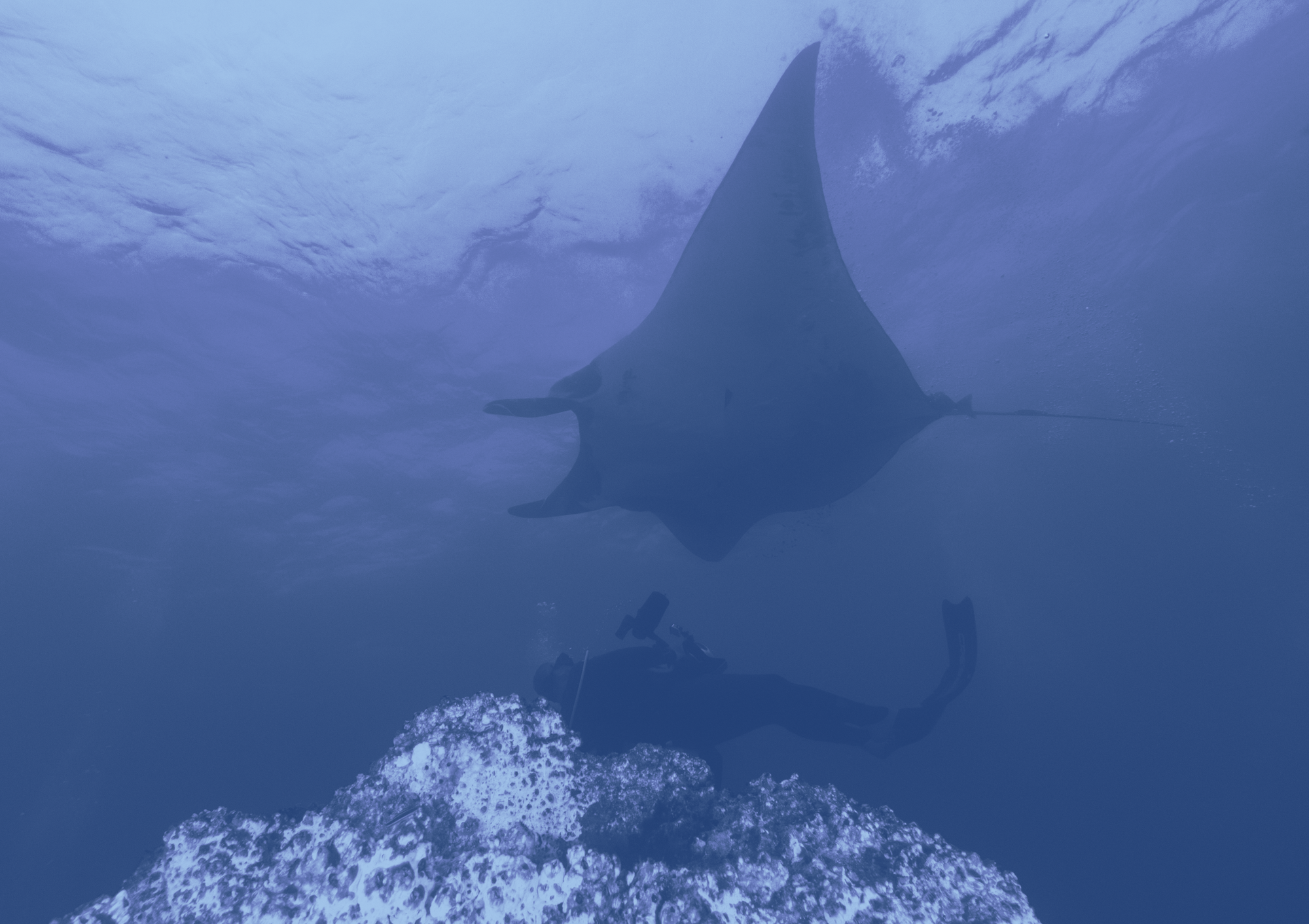
Michel Guerrero communes with an oceanic manta ray.
Photo: Patrick Joyce, Courtesy of Michel Guerrero*
I know well the power of the ocean and its creatures to change a life. This happened to me in March 2011, when I met Athena, a giant Pacific octopus. When the keeper opened the lid to her tank at the New England Aquarium, Athena and I locked eyes—and then, with her elastic, suckered arm, she reached for my awkward, jointed one, and we touched. Athena was clearly as curious about me as I was about her. She opened the sea to me.
Prior to our meeting, I had spent a career traveling the world, from the Amazon rainforest to the Congo Basin, writing articles, scripts, and more than 25 books about animals—all of whom lived on land or in fresh water. But now, I would spend three years getting to know and love the sea creatures at New England Aquarium, researching what would become my book The Soul of an Octopus. It was to meet their wild kin in the open that inspired me, at age 50, to learn scuba. Finally, I began to grasp the truth of our planet: while 70 percent of the globe’s surface is covered with water, the ocean holds more than 90 percent of its habitable space—a space full of creatures who, in ways we recognize and ways we don’t, think and feel and know, and who surely love their lives as we love our own.
Not every sea creature has an interest in connecting with humans. Not every species looks you in the eye the way the octopuses I came to know looked into mine. But oceanic mantas do. Spanning up to 20 feet, these huge animals can live for 50 years, and they have the largest brains of any fish on the planet. They often approach divers out of pure curiosity.
Other times, I learned, they come asking for help. Those who can still swim while partially entangled in fishing gear or pierced by hooks will often approach divers, slowing their speed so the humans can help.
And fishing gear is only one of the problems besetting these highly intelligent, balletically graceful, and critically endangered creatures. Once I learned of their plight, I began planning my own careful, curious underwater approach.
*
In a van loaded with our scuba, photography, and scientific gear, marine scientist Michel Guerrero, photographer Patrick Joyce, his wife, Deb, and I had traveled south for two hours from the big city of Manta, over winding roads through dry tropical forest and cloud forest, past seaside mansions overlooking sandy beaches and shacks selling fresh fish and coconuts.
For the next two weeks in August and September of 2024, the fishing village of Puerto López, on Ecuador’s Pacific coast, would be our home base. With Michel and two other research scientists soon to join us from Costa Rica, we’d be scuba diving among the largest aggregation of oceanic manta rays in the world—a gathering that was completely unknown to divers and scientists until Michel, then working as a divemaster and dive instructor, discovered it in 1996.
“It’s clear that something different is happening here,” says Joshua Stewart, an assistant professor at Oregon State University, who has studied these mantas with Michel. The number of the mysterious giant rays that gather here may be 10 times that of any other place in the world. Though these mantas can be found in all but the coldest of the world’s seas, they are sparsely distributed in remote, offshore areas—and their populations are crashing. They are endangered throughout their range because of overfishing both legal and illegal, because they get entangled in fishing gear, and because of a shady belief that their gill plates—feathery structures inside the gill slits that strain their plankton food—have curative powers. This combination of factors could wipe out oceanic mantas across the world.
That’s what makes this site, and Michel’s work here, so crucial. The discovery of this place “is so important because it gives us a rare chance to study these animals in one of the few areas we can actually find and study them,” explains Guy Stevens, founder of the UK-based Manta Trust, devoted to research on the hundreds of different species of mantas worldwide. “We have very little data about this species, but we know their populations are declining so fast they could be gone in a generation or two. Here we have a rare opportunity to learn more about them so we can help.”
*
We check our air tanks. As we tug on our gear—wet suits, booties, gloves, hoods, fins, tanks, et cetera—Michel has a few last words for us before we dive. “Remember to equalize all the way down,” he says—holding the nose closed with one hand while gently blowing will protect our ears from painful pressure changes, like you sometimes get on a descending airplane. “This will be a 90-foot (27meter) dive.”
Diving so deep, we may see other rays on the bottom: diamond stingrays, who defend themselves with a venomous tail spine. Torpedo rays, who can emit electric charges of 220 volts—twice that of an electrical outlet. But of course we are longing for the gentle giants, who, despite their huge size, are harmless. Michel is confident: “I know we’ll have manta rays!” he insists. “I feel the manta energy!”
We enter the water not by walking off a plank, but with a back roll off the boat. One by one, we flip, bob to the surface, and at Michel’s signal, descend by letting air out of our vestlike buoyancy control devices. We hand-over-hand down the rope to the anchor at the sandy bottom.
It’s incredibly murky. Animals and algae too small to see cloud the water like dust. Bits of larger plankton float by. Something stings my cheek. Following Michel, kicking hard with our long fins, we glide over the sandy bottom, marveling at the stingrays beneath us. We arrive at the big rock. We’re relieved to stop here and hold on while we watch. A big green moray eel pokes his head from a hole. Because morays lack the gill covers of most fishes, they all open and close their mouths to breathe, revealing their impressive, pointy teeth. A blue starfish seems glued to the rock next to my hand. Deb points out a tiger snake eel—yellow with black spots.
We can’t see Michel, but soon we’re aware of the manta rays’ presence: enormous dark shadows slide by, ahead and above us. We don’t get a very good look. We’re still sorting out the diving. When I first entered the water, I discovered the air in my tank had been shut off. Deb’s mask kept flooding. Patrick knows that, because of low visibility, he didn’t get a good shot.
But we did see them. Though dark and distant, they are here.
*
These majestic, mysterious creatures are not always so easily found. Compounding their endangerment, they move in unpredictable ways. To discover where the mantas travel, Michel has enlisted the help of Costa Rican scientists Jeffry Madrigal and Carolina Martin and Ecuadorian assistant Duber Delgado to photograph, video, and attach telemetry to the animals to enable tracking.
As the engine stills, he screws together the three parts of his harpoon. It will release the transmitter dart like an arrow when he pulls a long string, as a trigger.
“The idea is to go to Roca Honda, and all of us stay there till there is a manta,” Michel explains. “I will go above the manta and try to tag. I will then go back to the rock, and Jeffry will try to take a tissue sample.” The sample is useless unless we know who it came from, so Carolina’s and Michel’s videos are essential. Everyone’s efforts must be carefully coordinated to record the date, time, depth, and still photos of the animal whose tissues are sampled.
At 11:30, the scientists have descended to the bottom; Deb and I are 30 feet below the surface, still going hand-over-hand down the anchor rope. We haven’t even had a chance to start toward Roca Honda before a manta swoops toward us from the murk.
It’s a light-colored male, about 11 feet across, with dark blotches on his white belly. He’s just 15 feet (4.5 meters) away from us. With a few kicks from his long fins, Michel shoots up above the fish, aims his harpoon toward the manta’s right shoulder, and releases the trigger. The titanium dart slides just beneath the surface of the manta’s skin. The fish doesn’t even flinch. A torpedo-shaped transmitter now floats above the dart, tethered to the manta on a foot-long rope (which Michel assures us does not pose an entanglement hazard, as it’s too small)—ready to transmit his position to the ARGOS satellite each time he comes within a foot of the surface.
Michel, Carolina, and Duber caught it all on camera, both stills and video. The entire procedure took less than two minutes.
With most of our air supply untouched, we pull ourselves against the current toward Roca Honda. To our astonishment, the male we just tagged follows us. And as we reach the big rock, we spot a new manta, a female trailing a colorful entourage of butterfly fish and angelfish. She’s huge—at least 16 feet (5 meters) from wingtip to wingtip—and Jeffry’s harpoon quickly snatches a biopsy from her, too. And like the male, she is unperturbed. Clinging to the rock, we feel like we are caught in some kind of spell: while whales sing in the distance, two mantas circle us overhead, round and round, a living carousel, eyeing us with benign interest.
The female eventually swims off and the male, at first, follows her. But then, he turns—and comes back to us! Jeffry waves at him, like you would at a friend. I instinctively raise my arms up toward him, like a worshipper in church. Later, Michel tells me he found himself whispering the words te amo: “I love you.”
Time stands still. We are absorbed in the strange beauty of this supremely graceful, liquid creature. The current, oddly, does not feel as strong as usual. The visibility is better than we have encountered so far. And the manta is close—so close it seems we could reach up and touch him. I can count nine spots on his white belly. His head is black. When his wings sweep down, we see the black top surface is edged with white—possibly scar tissue from an encounter with a fisherman’s net. We watch his strange cephalic fins curl and straighten. Sometimes one is rolled up and the other unfurled. Clearly, curling the cephalic fins makes the manta more streamlined. Unfurled, the paddle-like structures can sweep plankton into the mouth. But why is one rolled and one unfurled?
Is the manta sensing us? Is he greeting us? Asking a question? I wonder what it feels like to have fins on your head. I wonder what the manta is thinking.
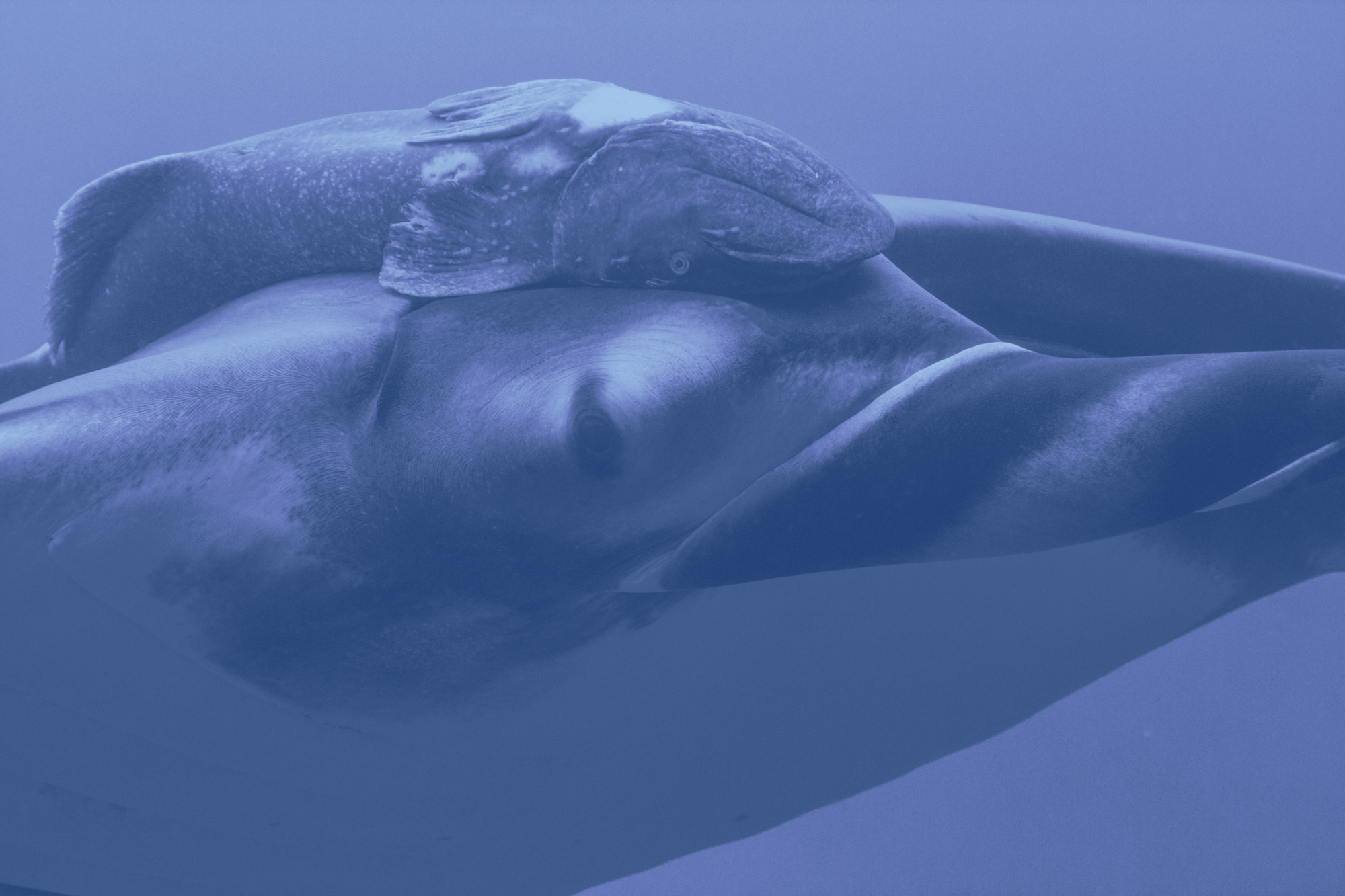
Direct eye contact with the curious manta ray, with a remora perched just above the creature's eye.
Photo: Patrick JoyceHis eyes are dark, dark black, like a hole in space, and they seem to lead to some deep place. In fact, tags like the one he now bears have shown these fish can dive so deep they reach ocean zones that harbor almost unimaginable animals, creatures with names like sea spiders and sea pigs and basket stars. One of the meanings of deep, “profound,” showing great understanding or knowledge, accumulated through time, could well be true of these animals, too. The first manta rays are thought to have evolved 20 million years ago. Their kind has seen the continents drift, the climate warm and cool, the ancestors of humans evolve from tailless monkeys who lived in the trees to creatures who clog the vast oceans with our plastics and poisons, noises and nets.
Michel takes me by the hand to carry me upward, so the manta ray is just a foot away. His black eye swivels to look at my face. Who am I to be worthy of his attention? I am flooded with awe.
Even after our tagging and sampling, the male manta stays with us—bubbling, awkward monkeys holding big sticks and huge cameras that must look like giant eyes. Do they think we are super cleaner fish? Do they hope we might remove their parasites? Do they tolerate us for the feeling of our bubbles against their skin?
Deb finally remembers to look at her pressure gauge to check her air. She’s running low, so she signals it’s time to surface. I check mine: oddly, especially for a new diver, I have plenty of air left. During this encounter, my breathing slowed remarkably—almost as if time really did stand still.
As we rise, we’re astonished to see that the male remains with us. He continues circling, now below us—where our bubbles do not reach. Why has he stayed with us? Perhaps we are all, fish and human, equally mesmerized by the strangeness, as well as the sameness, of the other. ♦
Excerpted from OCEANIC MANTA ADVENTURE: SAVING THE ANGELS OF THE SEA by SY MONTGOMERY and PATRICK JOYCE. Copyright © 2026 by Sy Montgomery and Patrick Joyce. Excerpted by permission of Clarion Books, an imprint of HarperCollins. All rights reserved. No part of this excerpt may be reproduced or reprinted without permission in writing from the publisher.
Subscribe to Broadcast