A Library of Oceanic Feelings
Alexandre Cabanel, The Birth of Venus, 1875.
Courtesy of The Metropolitan Museum of ArtAs one of those people who only feel well by the ocean, I’ve long followed the trail of oceanic feelings—that sense of eternity or limitlessness, the connection to something larger—and been perplexed by Freud’s confession that he could find none of this in himself. Oceanic feeling was as closed to him as music. He admitted this in a letter to his friend Romain Rolland, whose reflections inspired the term and prompted the opening pages of Civilization and Its Discontents, where Freud wrestles with the idea that an “oceanic feeling” binds people to religion through a lived sense of something immeasurably greater than themselves. He professes complete bewilderment, even as he speculates that such a feeling might preserve the earliest intimacies of infancy, a return to oneness with the maternal, or perhaps belong to that region beyond the ego where it brushes against the immensity of the id. But ultimately he remains suspicious, worrying that the experience has more to do with an infantile longing for a protective and omnipotent father.
Poor Freud. The great explorer of the unconscious could find no feeling for that oceanic depth: its vortices of power, its vast and rhythmic flow, its unknown origins, nor for the other life it reveals beyond our paltry shores. Yet I never wanted to dismiss Freud as others have, explaining away his difficulty through character assassination, or asserting that he was simply too rigid, too enclosed, too fixated on fathers and laws and languages—land, territories, cultures—to open himself to that great engulfing maternal flow, no doubt more musical than sensible. Freud, they say, had a mother problem.
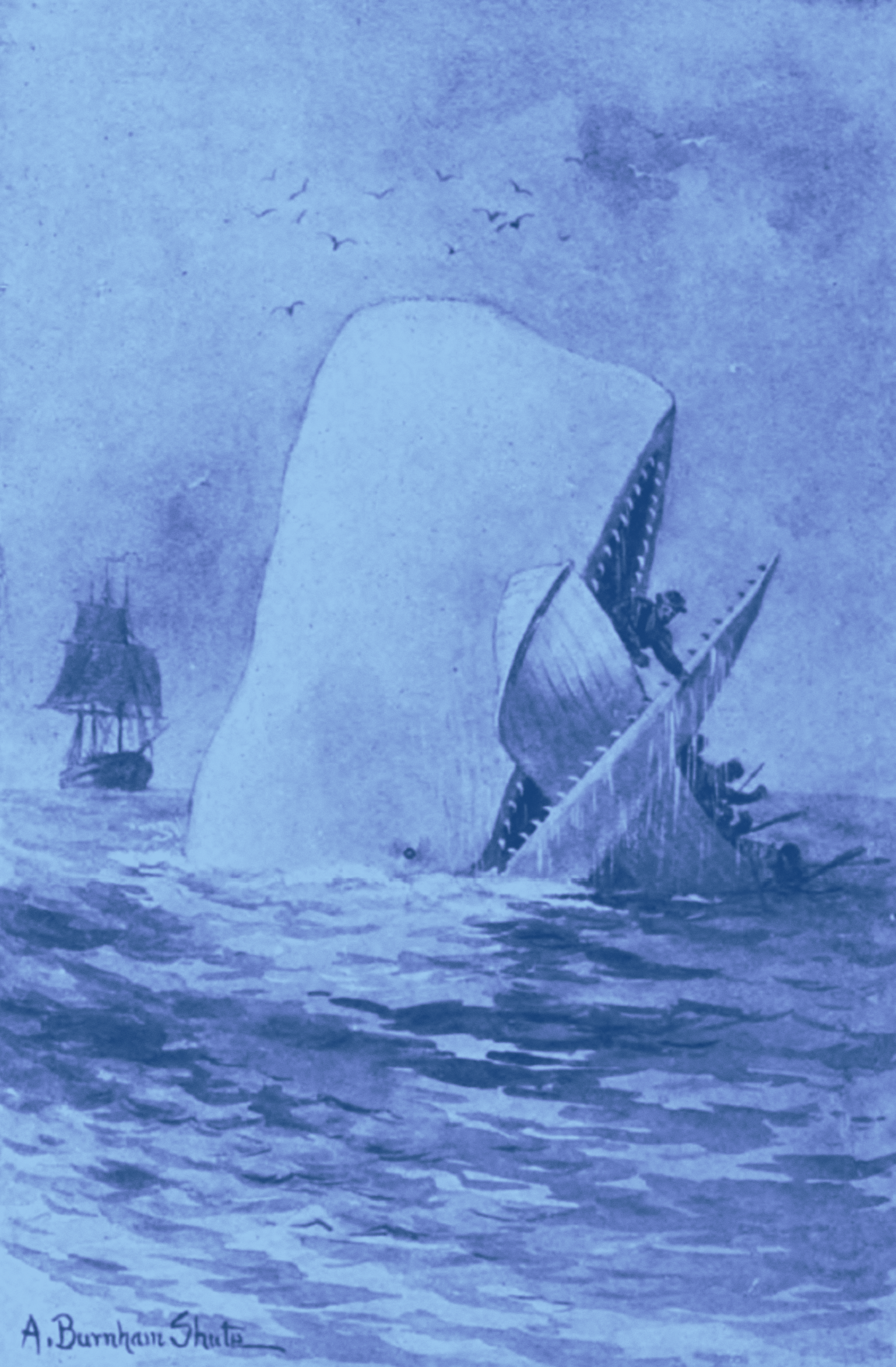
Augustus Burnham Shute's illustration from an early edition of Moby-Dick, 1896.
Courtesy of Wikimedia CommonsHow to make sense of such a cavernous difference of sensibility? I already feel a little suspicious of people who prefer mountains—or, God forbid, lakes—to the sea. In homage to the opening of Moby-Dick, I decided to become a kind of “Sub-Sub-Librarian,” assembling a library of oceanic feelings in psychoanalysis and chasing them like the white whale. The results are, at best, higgledy-piggledy, with no true gospel and certainly no complete account. They are simply traces of a feeling that psychoanalysis has never entirely known what to do with, gathered from many analysts, in many languages, across many shores.
*
I was recently surprised to find, in a case of Freud’s I’ve read a dozen times, a reference to a repetitive dream I had not remembered. In Fragment of an Analysis of a Case of Hysteria, Freud wanted to demonstrate that no dream is identical, even (or especially) when patients feel they are. The devil is in the details:
A patient told me that she had her favorite dream the night before and that it always recurred in the same form: She had dreamed of swimming in the blue sea, of joyfully cleaving her way through the waves, and so on. On closer investigation it turned out that upon a common background now one detail and now another was brought out; on one occasion, even, she was swimming in a frozen sea and was surrounded by icebergs. This patient had other dreams, which turned out to be closely connected with the recurrent one, though even she made no attempt to claim that they were identical with it.
As I read this, I felt as if I had never read it before. As if the passage had been previously redacted. How could that be possible? Even stranger, I’ve always dreamt of swimming—and these have been my favorite dreams. My analyst once remarked that water appeared to promise unmitigated enjoyment, with a sardonic nod to the idea that there is no such thing. Especially when it comes to the sea, which is as pleasurable as it is full of consequences . . . Hmph.
Years before his exchange with Rolland, Freud was already keyed into the watery symbolism of the maternal, despite his own lack of oceanic feeling. He mentions these dreams in relation to what Dora describes as her most urgent and unpleasant sources of distress: a sense of danger and lostness in her life, a claustrophobia in her family, and the feeling of being dismissed by the adults around her. These joyful dreams of navigating the sea and cutting through the waves seem to promise a way out, another way of being. They appear in a chapter specifically about fire and water, where fire is a problem of the family, of houses with locked or unlocked doors, amidst dangerous, combustible conflicts. Water, by contrast, points elsewhere: toward sexuality, fluids, longed-for exchanges, maybe even buoyancy. Is it such a problem that the recurring dream feels like one dream to its dreamer when, in fact, it is many, with a complicated set of variables?
Freud tends to speak to landlocked conflicts of sex and aggression. We women are certainly working on something else with our oceanic feelings. To swim is to remain in relation to a medium we only belonged to once, when we were inside our mothers. One moves through water but cannot live there. An awkward imitation of a prior condition nevertheless promises us something enigmatic ahead, something that isn’t this life on land.
Importantly, Dora’s mother is entirely erased, not necessarily by Freud but by everyone. Dora is working to recover her, to rescue her from the waters of oblivion. The father, meanwhile, persists even in death. Perhaps predictably, Freud was fond of these lines from Shakespeare’s The Tempest:
Full fathom five thy father lies;
Of his bones are coral made;
Those are pearls that were his eyes:
Nothing of him that doth fade,
But doth suffer a sea-change
Into something rich and strange.
The killing of the father by his sons at the dawn of patriarchal civilization creates our first social contract, even as it sacralizes and justifies murder. In his Totem and Taboo, Freud sketches the origin story he would become most well-known for—a story that tells, characteristically, not of a maternal issue, but a paternal one.
The father lives on, improperly mourned. Religions organized around fathers and sons always leave the mother (indeed, women) in the background: an erasure for sure, but also a protection from this compulsive reanimation, these repetitive cycles that require work to transcend. Patriarchy installs omnipotence based on the idea of an uber-Daddy—the source of crime, sin, guilt, punishment, laws, and transgressive wishes. We try to kill the father, but that just ingrains him further, in ever stranger genocidal visages. He is the ultimate living-dead substance, a little like coral or pearls. Full fathom five thy father lies. One could see this as Freud’s way of obliquely protecting the mother. I can almost hear him saying, “Don’t make your mother guilty of this problem. Let her waves roll on. Look elsewhere.”
Dreams of water for Freud always signaled birth, despite his anti-oceanic feelings. His youngest and most revered colleague, the psychoanalyst Otto Rank, posited that while the longing for “oneness” may be a memory of uterine life and birth, it is also a calling for rebirth. All of us must be born at least twice, biologically and socially. Freud was concerned with this social birth. Humans must find their way through inevitable conflict—in language and in society with one another—and not simply run away from it.
Rank eventually agreed with Freud about the importance of the father, while also rejecting a full regression towards the mother through the unconscious or the dream of unity. Nevertheless, despite so many concessions by Rank, the father and son fell out with one another over this watery maternal question. Freud decided Rank was advocating for a shortened, problematic treatment, one that sought to abreact or correct birth trauma and nothing else. He went on to expel him from his inner circle, declaring Rank manic-depressive. Ouch.
Melville’s world of seamen had forsaken life on land. They maintained something broken—splintered hearts, Melville called them—in relation to civilization. Maybe they were hysterics, too? Did Freud insist on playing the father, refusing to give in, by not giving up on life on land, not dreaming otherwise? Should we have asked him to dream more oceanically? Can we still search for something older to get beyond this world of the father? Or must we simply charge ahead with what we’ve inherited?
*
In his introduction to Civilization and Its Discontents, Freud says:
I cannot discover this "oceanic" feeling in myself. It is not easy to deal scientifically with feelings. One can attempt to describe their physiological signs. Where this is not possible—and I am afraid that the oceanic feeling too will defy this kind of characterization—nothing remains but to fall back on the ideational content which is most readily associated with the feeling . . . "We cannot fall out of this world." That is to say, it is a feeling of an indissoluble bond, of being one with the external world as a whole. I may remark that to me this seems something rather in the nature of an intellectual perception, which is not, it is true, without an accompanying feeling-tone, but only such as would be present with any other act of thought of equal range. From my own experience I could not convince myself of the primary nature of such a feeling. But this gives me no right to deny that it does in fact occur in other people. The only question is whether it is being correctly interpreted and whether it ought to be regarded as the fons et origo of the whole need for religion.
We cannot fall out of this world! Freud even goes on to say that the wish to fall out of this world, no doubt from the rather narrow confines of the ego, certainly exists. The ego was forced to separate itself off from everyone and everything, but the wish is a wish for an even greater and limitless narcissism, not a diminished one. We should be wary, because really it’s a disguised wish for another omnipotent father. In wishing for an even greater father, we are no doubt killing the ones all around us, because we envy them as much as they disappoint us and we want revenge. Some of Freud’s friends implored him with their knowledge of yoga and breathing techniques, moving towards states of mysticism and ecstasy. Freud was rather unimpressed.
“Let him rejoice who breathes in this rosy light,” Freud quotes Schiller from his poem “The Diver.” In the poem, a page is forced to dive into a whirlpool to retrieve a golden goblet for a king. He returns, having glimpsed the unknowable, monstrous world beneath the waves, and warns against trying to master anything of it. The King, of course, is annoyed and sends him back in, killing him. Freud didn’t want to merge with this limitlessness. He did not want even to be tempted by it. There are days I find myself agreeing with him more than I’d like to admit, watching how readily our present moment reaches for its own versions of limitlessness and calls it liberation. And yet, I think we ought not give up so heartily on mysticism and transcendence.
*
Individual observations of the symbolism of dreams and neuroses reveal a fundamental symbolic identification of the mother’s body with the waters of the sea and the sea itself on the one hand, and on the other with “Mother Earth,” provider of nourishment. Now such symbolism might be expressive of the fact not only that the individual lives on the mother before birth as a water-inhabiting endoparasite and then for a longer time after birth as an air-breathing ectoparasite, but also that sea and earth were actually the precursors of the mother in the development of the species, and at this stage took the place, in that they protected and nourished these animal ancestors, of the maternal protective adaptations which were acquired later. In this sense the sea symbolism of the mother would approach a more archaic, more primitive character, while the earth symbolism would pattern upon that later period in which the fish, set down on land in consequence of the recession of the ocean, was dependent upon the sources of moisture welling up from within the earth as a substitute for the water of the sea which it had lost (and which had simultaneously brought it its nourishment as well), and in a favorable environment of this kind could lead a parasitically vegetative existence, so to speak, until its metamorphosis into an amphibian was achieved.
—Ferenczi, Thalassa: A Theory of Genitality
Hungarian psychoanalyst Sándor Ferenczi—a patient of Freud and one of his closest disciples—radicalizes the intuition about the ocean and the amnion. In Thalassa, he asks us to imagine not simply our individual past in the womb, but something much older: a world in which all of life unfolded in water before catastrophe forced it onto land. The womb, then, is already a repetition. Before there was a mother, there was a sea.
Ferenczi imagines evolution less as progress than as adaptation under duress. As the oceans receded, living creatures were compelled to invent lungs. Breath is not the mark of our superiority but of our exile. We breathe because we could no longer remain immersed.
This changes the meaning of the oceanic feeling—intentionally so, as Ferenczi was intervening in the fight between Freud and Rank. He wanted Freud to see that Rank’s ideas were not as incompatible with his as they seemed. The oceanic is not simply regression to the mother. It is homesickness for a mode of existence before breath, announcing our dependence on the world outside ourselves with every inhale. We may leave the womb but we are still dependent, first on our caregivers and then on our societies.
Importantly, evolution never abandons its earlier forms. Mammals return to the sea—not by becoming fish again but by adapting into whales and dolphins, creatures who carry lungs back into water, transforming breath into song and echolocation. Earlier forms persist inside later ones. Nothing is ever entirely overcome. Here we might hear Rank’s insistence that we have to constantly be “reborn.”
Breath is meant to disappear from consciousness so that we can live. It announces itself only when disturbed. The sea is often imagined as a world before this disturbance, a fantasy of effortless immersion. Ferenczi reminds us that this fantasy carries catastrophe. Today, as coastlines disappear and rising waters redraw the map of the Earth, the ocean returns with a different face. It is no longer simply the site of origin or longing. Conscripted by human cataclysm, it becomes an agent of history.
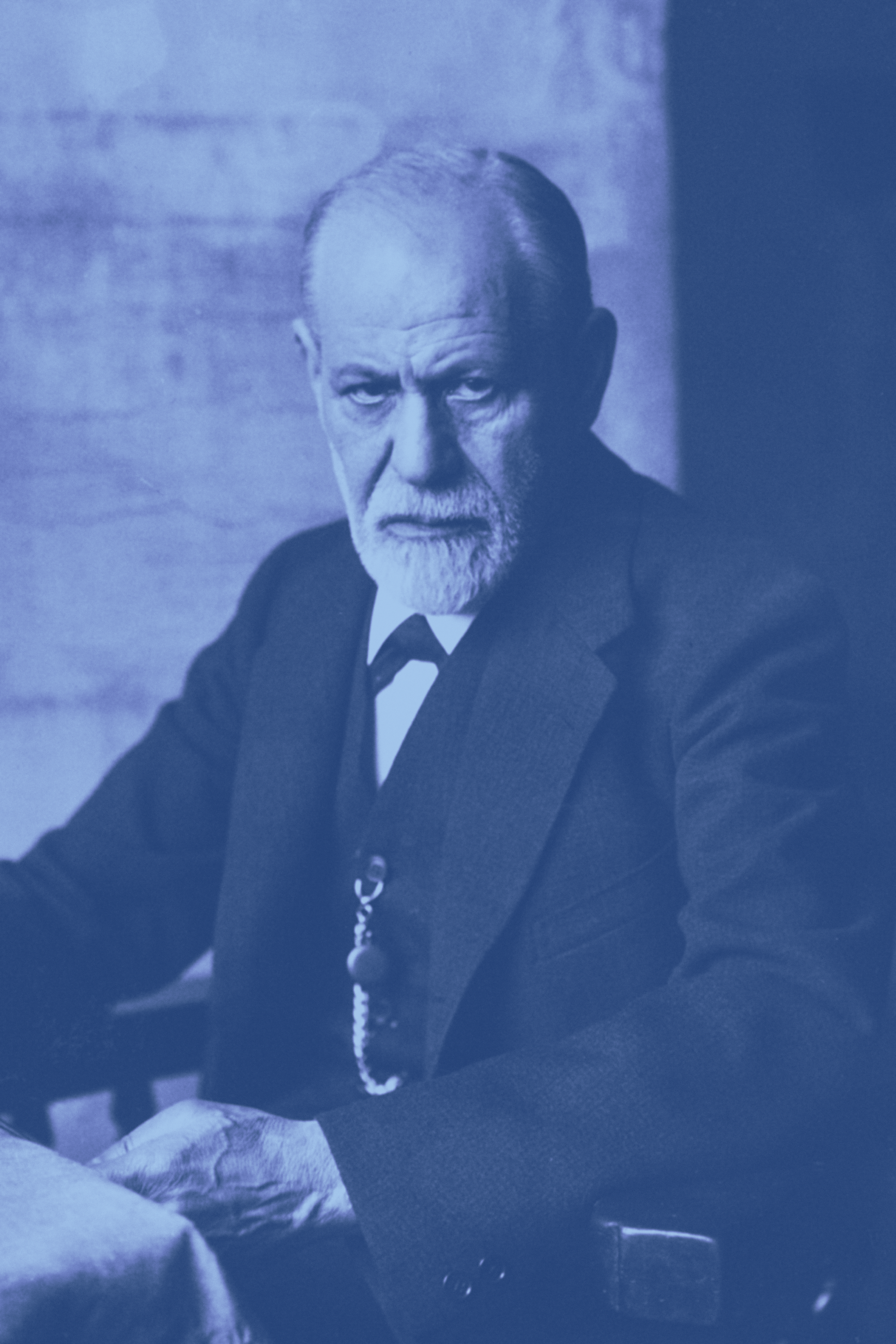
Sigmund Freud, 1926.
Photo: Ferdinand SchmutzerFerenczi imagined catastrophe forcing life out of the sea. We increasingly imagine catastrophe carrying us back toward its tides. Perhaps this is why the oceanic feeling, in an age of climate crisis, has become newly difficult to think about. The concept now contains both nostalgia and dread. It promises shelter and threatens inundation. It remembers our earliest home while hinting that we may have made it uninhabitable.
*
Princess Marie Bonaparte, great-granddaughter of Napoleon, lover of Giacometti, and rescuer of Freud from National Socialism (she was originally his patient), founded important psychoanalytic institutions in Paris and was a key figure in the development of French psychoanalysis. Her paper titled “The Legend of the Unfathomable Waters,” published in 1946, gathers together folktales about water that must not, at all costs, be swum in, whose bottom is unreachable and deadly, and whose surface appears eerily still; she reminds us that these waters are, of course, the mother: the one who was there in the beginning and who will be there to embrace you at the end. But this is not the mother who smiles and brings you to life. It is the enigmatic mother, whose anger has not yet manifested. Bonaparte calls this mother and these waters the “sleeping mirror.”
Aphrodite, the Goddess of Love, the incarnation of the sovereign Libido, emerged from the foam of the ocean’s waves, not from the smooth mirror of a pond, since the rolling salt-waters lend themselves better—the Sirens notwithstanding—for representing the function of the Mother as the giver of life than the fresh water and especially the inland ponds . . . Death adorns himself with the hope of repose, of the same repose which the child enjoyed in the depth of the mother's body, for which man whom life disturbs and torments, keeps an eternal unconscious nostalgia. The smile of the mother, the unforgettable smile whose countenance treacherous death borrows, seems, under the mirror of the sleeping water, to call the children who have remained under her fascination.
Bonaparte was interested in the hidden space of a female body. I like that this space, connected to the powers of creation and a mother’s different visages, is imagined as tumultuous— characterized by rolling and roiling waves rather than the smooth, reflective surface of water. The latter, for Bonaparte, is only fascination, nostalgia, and death.
*
Marion Milner, part of the British Independent, or Middle, Group of psychoanalysts that included Winnicott and Bion, turns to breath and the ocean in her search for feelings of aliveness, creativity, and being oneself. These are best encountered for Milner in solitude, away from the pressures of society. She likes the way that artistic acts, meditation, and psychoanalysis all point to a way of losing yourself: “to feel[ing] life pulsing through me, the big tides sweeping in, till I’m one with the immense surging fullness of the sea.” For Milner, it’s in the tidal momentum of breath and in the inkling of something very deep below awareness that queer things grow, swimming quietly as in the deepest reaches of the ocean. She even writes of island dwellers who become obsessed with logic, counting, and knowledge, which she considers to be the manifestation of their fear of the sea.
The scholar and psychoanalytic theorist Mari Ruti explores Milner’s seven-year project of self-discovery recorded in her book A Life of One’s Own, which W.H. Auden called “as exciting as a detective story.” In The Creative Self: Beyond Individualism, co-authored with Gail M. Newman, Ruti writes:
For Milner, the ego is mostly a nuisance to be outwitted so as to create an opening for the transcendent experiences that she is after. She therefore spends a great deal of time trying to figure out how to evade it, reaching the conclusion that the best way to accomplish this goal is to surrender herself to what, in Lacanian terms, we could call the jouissance of the real, but what Milner herself calls her ‘private sea of being.’ This private sea is an oceanic, watery, and at times even swampy space beneath her ego that is populated by water reeds and ‘the swaying weeds’ of her body’s "inner darkness." Milner’s private sea is therefore, first and foremost, a murky and mysterious place—certainly not the kind of place that first jumps to mind when we think of sublime, transcendent experiences.
By combining Milner with the French psychoanalyst Jacques Lacan’s notions of enjoyment beyond the ego, Ruti points to something feminine—not simply maternal—about this “sea of being.” For Lacan, patriarchy has pushed everything feminine out of its symbolic determinants, what Freud would later call a universal repudiation of femininity. This means that it is in those special ways of reclaiming what life on land takes from us (psychoanalysis is only one such method) that we regain access to this oceanic feminine immensity that helps us feel alive again.
*
Otto Isakower really only wrote one significant paper, and it’s a wild ride: “On the Exceptional Position of Auditory Sphere,” published in 1939. It gets us a little bit outside the characteristic psychoanalytic Mommy-Daddy problem, as the anti-Oedipus philosopher Gilles Deleuze liked to call it. And it’s probably my favorite text, an appropriate place to end our seafaring quest.
Isakower also brings us to another thorny question hiding inside the oceanic—the question of music. Isakower was born in Vienna and trained under Freud, part of a later generation of analysts than Ferenczi and Rank, only joining in the 1920s. Isakower asks about the development of the ear, its ties to the ocean as a fluid-filled organ responsible not only for listening but also for balance and movement in space. Language differentiates us from oceanic creatures; our ears’ sensitivity to music and pitch becomes sensitivity to ordered noises. Jacques Lacan, who incorporated linguistics into psychoanalysis, was particularly fond of Isakower.
His paper starts with shrimp. The crustacean, after molting, searches anxiously for grains of sand to place inside tiny sacs in its body. Without these foreign particles, it cannot orient itself. It needs to lodge these bits within its statocysts to know which way is up and which is down. Isakower begins his remarkable work with this curious experiment because the shrimp offers an image of what human beings eventually become. Something from outside must be taken inside in order for us to find our bearings.
The evolutionary twist is extraordinary. The organ responsible for balance and orientation becomes, in mammals, intimately joined to the organ of hearing. For Isakower this is not merely an anatomical coincidence. Speech colonizes an apparatus that once told creatures how to move through water. Long before the ear listened for language, it oriented bodies within a fluid world. Language does not replace that older function so much as inherit it. We learn to speak by allowing something foreign to settle inside us, just as the shrimp fills itself with grains from the sea floor. The external world becomes an internal compass.
Freud had already written that the ego is first and foremost a body-ego, acknowledging that our image of ourselves is first based on a sense of the body, even a projection of its totality. Isakower proposes something stranger: that the nucleus of the super-ego, that strange appendage, is the auditory sphere itself. The voice that tells us what is right and wrong, possible and impossible, is taken in by an organ that first evolved simply to tell us where we are. Orientation becomes judgment. Balance becomes morality. Grammar becomes a way of standing upright in the world. There is something beautiful, and something frightening, about this.
For Isakower notices that when this apparatus begins to fail, language changes before almost anything else. At the threshold of sleep, speech becomes elaborately grammatical before dissolving into murmurs. In psychosis, voices acquire impossible authority. In moments of mortal danger, Freud himself reported hearing the words, “Now it’s all up with you,” or “This is the end,” as though someone were shouting directly into his ear, while simultaneously seeing the sentence written before him. Isakower writes,
Just as the statement "the nucleus of the ego is the body-ego" has not merely a genetic significance, but is also fully valid for the finished structure, so the assertion "the nucleus of the super-ego is the auditory sphere" must also be confirmed in the fact that this aspect of the super-ego comes to light in certain circumstances. As the classical evidence for this we may bring forward the phenomenon which Freud referred to as the one which first suggested the conception of the super-ego to him: namely, delusions of observation. An essential element in these are alarming experiences in the realm of hearing: a keen awareness of cadences in the speech of the people around, an importing of deeper meaning into what is heard, falsifications of auditory perception and finally auditory hallucinations. The hallucinatory voices serve the purpose, among other things, of warning the sick person of the danger of being overpowered by the id. When the integrity of the personality is threatened from within, the super-ego reveals both its history and its genesis, that is, it reveals not only the way in which its nucleus arose but also of what its nucleus consists.
The super-ego announces itself not simply through meaning but through cadence. It speaks with the certainty of syntax. We obey because it sounds like truth before we have asked whether it is.
As children we borrow language to orient ourselves; later those borrowed voices become almost impossible to distinguish from our own. Eventually they persecute us, alienate us, and guilt us, inciting us to transgress all limits. The problem isn’t the sea, the problem is this flotsam brought inside and twisted, indeed perverted, into command. And yet Isakower leaves us with another possibility, though perhaps not one he intended.
We never entirely leave the sea, as we do the womb; rather, the sea survives inside the ear itself. The labyrinth remains filled with fluid. We navigate the world by means of a tiny ocean enclosed within our heads. Perhaps this returns us to Freud’s curious confession that he possessed neither oceanic feeling nor much feeling for music. Music asks the ear to become something other than an instrument of judgment. If language narrows hearing toward meaning, music widens it again toward rhythm, interval, breath, another’s presence, perhaps even that wild sound of the sea inside a conch. Lacan was interested in those sounds that seemed to bring judgement to an end and provide a sense of action or atonement, like the blowing of the shofar in Judaism or the conch blown for purposes of assembly, and in certain forms of literature and poetry less concerned with semantic meaning and more interested in a kind of taking in. Perhaps that is what I have been searching for in this library all along. Not the fantasy of returning to the mother, nor of escaping fathers and laws, nor even of recovering some lost oceanic unity.
Psychoanalysis has often mistaken choosing an alternative to authority for regression. But perhaps the alternative is simply another form of attention or listening. One that does not abolish language, but loosens its death grip, allowing us to hear, however briefly, that strange world of rhythm, breath, and relation from which language first emerged, and to which it occasionally—mercifully, musically—returns. The super-ego speaks as though it were the last word. The ocean never does. ♦
Subscribe to Broadcast