The Sea Before Us
Echinoderms, engraving by Jacques Renaud Benard, from Tableau encyclopédique et méthodique des trois règnes de la nature, vol. 2, plate 107, 1827.
Courtesy of the Biodiversity Heritage Library.The oceans, which gave birth to life on Earth, also continually generate simple, tiny beings that create and recreate the surface geology of the planet, including islands, mountains, and coastlines. This was the radical idea of Jean-Baptiste Lamarck, the French naturalist who coined the word “biology” (biologie) in 1802 and published the first theory of evolution in his 1809 magnum opus, The Zoological Philosophy. Lamarck was a revolutionary thinker who brazenly usurped God’s monopoly on Creation, ascribing it instead to mortal beings, down to the very humblest of them. Life began, according to Lamarck, not when God created the world, but when forces such as electricity and heat acted upon the elements of inanimate matter, spontaneously generating tiny, rudimentary beings—for plants, the simplest algae, and for animals, the globular infusoria visible under a microscope that he called “monads,” using a philosophical term derived from the Greek monas meaning “unit.”
Next, from the moment of its spontaneous generation, Lamarck believed that organic matter contained what he called the “power of life”: an upward striving tendency that drove living matter to compose, elaborate, and complexify its organization over time. This was a natural force like the forces of contemporary physics, such as gravity, electricity, or magnetism. A little over a century before Lamarck began developing his new science of life, Isaac Newton had described a universal tendency of common matter by which the planets gravitated toward one another, and toward the sun, and by which objects on Earth moved downward toward its center. Then, during Lamarck’s lifetime, people had been discovering the dynamic and fiery tendencies of electricity, which would move through some substances but not others, following metal or water, avoiding glass or wax, and could cause objects to attract and repel one another. The power of life as Lamarck conceived of it was a material force such as these others, specific to organic matter and characterized by its own defining property of elaboration or complexification.
Lamarck lived and worked in the Garden of Plants in Paris, carrying on steadfastly through an unending succession of upheavals: he began during the French Revolution, and continued through the tumultuous reign of Napoleon and into the Bourbon Restoration. He held the wonderfully named Professorship of Insects and Worms at the Garden’s Museum of Natural History and coined another new word for his assigned creatures: “invertebrates.” His course in invertebrate zoology, which he taught for over two decades, drew people from all over the world and became so famous that even fictional characters attended it: Sainte-Beuve, in his autobiographical novel Volupté, The Sensual Man, sent his lightly fictionalized doppelgänger, the lovelorn young Amaury, to Lamarck’s lectures, where he thrilled to the “passionate and almost painful tone” in which Lamarck raised “serious primordial questions.”
Lamarck traveled very little, never made an ocean voyage, and, as far as we can know, never actually saw the sea. It’s an extraordinary thought for the person who introduced the idea that the oceans were the “true cradle” of life. But his cabinet in the Garden of Plants was located at the seat of an empire, so he received specimens from all over the world, especially from its watery parts, brought or sent back by French explorers in the service of imperial expansion. These included corals, sea sponges, hydrozoans—small, predatory animals related to jellyfish and corals—and bryozoans, often called “moss animals” for the mossy appearance of their colonies. Lamarck especially admired some “extremely pretty varieties” of these that he had in his collection: purple and tawny white, funnel-shaped and tubular, with systems of delicate branches. He delighted in the rich colors of the marine organisms, noting another bright purple one, an organ pipe coral with “fringed tentacles of a beautiful green.”
One of the most remarkable creatures, in Lamarck’s estimation, was a jelly known as the “Venus girdle,” a long, gelatinous, transparent, ribbon-like being with iridescent edges, all milky white with glints of blue. Also, a starfish-like echinoderm known as a “brittle star” that uses its long arms to crawl along the sea floor. And from the Southern Ocean, a Spirula preserved in fluid, which Lamarck liked to show his students during lectures. The Spirula, colloquially known as the “ram’s horn squid” for its horn-shaped internal shell, or sometimes the “tail-light squid” because of a light-emitting appendage on its rear end, is a kind of cephalopod rarely seen because it lives so deep in the ocean. Lamarck was apparently the first to capture a likeness of the elusive Spirula: he made sketches of it in pen for his lectures, then had them engraved for the giant Encyclopedic Chart of the Three Kingdoms of Nature, for which he supervised some of the volumes on worms, shellfish, mollusks and corals.
Even the very simplest plants and animals—tiny, fragile, translucent algae and monads—contained the power of life. Lamarck wrote that these infinitesimal beings were continually being spontaneously generated: nature “begins again every day.” He judged that conditions favorable for spontaneous generation existed “exclusively in water or very moist places,” where these most rudimentary organisms were always found, so that “water is the true cradle of the entire animal kingdom.” As living beings grew more complex, another source of transformation came into play: their own responses to their environment. At first, these consisted of just a rudimentary sensibility or irritability and reflexive reaction. But more advanced animals, wrote Lamarck—specifically, birds and mammals—were capable of acts of will, forming habits in response to their surroundings. Through these habits, they transformed their bodies infinitesimally, then passed on to their offspring the tiny changes, which accumulated over the generations. The result was the striking fitness of each kind of organism to its environment, which earlier writers had attributed to a divine creator suiting every creature to its appointed place in nature.
*
Lamarck found evidence of the self-making of living beings everywhere, beginning with the ocean. For instance, he noted the contrast between the perpendicular fishes of the deep ocean, who have one eye on each side of their head, maximizing their lateral vision, with the fishes that swim in shallow water near the beach. These are obliged to swim on their flattened surfaces, receiving more light from on top than beneath; they also have a particular need to focus on what’s happening above them. The constant effort of looking upward has directed their inner fluids to slowly but inexorably force “one of their eyes to undergo a sort of displacement, and to assume the very remarkable position found in soles, turbots, [and] dabs.” In these species, Lamarck said, the eyes have arrived on the upper surface, but they’re still asymmetrically placed because the mutation is “incomplete.” In skates, it’s fully accomplished: they’re altogether flat, with their eyes symmetrically placed and directed upward.
Darwin, several decades later, would comment similarly on the “remarkable peculiarity” of the placement of the eyes in flatfish and would attribute it—like Lamarck—to the inherited effects of habit. Young flatfish, Darwin noted, had one eye on each side of their heads. But because of their shape, the size of their fins and their lack of a swim-bladder, these fish find it hard to remain upright in the water and soon grow tired, flopping over onto one side. They then “often twist … the lower eye upwards, to see above them; and they do this so vigorously that the eye is pressed hard against the upper part of the orbit. The forehead between the eyes consequently becomes, as could be plainly seen, temporarily contracted in breadth.” As they grow, they become increasingly flat and the lower eye “begins to glide slowly round the head to the upper side” as a result of this habit. Darwin surmised that the changes in eye position were inherited to some degree, so that the eyes were shifting not only in individual young fish but from generation to generation.
When a seal arrived in the menagerie of the Museum of Natural History at the end of June 1809, Lamarck watched it with fascination. The Zoological Philosophy was already in press, but he hastily wrote up his observations, and the reflections they inspired, as a last-minute and very important “addition” to the end of Volume Two.
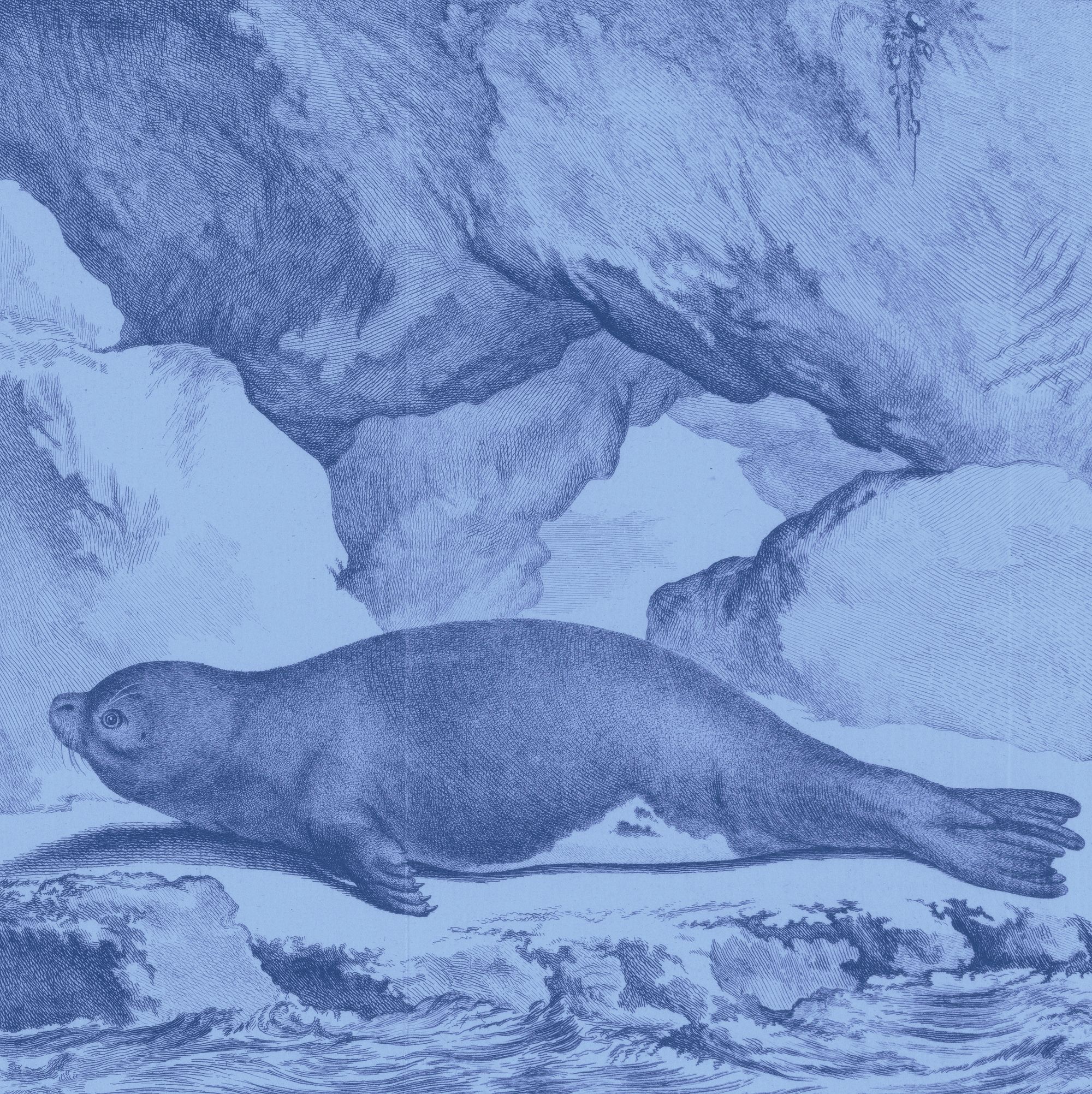
Illustration from Georges-Louis Leclerc, comte de Buffon’s Histoire naturelle, générale et particulière, 1782.
He noticed that the seal could join its hind flippers together, separating the digits to spread out the membranes between them, forming a large paddle “which it uses for travelling about in the water in the same way as fishes use their tail.” From the habit of using its hind legs as a fin or paddle, the legs had shifted in position so that they extended “in the same direction as the axis of their body.” However, when it was on land, the seal could move speedily “by means of an undulatory movement of the body,” not using its hind legs at all—these it held stretched out behind—but supporting itself on its forelegs “on the arms up to the wrists,” and not really using its “hands.” The seal seized prey with either its hind feet or its mouth. When it remained underwater for an extended period, it completely closed its nostrils “just as we close our eyes.” Lamarck was especially interested to observe that the seal’s legs had not fully joined together and become a fin because it still used them for seizing prey. In other words, through their distinctive uses of their hind legs, seals had produced a structure that could work either like a paddle or like a hand.
The seal’s obvious kinship with land mammals confirmed Lamarck’s belief that all mammals, and indeed all life, had originated in the water. The transition between land and sea mammals also led him to reflect on another transition of mammals from land to air. Birds must have come about by a gradual passage from land mammals through “those animals that can make but a very prolonged leap,” such as flying squirrels. By their efforts to extend their jumps, these animals had extended their skin to form flaps, which exemplified structures partway from arms to wings. In bats, you see the transition from land mammal to flying mammal completed. Watching the seal, Lamarck began to think in more detail about a branching structure of animal life, originating in the ocean, and developing into more complex sea organisms, then splitting off into amphibious creatures, land animals, and those that could fly. Starting with the tiny, spontaneously generated organisms appearing in water, over an “incalculable series of centuries,” the simplest forms of life gave rise to every kind of living being. He drew a series of charts, with lines representing the “very branchy” tree of life as it spread through the ocean, onto the land and into the air.
As living beings complexified and proliferated themselves, they also produced the inanimate world around them. “[W]hat must be our astonishment,” Lamarck exclaimed, upon learning that some of the tiniest and simplest of creatures, the madrepore and millepora coral polyps, have been the chief producers of the great calcareous mountain chains and enormous banks of chalk found all over the Earth? These minuscule animals create islands, fill up bays and gulfs, clog ports and “completely transform the coastlines,” all with just a little help from shellfish. Shelled creatures also offered essential evidence in support of the theory Lamarck was developing: they revealed the animal creation of the world in action. Invertebrates with shells represented the living source of the infinitesimally slow processes that transformed the Earth’s surface. Shells were exquisite works of invertebrate production presenting “an astonishing diversity of forms” in an “almost infinite variety of colors,” rivaling flowers, birds and butterflies in their brilliancy and magnificence.
Moreover, shells displayed the transition from organic to mineral matter. Any shell, Lamarck observed, was originally formed “of an intimate mixture of two materials of different natures, one of which is entirely animal, and the other purely calcareous.” Both sorts of particles came from the same “viscous matter exuded by the animal” through special glands dotting the surface of its body. While the shell remained mixed in this way, partly animal and partly mineral, it could be considered alive; once its animal part had been destroyed and only the “stony part” remained, it was an inanimate fossil.
Lamarck scrutinized the muscles attaching shelled animals to their shells and observed that the muscle gradually gave way as the shell grew, releasing it bit by bit, and that the “tendinous” part of the muscle where it attached to the shell was “hard, horny, and is in this place completely inorganic.” Once again, here was direct evidence of living organisms creating the inanimate world as organic matter became mineralized. He remarked too that shells grew in the same way as minerals, “by juxtaposition,” through a continual deposit of new particles onto the interior surface or, more rarely, onto the exterior surface.”
The discretion that animals employed in building their shells especially interested Lamarck. He noted, for instance, that as a shelled mollusk grows, it becomes ever more “constricted and uncomfortable in its shell,” and therefore “seeks to make itself more comfortable.” In order to achieve this end, “the animal moves a little in its shell, extends its body out of the opening, places itself in a stationary state, and remains motionless for some time.” When it does this, it is patiently waiting for the uncovered part of its body to cover itself in the viscous shell-forming secretion, and in this way to expand its shell. In spiral-shelled marine organisms, such as gastropod mollusks, “the fully grown animal, finding itself too uncomfortable in its shell,” doesn’t simply stick a part of its body outside the opening, but gauges just how far to extend this part in order to continue the spiral in perfect proportion. “Depending on the species, the portion of its body that it exposes at each station is sometimes half a turn of a spiral, sometimes a third of a turn, sometimes a sixth of a turn, or even less.”
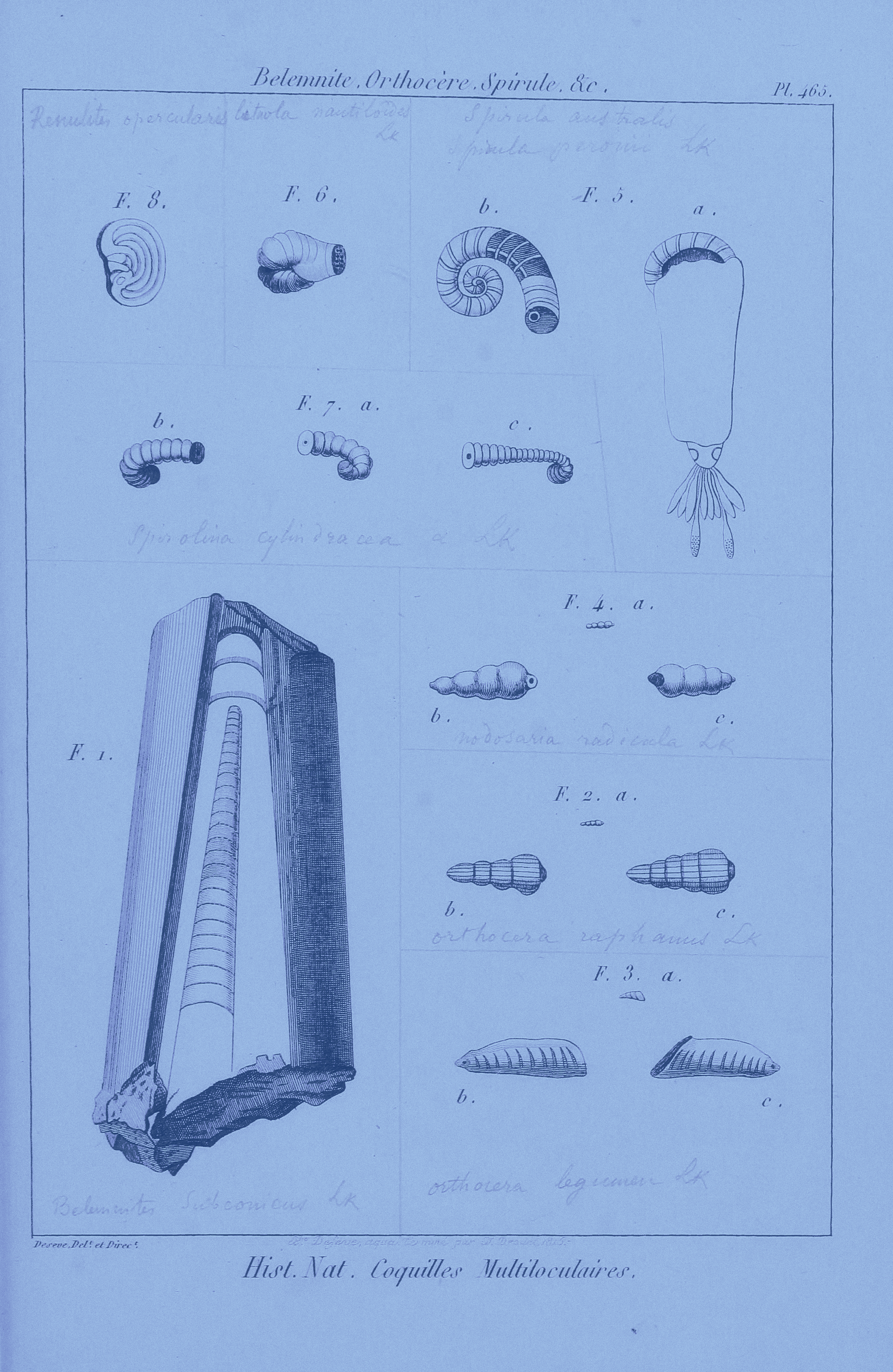
Illustration from Tableau encyclopédique et méthodique des trois règnes de la nature, 1827.
Courtesy of the Biodiversity Heritage Library.Meanwhile, cowries from Senegal and Madagascar, Lamarck observed, build their shell by a two-part process. At first, they build from within, but later on in their development they acquire “two soft and membranous wings which constitute the mantle of the animal,” and which they extend outside their shell whenever they want to move around. Using these “wings,” the animal adds layers of contrasting colors in various patterns—“spots, flames or bands, depending on the species,” to the external surface of its shell. It also uses its “wings” to transform the outershape of its shell “in a remarkable way,” adding “crenellations,” forming “wrinkles, furrows, and … knobs,” and “encrusting the turns of the whorl” with a kind of “teeth.”
Murexes, a spiky, spiral-shelled marine mollusk, show an even greater degree of judgment. Lamarck described their procedure minutely. At first, they seem to block their own path with rows of spikes and fringes that obstruct the opening of the shell; these might seem to prevent the animal from sufficiently exiting the shell to be able to rotate around its axis and continue the spiral. “I felt this difficulty: nevertheless, by considering various individuals of the murex tribulus, the murex ramosus, etc., I convinced myself that the animal had known how to overcome it.” He noted that on the already-formed spiral “we can still see the old rows of fringes or thorns which it did not need to destroy; but the thorns or testaceous [shell] fringes that it found in its path it knew how to make disappear.” The animal therefore selectively “destroys the testaceous protuberances which hinder its exit.”
Insisting on the agency and discretion of tiny marine creatures might seem like a small matter, but it was in fact the essence of Lamarck’s radical view of life and of nature. To live, he decided, was to create both oneself and the world around. The planet Earth itself was in a state of continual transformation—according to Lamarck, nothing in nature remained the same even “for two seconds in a row”—to which the oceans were crucial: they were always modifying the surface of the globe; the moon was continually moving the sea basin and the Earth’s center of gravity; and the planet was also always absorbing solar light, which transformed its matter, mass and volume. All in all, the Earth’s landscape, atmosphere and climate were a great commotion of interacting elements. In this commotion, the sole force of composition and creation was the inexorable action of mortal beings.
Lamarck’s claim that only living organisms could produce compound matter was certainly radical in his day, and it might sound farfetched even today. Yet over two centuries after Lamarck’s writing, the role of organisms in the formation of minerals has inspired renewed interest among geologists. The prevailing view among scientists now is that “abiogenesis”—the emergence of living organisms from inanimate matter, or spontaneous generation—has happened at least once. Then the first organisms, over 3.5 billion years ago, changed the chemistry of the atmosphere and the ocean, precipitating large-scale mineral deposits; and ever since, living beings have shaped the Earth’s surface mineralogy.
Overall, geologists studying “mineral evolution” suggest that biochemical processes are responsible for most of the Earth’s mineral species. Although Lamarck didn’t describe these biochemical processes specifically, he did claim that for as long as it has existed, life has produced and shaped the inanimate world. Geologists working today share this view. “The origin of life depends on minerals,” as one mineral physicist has put it, “but the origin of minerals depends on life.” Living beings have built the Earth’s surface landscape on the grandest scale, from granite for continents to limestone for mountains.
If you’re not a geologist, you probably didn’t know that there’s such a thing as “biogenic” quartz, for instance quartz that forms from silica-rich plankton. But you may have known that the White Cliffs of Dover are made of chalk from pulverized shells of single-celled algae called coccolithophores. Or that the summit of Mount Everest is made of limestone, also a primary component of the Rockies, sections of the Alps, and the mountains of Guilin in China, and that limestone is made from calcium carbonate from corals and seashells.
The idea that living beings could make mountains was quite new in Lamarck’s lifetime. For centuries, when people found marine fossils far from any ocean, such as on the tops of mountains, they’d taken these as evidence of the biblical Great Flood of Noah, in which water covered the whole Earth. But around the time Lamarck began taking an interest in botany and natural history, certain people started suggesting that the rock of mountains such as the Jura range, along the border between France and Switzerland, didn’t just have seashells on or in it, but was in fact made of the remains of living things. “All calcareous rock is produced from the animal kingdom,” wrote the Swedish naturalist Carl Linnaeus, and his archrival—Lamarck’s protector and benefactor, Georges Buffon—for once agreed. “All calcareous earth,” he concurred, “can be regarded as animal earth because it is produced only from the detritus of shells.”
Lamarck contributed a subtle yet crucial change of emphasis: these mountains weren’t just made from the remains of marine organisms, he said, but they—along with the rest of the inanimate world—were made by living things. The original source of the mountains was not dead organisms, but the incessant activity of living ones. His was a life-made world continually reborn from the ceaselessly burgeoning oceans. ♦
Adapted from THE POWER OF LIFE: THE INVENTION OF BIOLOGY AND THE REVOLUTIONARY SCIENCE OF JEAN-BAPTISTE LAMARCK by Jessica Riskin. Published by Riverhead Books. Copyright © 2026 by Jessica Riskin. All rights reserved.
Subscribe to Broadcast