The Hidden Sound of Ice
Wall of ice exposed by the crumbling of the Russell Glacier, west Greenland.
Photo: Marco TedescoIce is often imagined as silent. But it does have a voice.
As a climate scientist, I have spent much of my life listening to ice’s voice, to its message and heartbeat. I watch it from space via satellites and through the lens of climate models that unveil the processes driving its disappearance. But I also hear what it has to say, whether I am sitting on the vast open ice of Greenland or translating the data we collect there into sound. While on the ice sheet, I often think of the experiment in an anechoic chamber—a room designed for total silence—that left John Cage hearing only two sounds: his own nervous system firing and his pumping blood. In the natural anechoic chamber of Greenlandic isolation, I have experienced the nervous system and the blood of the ice: expanses of white, grays, and blues stretched across the landscape; a pulsating ocean of layers, both before and below me. The horizon there doesn’t just seem endless—it is endless, like the memory the ice carries. Beneath that apparent stillness, the ice is constantly moving, like an Arvo Part composition: slowly evolving, full of stories and surprises.
The ice of Greenland might appear still, timeless, suspended between past and future. Yet ice is never static. From a geophysical perspective, glaciers crack, meltwater rushes through channels that cut the surface and dive within ice like arteries, snow crystals break under the wind pressure. Silence is a part of ice’s composition, a complement to its noise, the space between words. The entire ice sheet resonates with frequencies beyond human hearing, roaring and whispering, speaking through electromagnetic waves, emitted continuously by snow and ice, recorded by satellites in orbits that circle the dark polar night. These space sentinels can record data in electromagnetic regions that are invisible but still play a large role in describing the processes around us. It’s as if we are immersed in an electromagnetic soup that only these sensors can see.
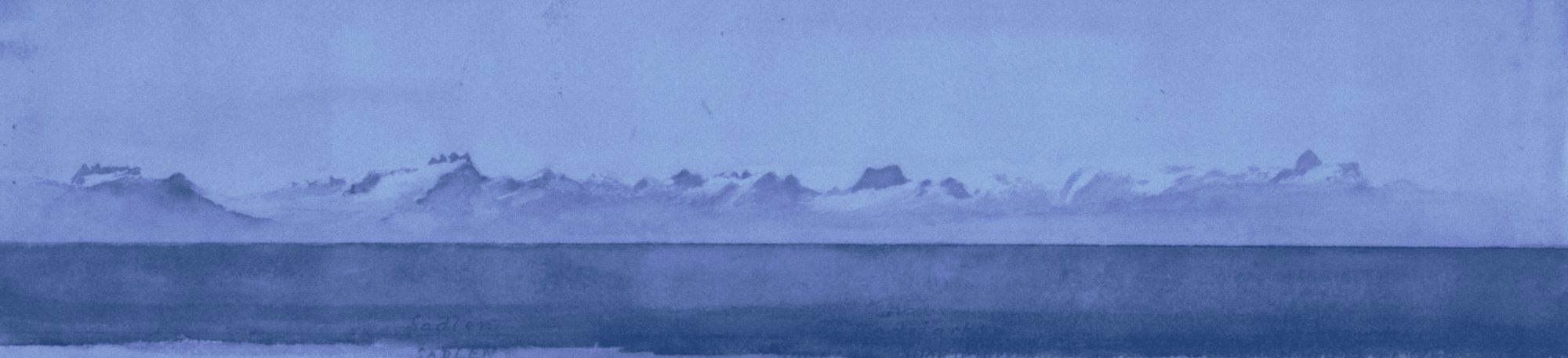
R. Pocock, Watercolour Panoramas of the West Coast of Greenland, 1904.
Courtesy of The Royal Geographical SocietyMaps privilege vision as a means of extracting and sharing knowledge. In some cases, they might encourage distance while transforming dynamic realities into static representations. Sound offers an alternative tool for mapping. Instead of viewing a landscape from above, it allows us to move through it. Listening requires duration and attention, and sonification transforms scientific data into acoustic journeys, allowing listeners to experience spatial and temporal processes rather than merely observe them.
To listen to the ice, we use sensors that record waves in the microwave spectrum, the same spectrum used in the kitchen. Due to the same principle that allows us to warm up our meals—the vibration induced by the oscillation of the waves in water molecules, which is translated into heat—even a thin film of liquid water changes that emission. It is as if the ice had changed its volume and tone, going from whispering to speaking to raising its voice, louder and louder, until it is finally screaming. Satellites have recorded that voice since the late 1970s, each melting season announcing itself before our eyes could catch it. Our ears could hear the voice of ice changing over the past decades, becoming the scream that it is today.
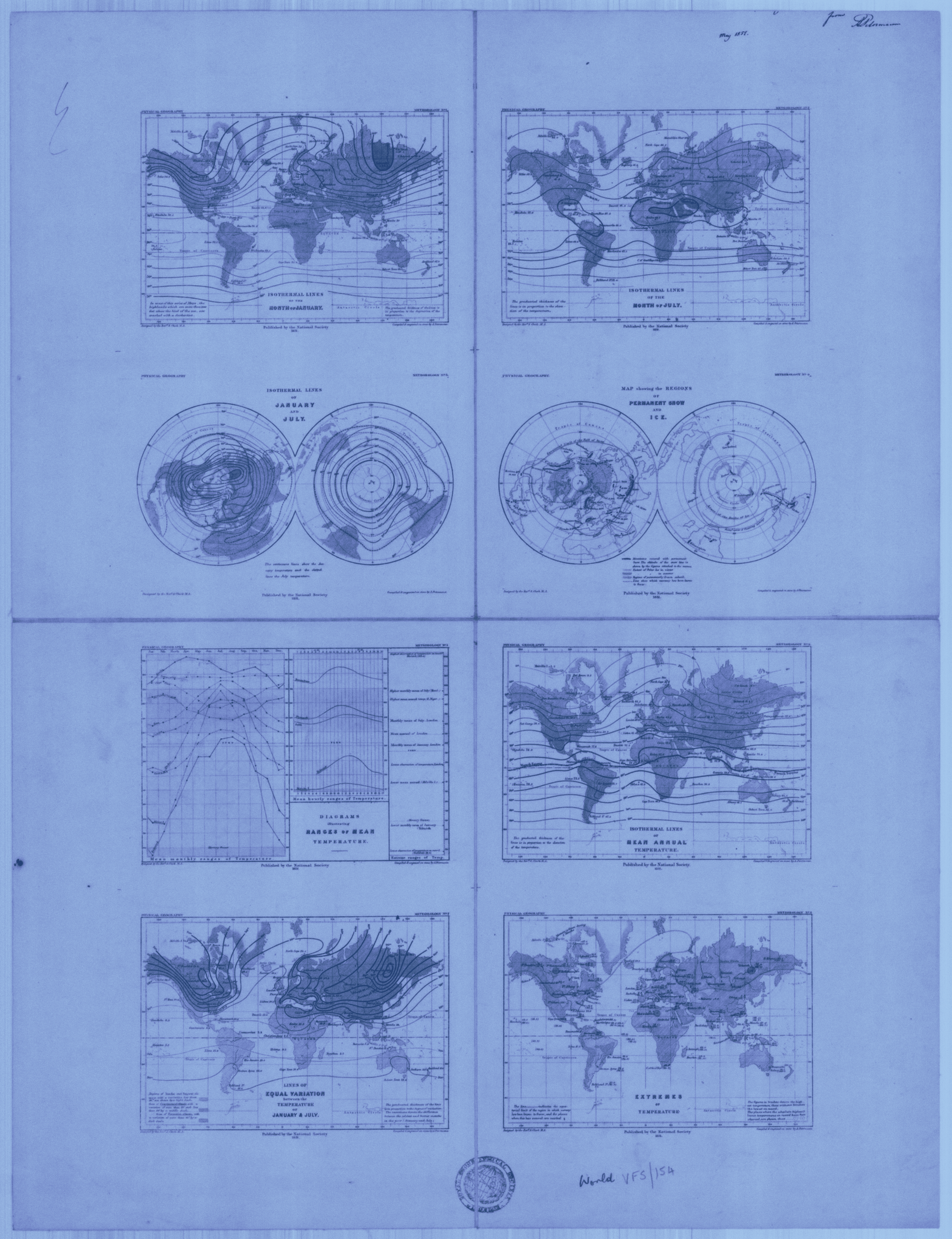
A collection of maps and charts from Spitsbergen, 1901.
Courtesy of The Royal Geographical SocietyDespite this deafening scream, the melting of the Greenland ice sheet—and its consequences for sea level rise—is unfolding almost silently in public consciousness and perception. The numbers are anything but quiet. In July 2012, melting occurred across nearly the entire surface of the ice sheet, something never before observed from space. Greenland now sheds, on average, roughly 270 billion tons of ice each year. That’s three swimming pools worth of water per second, or the equivalent of 200 years’ worth of New York City’s water supply, gone in a single trip around the sun. This transformation is also making Greenland darker. Retreating snow exposes older, dustier ice, and dark-pigmented algae bloom along the margins, tracing a “dark zone” visible from space along Greenland’s western flank. Darker ice absorbs more sunlight, which hastens melting. The ice sheet is quietly amplifying its own melting, which I’ve called “melting cannibalism”: the more snow and ice melts, the more the associated processes (the reduction of albedo and increase in absorbed solar radiation, the primary source for melting during summer in Greenland) make the ice melt faster and faster, feeding on its own fate.
But the hidden sound of ice, I’ve found, is not only an expression of geophysical processes. It can be a way of thinking about absence, loss, memory, and distance.
The disappearance of a place, a season, a landscape, or a way of life rarely occurs through a single dramatic event. Changes happen slowly before happening suddenly, like a glacier inching towards the ocean, then suddenly calving into the water in the last phase of its journey. The ice sheet of Greenland is not formed by the freezing of water, as sea ice is: instead, it is composed from layers of snow that, year over year, are compressed by their own weight, squeezing out the air until 91.7 percent of the volume is occupied by the ice. (This is the reason why icebergs float but remain about 90 percent below the water’s surface.) Memories are stored in layers of ice, a kind of encoded time machine as the sheet forms, year after year, decade after decade, century after century. Every layer becomes part of a planetary archive. Embedded within them are records of volcanic eruptions, wildfire smoke, industrial emissions, and climatic variations. When Greenland ice melts, its memory is diluted, mixing the deep past with the recent one, erasing the chronology of Earth’s history book. The ocean absorbs that memory but its sequence is lost, mixed with the noise of the world, impossible to untangle and isolate.
There is another way we can listen to the ice. The same way we use Geiger counters to detect radioactive material—with the detector’s clicks becoming louder and more frequent as the radiation levels increase—we can listen to Greenland’s ice via “sonification,” the use of non-speech audio to convey information, interpret data, and represent relationships in an acoustic signal. Through sonification, melting data becomes audible: pauses invoke reflection, creating a new, empathetic yet scientific vocabulary narrated to us by the disappearing ice. By listening, we discover and transform forms of change that would otherwise be impossible to perceive. Through sound, scientific observations become shared experiences.
Lantern slides of the coast of Greenland, circa 1839.
Courtesy of the Royal Geographical SocietyIceberg in the Ilulissat Bay, west Greenland.
Marco TedescoAs mentioned, sonification is a different way of mapping, and maps are made, not found. The very measure we use to track sea level rise, the melting of ice, is itself a construction. As the historian Wilko Graf von Hardenberg has pointed out, sea level was not discovered but defined: a baseline that scientists imposed on a surface that has never been fixed. The ocean has no natural zero point. We created one so we could measure change. The number we use to describe what is happening—sea level rise—is a human invention trying to keep pace with a planetary reality it was never quite designed to capture. We are drawing a new map of the world with its redefined coastlines.
The same might be said of measurement itself. We treat observation and personal experience as opposites—one objective and shared, the other personal and unreliable. But every measurement begins with an interpretation: someone decides what counts and what does not. The historical images in this article are earlier versions of this sort of decision, each made with the instruments of their respective times. Measurement strips experience down to what can be recorded, so others can examine and use the data. But when that objective account becomes the only one, the experiences it excludes become lost.
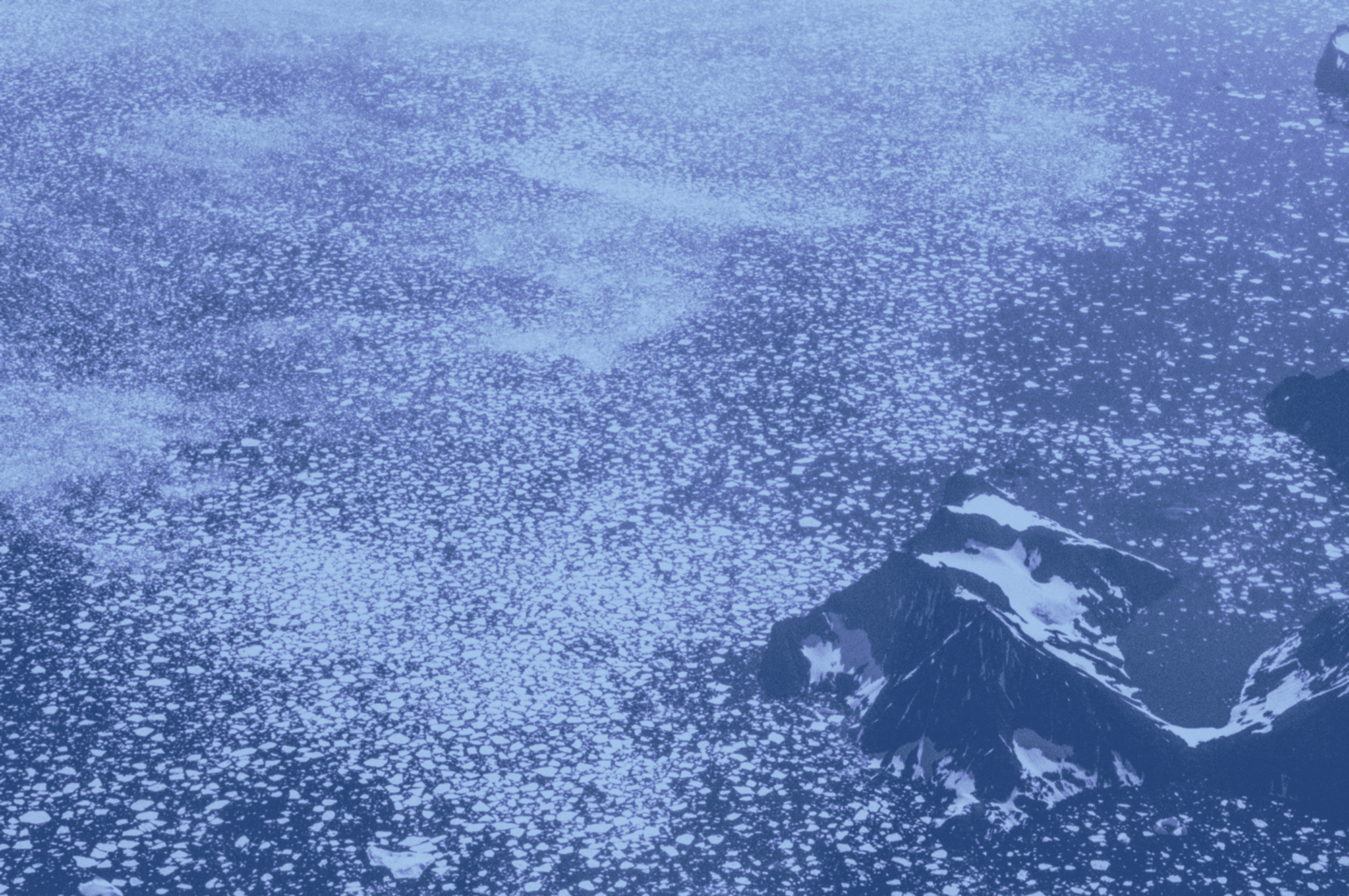
Sea ice in the Disko Bay area, west Greenland.
Marco TedescoThe hidden sound of ice raises questions about absence. What does it mean to listen to something that is disappearing? Can sound preserve aspects of a landscape that may no longer exist in the future? Can acoustic experiences function as repositories of collective memory? Which public sites—museums, historic centers—will we be able to visit to explore and hope to make sense of the loss that accompanies the transformation of the place due to climate change?
Climate change is often discussed through projections and forecasts. But it is equally a story about memory and social justice. Communities remember storms, floods, droughts, and changing seasons. Landscapes remember through sediments, ecosystems, and ice layers.
The Greenland ice sheet is losing ice faster than at almost any point in the past several thousand years. This is not something anyone can picture; it is a fact the mind can barely hold. That is part of the problem. We have built an entire apparatus—satellites, models, a baseline we call sea level—to measure a loss we cannot otherwise perceive, that many choose to ignore. Unless action is taken at a political and social level, simply listening will not change the path we’re on.
Some of the most important consequences cannot be plotted. When we listen to the song of the ice, we need to remember that it is also the voice of those most affected by the consequences of climate change. Through its data, the ice does not only narrate what is happening in the far, cold Arctic region, but also the stories of those whose exposure to climate hazards is amplified by social and environmental injustices. Until our instruments, institutions, and habits of attention learn to listen, we will be disconnected from one of the most important sources of information about our living, breathing planet—and unable to act on what we hear. ♦
Subscribe to Broadcast