The Dreams of Octopus and Cuttlefish
Octopus vulgaris, 2010.
Photo: Paul Asman and Jill LenobleDreaming seems a mental extravagance, far from the brain's essential business of perceiving the world, remembering events, and controlling behavior. Tracking the environment and learning its patterns—those are the sorts of things we'd expect to be common in the minds of other animals, not the wild excursions of dreaming.
Dreams are also hard to study even in ourselves, quickly forgotten and likely confabulated in memory and report. But the evidence for dreaming in nonhuman animals is better than we had any right to expect.
Cephalopods, especially octopuses and cuttlefish, have a special place in the history of these discoveries. This is partly because they are such expressive animals; an unusual amount of what is going on inside them can be glimpsed from the outside. The continual changes in color and pattern on the skin of these animals are controlled by the brain, through tiny muscles, and these colors and patterns can change in less than a second. In cephalopods, the skin is a window in. These are expressive animals in other ways as well, with their numerous and flexible arms. From this expressiveness, we've learned a lot.
*
In humans, sleep has several phases, including an alternation between “quiet” and “active” (REM, rapid eye movement) sleep. REM sleep is more associated with dreaming, though dreams can occur during quiet sleep as well. An alternation between sleep phases that look similar to ours has turned out to be common in many animals, including some invertebrates.
The first report of this alternation in any invertebrate animal, as far as I can tell, was a description of sleep in cuttlefish in 2012. The paper reported a sleeplike state, which itself was news, and also an alternation that appeared to include quiet and active phases. In the active phases, cuttlefish showed "rapid eye movements, changes in body coloration and twitching of the arms." The active phases were observed once in each animal at night, lasting for roughly two minutes.
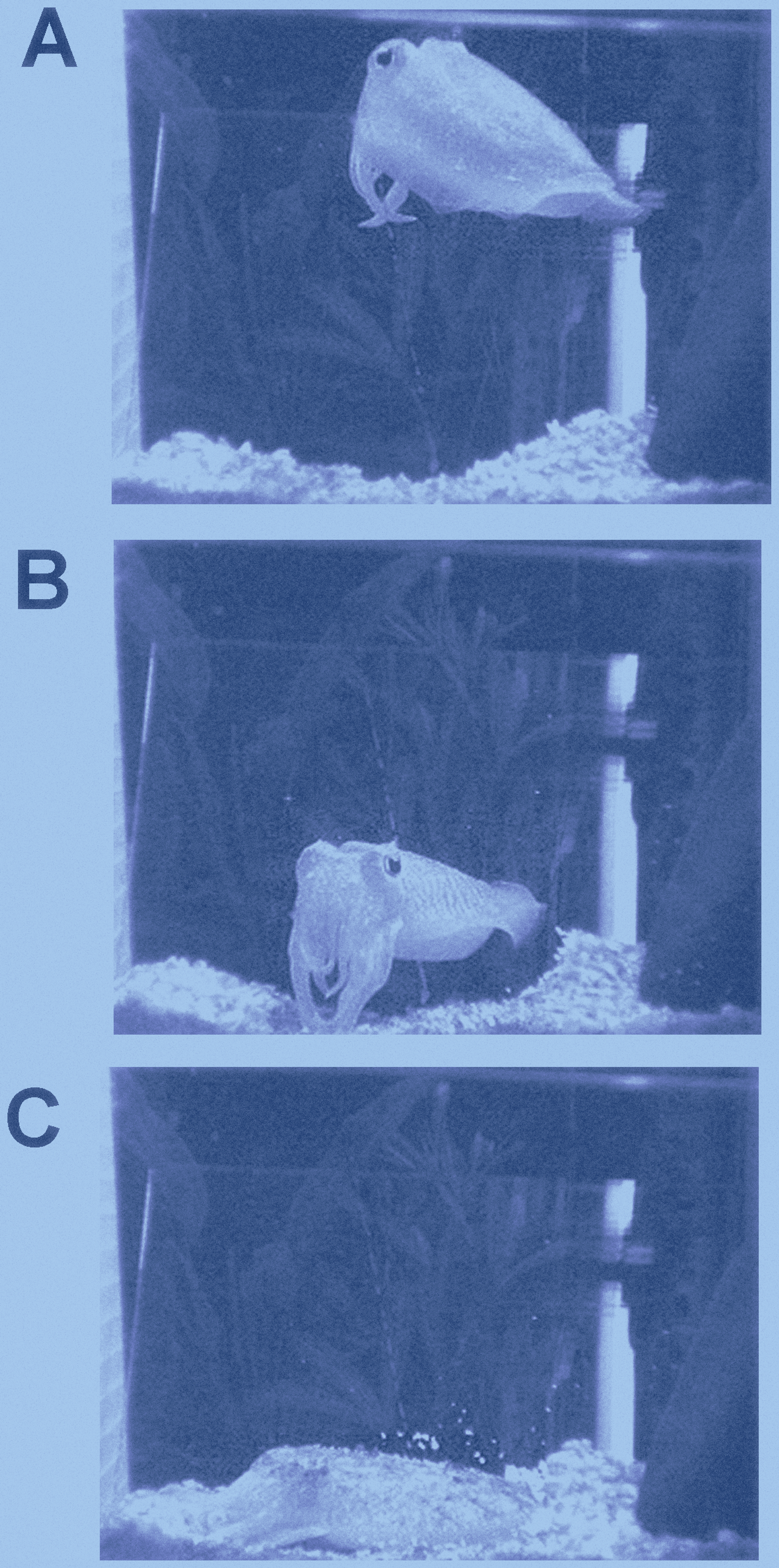
States of arousal and quiescence in the cuttlefish Sepia officinalis.
From Frank et al., “A Preliminary Analysis of Sleep-Like States in the Cuttlefish Sepia officinalis,” PLOS ONE 7, no. 6 (2012): e38125.A second paper followed up in 2019, using the same species of small cuttlefish (Sepia officinalis). The same alternation was shown, with REM-like episodes of about two minutes, though more of these were seen per night than in the first study. A cuttlefish would often be quiet for half an hour or so, and then active for about two minutes. Again: twitching, eye movements, and changing patterns on the skin.
That same year, a famous TV documentary showed Heidi the octopus, living in the biologist David Scheel's house, appearing to go through a series of vivid color and pattern changes during sleep. She was sometimes pale except for subtle moving shadows, sometimes almost an ivory white, then darker all over, followed by a mottled olive camouflage pattern.
A 2021 scientific paper then reported cycles of quiet and active sleep in octopuses, quite similar to those seen in cuttlefish. The active sleep episodes were shorter—under a minute. A possible "nightmare" was observed in an octopus in a lab in 2023. And the newest study, using more invasive methods, managed a tracking of octopus brain rhythms. It found an association between the behavioral signs of active sleep (colors, twitches) and brain rhythms that are similar to those seen when awake.
How might we demonstrate, or disprove, a link between all this and dreamlike phenomena in these animals? Cephalopod skin is a window into something in the brain, but why should we think that what's going on in there is experienced in a dreamlike way?
In humans, a phenomenon called REM Sleep Behavior Disorder features "dream enactment behavior." The paralysis that's typical in REM sleep breaks down, and people perform behaviors, often violently. This is seen as a disorder and often the beginning of larger problems, though milder forms of dream-enacting behavior are also seen. This is not the same as sleepwalking; that is something that happens in non-REM sleep, is not apparently associated with dreaming, and might be best seen as a mixed half-awake state. Though dream-enacting behavior is hard to study (like everything associated with dreams), some papers have reported a correlation between the behavior observed and what the person was apparently dreaming about. That would not be surprising, though it's hard to show scientifically.
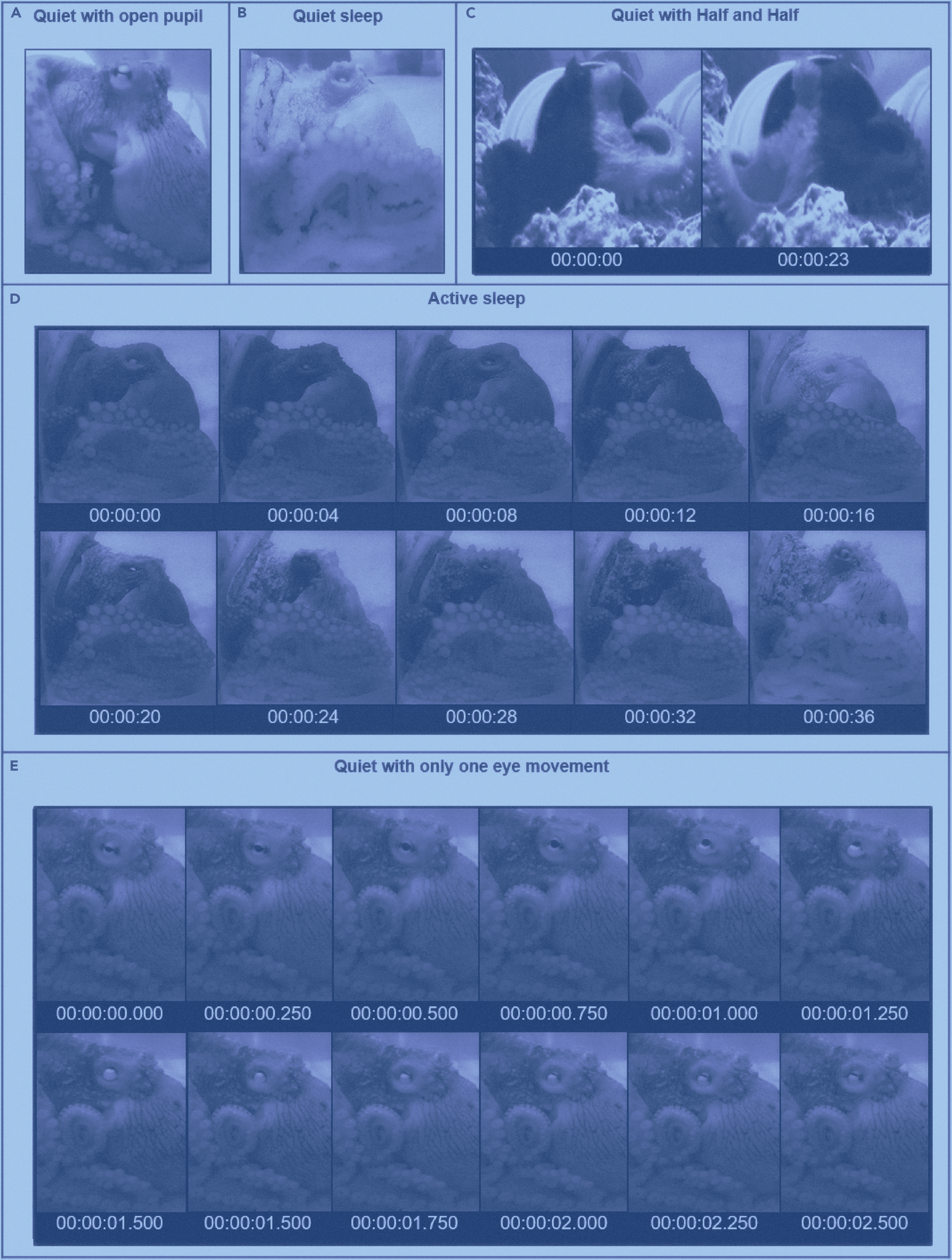
Behaviors observed during different quiescence states in Octopus insularis. (A) Quiet with open pupils; (B) “quiet sleep,” with closed pupils; (C) quiet with a “half-and-half” skin pattern; (D) “active sleep,” with a dynamic skin pattern and eye movement; (E) quiet with movement of only one eye.
From Medeiros et al., “Cyclic Alternation of Quiet and Active Sleep States in the Octopus,” iScience 24, no. 4 (2021): 102223.Is the behavior observed in cephalopods during sleep at all similar to this, or is it a completely different matter? Twitching during sleep doesn't seem especially significant, in either humans or cephalopods, and it's the color changes that are more important, as these are an important form of waking behavior in cephalopods. Do these suggest dreamlike experience?
At this point, it's worth asking a general question. Why do we humans experience dreaming? We don't know. It might be that so much of normal waking brain activity is engaged during human REM sleep that we just get dream experience, at least some of the time. Perhaps it would be hard to have all those brain areas activated without some felt experience. This argument might carry over to cephalopods. If an active sleep state evolves because it has some cognitive function, that state might create so much waking-like brain activity that experience also tends to arise. This argument relies on the assumption that ordinary waking activity in octopuses is conscious. That is not certain, but it gets more and more likely as evidence comes in. There is now evidence for pain-like states, for example, and the attentive and inquisitive way they behave is, within a range of theories, plausibly associated with consciousness. The argument also relies on the assumption that the great differences in brain architecture between us and them don't matter too much with respect to this possible link between active sleep and the fortuitous appearance of experience.
To summarize, with acknowledgement of all the uncertainties: If active sleep in both humans and octopuses features waking-like brain activity, and if this activity results in dream experience in us, then given that octopuses are probably conscious when awake, it seems reasonable that active sleep produces dream experiences in them, too.
*
Suppose that octopuses and other cephalopods do dream. What does the evolutionary history of dreaming look like? Who dreamed the first dream?
Sleep itself seems remarkably common across animals and has even been reported in jellyfish, though in many animals it is hard to detect. Active sleep is not so common, but has been seen in flies as well as cephalopods, and probably in bees. The common ancestor of all these animals—humans, octopuses, cuttlefish, bees, flies—lived something like 570 million years ago in the sea, and might have looked a bit like a flatworm. Present-day flatworms do sleep, it seems, though there's no sign of active sleep. A present-day flatworm might not be similar to the common ancestor of all those animals I listed, but the size of its nervous system and complexity in its behavior might be roughly comparable.
Then the picture might look like this: Sleep is very old and common; active sleep is rarer and evolved several times in animals that have a fair bit of complexity in their nervous system and behavior. In humans, several kinds of sleep appear to help with the consolidation of memories. Sleep has been shown to help bees with memory, too, but in their case it's quiet sleep that does this. Some famous work in rats has shown a link to memory, and even mental exploration, for both quiet and active sleep. The picture is not simple, but the idea that active sleep has a specific usefulness for behaviorally complex animals is reasonable. And then, given that active sleep includes brain patterns similar to waking life, and that the animals I've mentioned who undergo active sleep are probably conscious in general, there's a good chance that dreaming has evolved several times.
It's even possible that dreaming evolved more than once within cephalopods. Octopuses and cuttlefish are “close” relatives, when we compare them to other animals, but the common ancestor of these two groups perhaps lived around 300 million years ago, back before the dinosaurs, and might have had a simpler life. Alternatively, there might have been hints of dreaming in that ancient squid-like animal, which became stronger as octopuses and cuttlefish evolved down their own lines.
When Heidi the octopus was filmed during a possible dream, David Scheel and others offered interpretations of what she might be dreaming. Scheel wondered if in her dream she'd seen a crab, which she then emerged to catch in her dream-movement, before returning to her den. Perhaps the dream was a replay or imagined version of some other event. But should we assume that the content of animal dreams is always derived from waking life in this way?
In our case, dreams often have either a close or more oblique reference to events in waking life—or so they seem to us on waking; we should be mindful of the possibility of confabulation in our memories. Certainly dreams tend to be populated with versions of the waking world's objects (cars, houses, trees), though they are transformed, merged, and upended in many cases.
The views about the cognitive function of dreams I mentioned a moment ago (memory consolidation, exploration of possibilities) might seem to suggest that dreaming will often be related to situations of waking life, but the connection need not be very tight. An effective mechanism for "useful" dreaming might produce much wilder, more chaotic dream experiences along the way, in nonhumans as well.
Watching animals, especially in the sea, I also often wonder about states they might be in that are midway between dreaming and waking, and that might have experiential features that reflect both of these. Back in 2011, I watched a giant cuttlefish go through a long series of color changes as the afternoon turned to dusk in Cabbage Tree Bay, Australia. The cuttlefish was hovering in the water under a ledge, not resting on the bottom, and did not seem completely asleep. But the long sequence of color changes and patterns, seemingly unrelated to anything happening around him (there was nothing at all happening that I could see, and I was not very close) made me wonder whether he was in a half asleep state and going through some sort of mind-wandering.
He produced a series of displays, postures, and colors over a period of 40 minutes or so—a much longer time than the active sleep episodes reported in the cuttlefish research papers. As I say, the fact that he was hovering seemed to make it unlikely that he was wholly asleep. But the wildness of the patterns and the puzzling, disconnected sequence he went through—the rust-like colors, the dagger-shaped arms—made me wonder about a dreamlike state.
Perhaps animals of this kind, and others, spend long periods in states that are quiet but distinct from sleep, and where their experience has dreamlike features mixed in with those more typical of waking life. Human daydreams and mind-wandering are in some ways akin to this, but the cuttlefish version, if that is what it was, seemed much more intense. One can imagine a flow of experience that is partially grounded in the situation the animal is actually in, but partly untethered. If something important occurs, the animal will "come to," but if nothing much is happening and the day is winding down, perhaps an experiential mix of this kind can drift on for some time. And with cephalopods, we might glimpse this if we quietly watch. ♦
For discussion of these matters, thanks to Claire O'Callaghan, Jackson Freeman, Tim Bayne, and especially to David Scheel.
Subscribe to Broadcast