Big Apple Sky Calendar: October, November, December 2026
In the 1990s, astronomy professor Joe Patterson wrote and illustrated a seasonal newsletter, in the style of an old-fashioned paper zine, of astronomical highlights visible from New York City. His affable style mixed wit and history with astronomy for a completely charming, largely undiscovered cult classic: Big Apple Astronomy. For Broadcast, Joe shares current issues of Big Apple Sky Calendar, the guide to sky viewing that used to conclude his seasonal newsletter. Steal a few moments of reprieve from the city’s mayhem to take in these sights. As Oscar Wilde said, “we are all in the gutter, but some of us are looking at the stars.”
—Janna Levin, co-editor-in-chief
October
October 1
Sunrise 6:52 am EDT
Sunset 6:37 pm EDT
Notice that daylight is now less than 12 hours. We've passed the equinox.
October 2
The Moon is just northeast of the M35 star cluster tonight—likely a grand sight in binoculars.
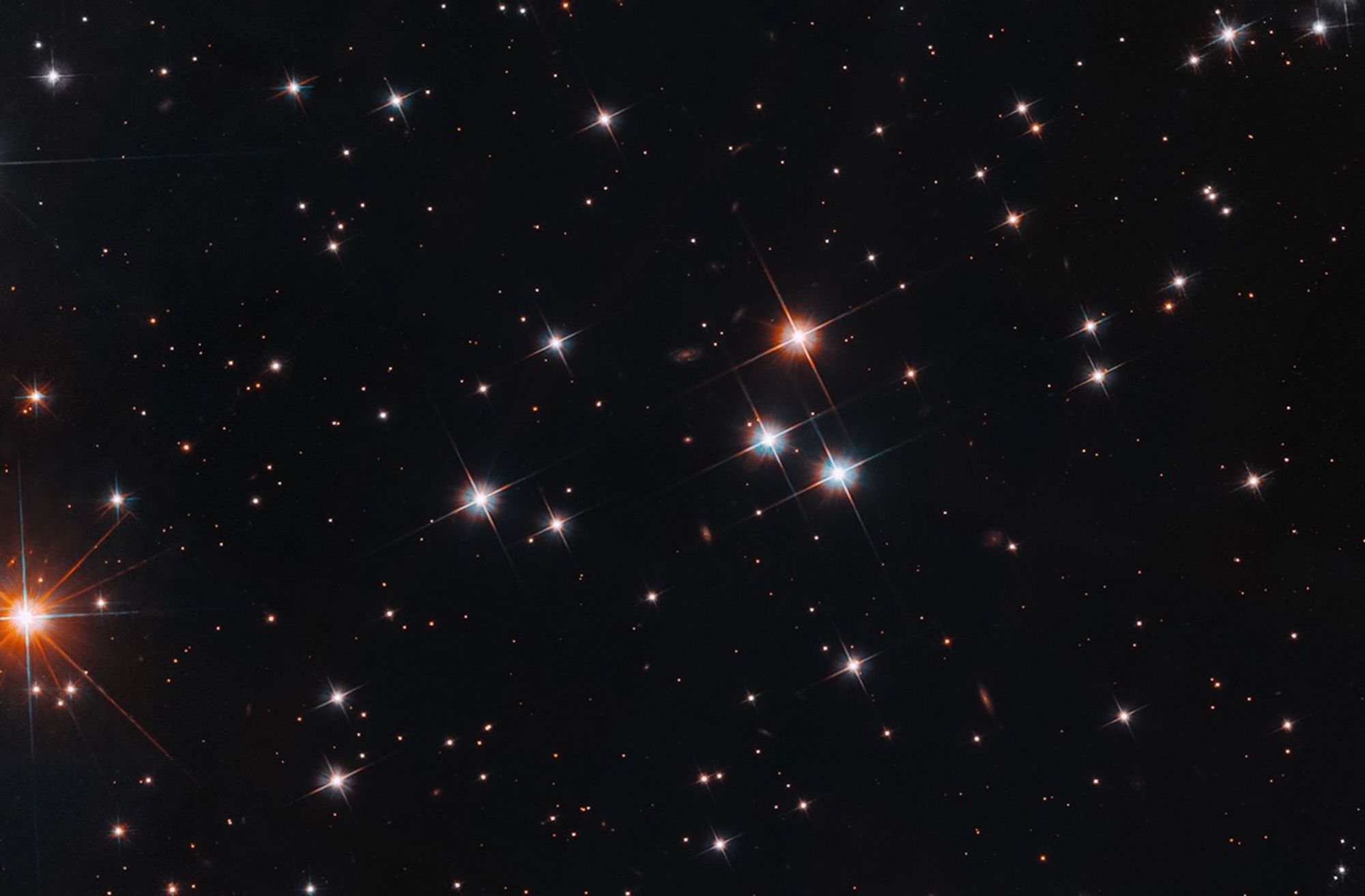
Hundreds of stars in open cluster M35 captured by the Hubble Telescope.
Courtesy of NASAOctober 3
Last-quarter Moon, 9:25 am EDT.
October 4
The Moon is just south of the Gemini twins, Castor and Pollux, in today’s early-morning sky.
Saturn is at opposition, and maximally bright near magnitude 0.5 in the constellation Cetus (the Whale). This is as close to Earth as Saturn ever gets, so it’s roughly as bright as it ever gets (magnitude 0.3). More importantly for telescopic views, the rings are beginning to open up again after appearing nearly edge-on in 2025.
On this day in 1957, the Soviet Union startled the world by announcing that it had launched Sputnik, the first artificial Earth satellite. It was just a little metal sphere, but it carried a radio transmitter—so the world could verify its existence and track its orbit. Along with the U.S. lunar landing and return in 1969, it will always be remembered as humanity's first venture into space.
Sputnik 1 was quickly followed by the much larger Sputnik 2, which carried the dog Laika, who survived only a few hours before dying from panic and overheating. Laika became an international folk hero; her story (or stories; there are many versions) is well told in the National Air and Space Museum, and in Smithsonian magazine. She belongs with Balto and Hachiko in the pantheon of dog heroics.
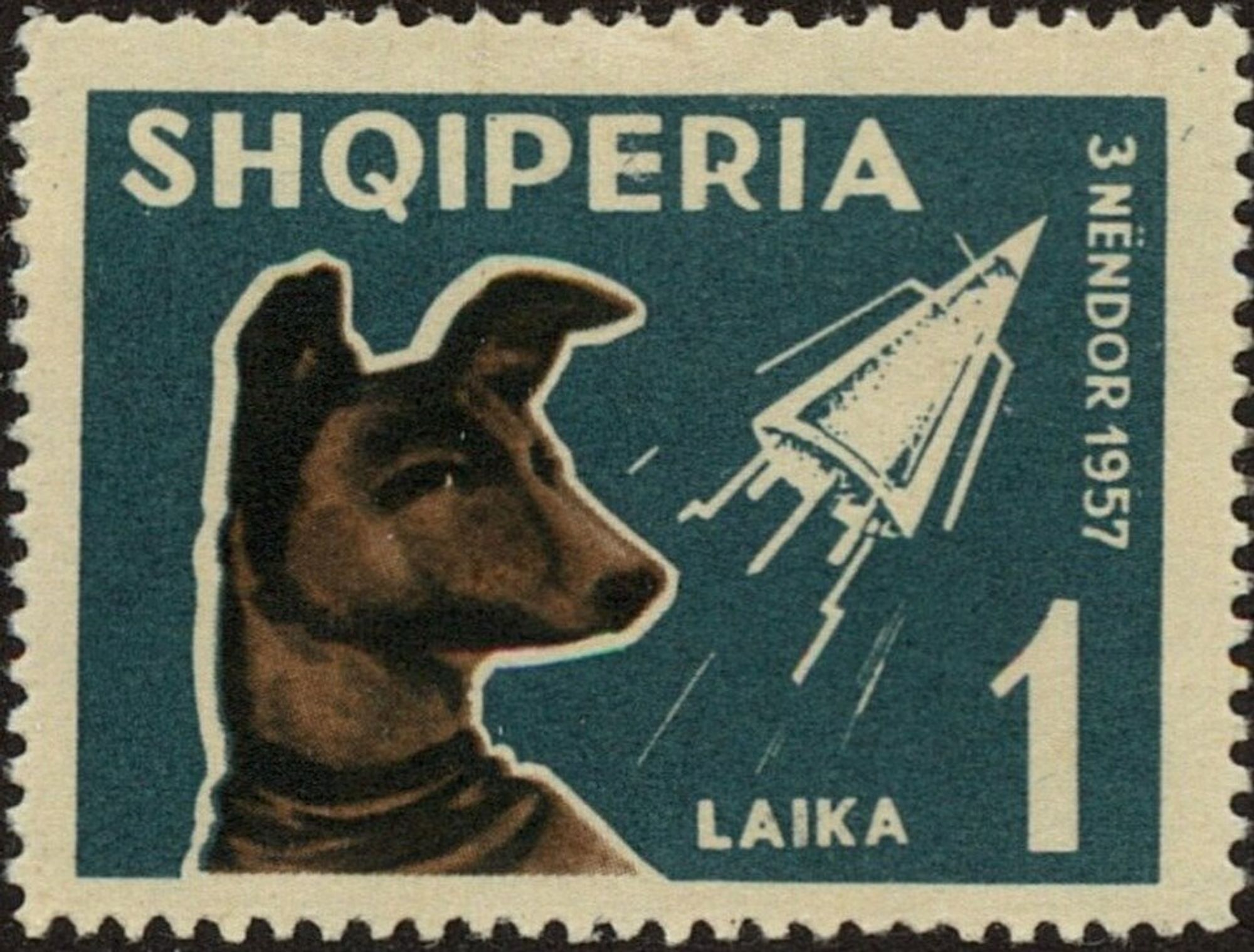
Commemorative stamp of Laila, issued in 1962.
Courtesy of Wikimedia CommonsOctober 5
On this day in 1882, Robert Goddard was born. At the age of 17, on a day which he always called his “Anniversary Day,” he climbed a cherry tree and dreamed of building a machine that would travel to Mars. As we all know, the successors to his rockets DID travel to Mars—the Mariner spacecraft of the 1960s. But Goddard had to battle enormous skepticism about his plans. His first test rocket, which he certainly regarded as a success, rose 114 feet and landed in a nearby cornfield; a newspaper greeted the success with a headline “Moon Rocket Misses Target by 239,785 miles.” The New York Times ran a famous article criticizing him for ignoring “the facts ladled out in every high school”: supposedly, that “you need something to push against to get a force” (and hence can never get propulsion in the vacuum of space). In the aftermath of the July 1969 Apollo landing, the NYT republished that critique, followed by “The Times regrets the error.” (Although, it should be noted, without explaining why their earlier analysis of the physics was incorrect.)
Goddard did, however, get some powerful and early allies, who knew more physics than the New York Times: Charles Lindbergh, the Smithsonian Institution, and the Guggenheim family. And late in World War II, after the Germans demonstrated the enormous potential of rockets (the V-1and V-2), there was a mad scramble by Russian and U.S. troops to kidnap German scientists for their own military programs. Late in World War II, after the Germans demonstrated the enormous potential of rockets with the V-1 and V-2, there was a mad scramble by Soviet and U.S. forces to secure German scientists and rocket technology for their own military programs. The U.S. brought Wernher von Braun and many members of his team to America.
October 5–14
These were the days that never existed in most of Europe in 1582. The inaccuracies of the Julian calendar had caused an error of nine days to accumulate between calendar dates and the dates of seasonal phenomena (solstices, equinoxes). This was worrisome to the Catholic Church because it meant that the timing of Easter was slipping away from its historic connection with Passover and springtime. Thus was born the Gregorian calendar, which improved the leap year convention and restored calendar agreement by legislating nine days out of existence. It caused a lot of social unrest too—landlords charging rent for the missing days, et cetera.
The Gregorian calendar isn't perfect either. Its error accumulates to about one day per millennium—good enough for practically everyone, except some enterprising souls determined in odd ways to make the world a better place. Recent proposals have impressive names like Equitable Calendar, International Fixed Calendar, Edwards Perpetual Calendar, etc. Another possibility is that we’ll go to a completely metric system, with millidays, centidays, etc. This was attributed in the 1976 Church Times to “an anonymous joker in Norfolk” . . . but one kiloday it may not be a joke.
October 7
Stargazing for the public with the New York AAA, 8–10 pm at Lincoln Center (Hearst Plaza).
Birthday of Niels Bohr in 1885. Bohr became famous for the “Bohr model” of the atom, which depicted each atom as a “miniature solar system,” with a massive central nucleus of positive charge (consisting of protons), surrounded by negatively-charged electrons in very distant orbits. Although it was mostly superseded by the invention of quantum mechanics in the 1920s, the Bohr model remains a useful introduction to atomic structure. And for most of the century, Bohr's Institute in Copenhagen became a mandatory stop for nearly all European physicists.
In those days, the “paradoxes” of quantum theory were much debated. Bohr’s leadership and calm demeanor at his Institute were critical. On one famous occasion, he quieted loud criticism of a visiting speaker with a typical Bohr-ism: “Gentlemen! There is no doubt that the theory is crazy. The only question is: is it crazy enough?”
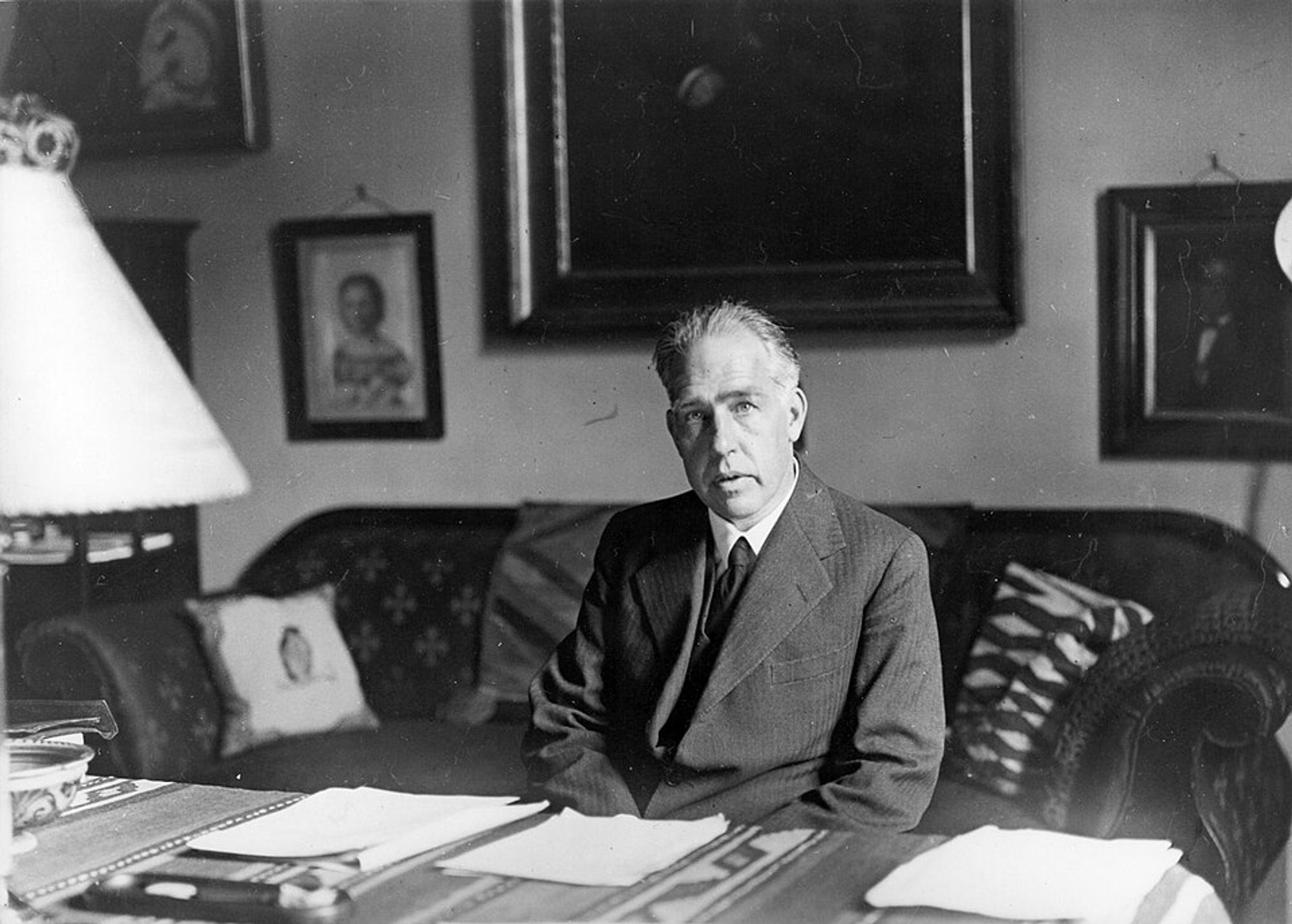
Niels Bohr in 1935.
Courtesy of Wikimedia CommonsOctober 9
On this evening in 1992, a 28-pound meteorite crashed into a parked car in Peekskill, NY—the only known such event in history. The last few seconds of the meteor’s path were well photographed, because a high school football game was going on next door. The car was a 1980 Chevy Malibu, recently purchased for $300 by a 17-year-old girl. It was later sold at auction for $50,000. As Perry Como used to sing, “Catch a Falling Star/And Put It in Your Pocket/Save It For A Rainy Day.” But I doubt the young lady saw much of the dough. I later saw the car on exhibit at the Hayden Planetarium (which, by the way, has probably the finest display of meteorites anywhere in the world). Another good display is at Arizona’s “Meteor Crater” (near Winslow, just off I-40). The crater itself is beyond fascinating!
The early history of U.S. meteoritics is basically that of Harvey Nininger, a Kansas farmer who chanced upon a strange-looking black rock and then went around the Midwest urging farmers and members of 4-H Clubs to look for odd black rocks when plowing their fields. He was tireless; for a while, half the known U.S. meteorites were from Kansas. His story makes for great reading.
October 10
New Moon. 11:50 am EDT.
October 11
Solar Observing, 1–4 pm at Pioneer Works.
October 15
Sunrise 7:07 am EDT
Sunset 6:15 pm EDT
October 18
First quarter Moon, high in the evening sky. Any time around now is great for telescope or binocular observing of the Moon—as the Sun, rising over the most heavily cratered part of the Moon, casts long shadows.
October 21
AAA stargazing for the public at Lincoln Center (Hearst Plaza), 8–10 pm.
October 21–22
Early this morning (on the 22nd), the Earth “collides” with the orbit of Halley's Comet. The comet itself is long gone (totally invisible, somewhere in the rough vicinity of Neptune) . . . but the comet's dust debris, shed by solar heating during thousands of previous visits to the inner solar system, still continues to orbit the Sun. So there's a continuous trail of dust along all the places the comet has recently been. Twice a year, in October and May, the Earth's orbit carries it through that trail, and a meteor shower occurs as the dust particles burn up in our atmosphere. Away from city lights tonight, a naked-eye observer might see around 20 meteors per hour.
They're called “Orionid” meteors because they'll appear in the rough (VERY rough) vicinity of Orion. More correctly, they'll appear to emanate from Orion—but appear all over the sky. Despite a mediocre ranking among the annual showers, the Orionids are my favorite for observing. Why? Because Orion, grandest of the constellations, hasn't been properly seen since March . . . and the October mornings still permit viewing without frozen fingers. Also, a chance to welcome back all those beautiful winter constellations.
October 23
Of the year 4004 BCE: the much-cited estimate for the beginning of the world, according to the work of Archbishop Ussher. He obtained this by adding up all the various “begats” in the King James Bible, and it was much quoted in the various nineteenth-century debates about evolution. Physicists didn’t care much for this estimate, but they did care for the estimate of Lord Kelvin (née William Thomson). Being British in the age of deep mining of coal, Kelvin could estimate how much heat energy there was deep in the Earth. And, of course, he knew the mass, radius, and temperature of the Earth. From that, he calculated an Earth age of about 30 million years. This figure was widely accepted until 35 years later, when a young Ernest Rutherford spoke before the Royal Society . . . ending with “I have here in my hand a rock which I know is 400 million years old.” Rutherford was plenty nervous because Kelvin was in the front row. Building on Henri Becquerel’s discovery of radioactivity a decade earlier, Rutherford had plenty of experience with radium, uranium, et cetera—and realized that the radioactive decay of heavy elements released vast amounts of heat energy. After explaining the reasoning and then glancing nervously at Kelvin in the front row, Rutherford later described the moment and said, “and behold—the old boy smiled at me.”
A century or so later, the best estimate has grown by another 10x. “Radioactive dating” shows that some rocks on both the Earth and the Moon are ~4 billion years old.
Sir William Thomson circa 1900.
Courtesy of T. & R. Annan & Sons; restored by Adam CuerdenSir Ernest Rutherford circa 1920.
Courtesy of the Library of CongressOctober 24
Venus at “inferior conjunction,” passing roughly between Earth and the Sun. Usually Venus passes north or south of the Sun as seen from Earth; only on rare occasions does the alignment produce a transit across the Sun's face. The bad news: It only happens twice a century, and we’ve used up our quota (in 2004 and 2012). The next won’t occur until 2117.
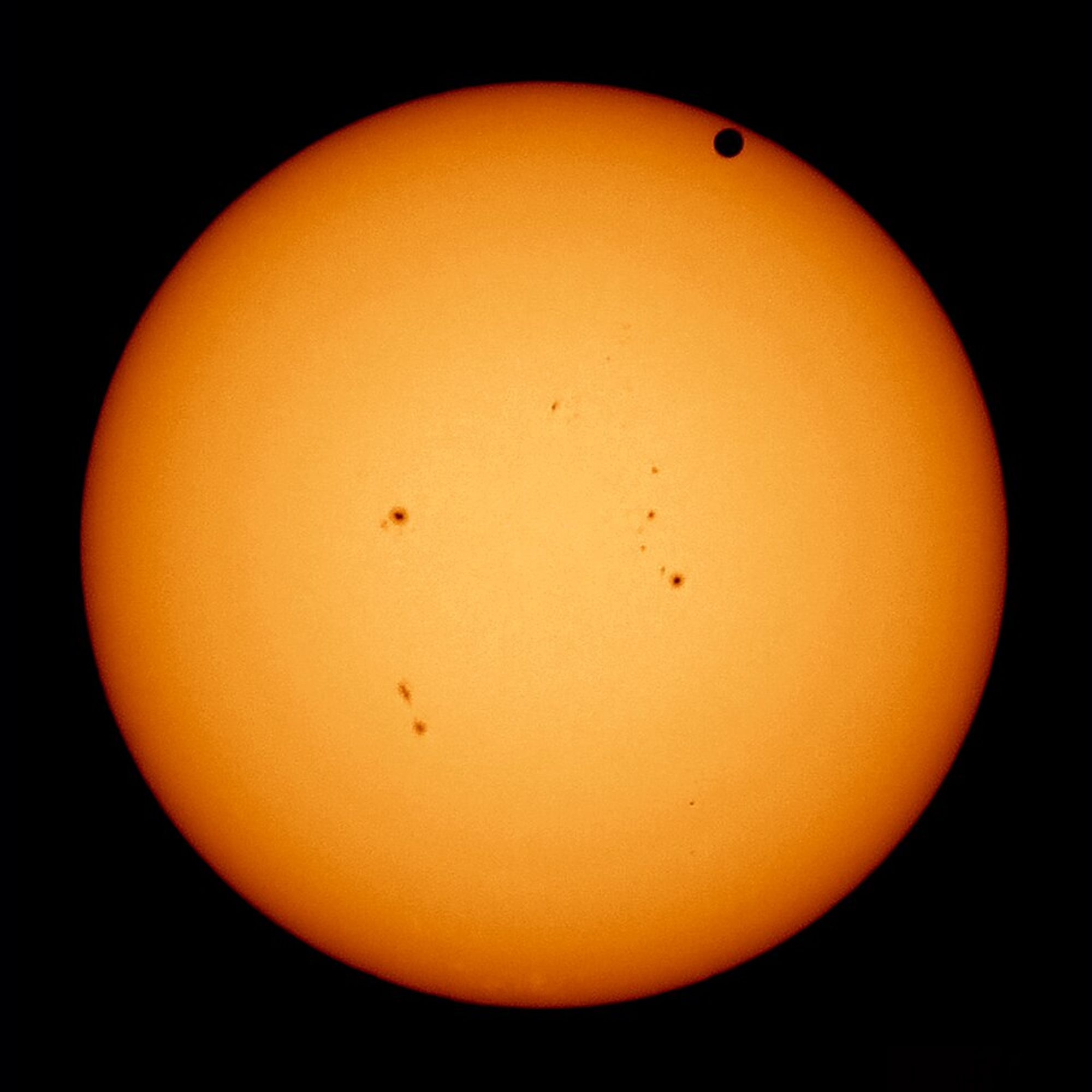
Photograph of the 2012 Venus transit.
Courtesy of Wikimedia Commons and NASAOctober 26
Full Moon 12:12 am EDT.
Also, the day of the NEXT TOTAL SOLAR ECLIPSE in NYC in the year 2124. Conveniently, it occurs just about noontime. To read about this and a lot of fascinating stuff on periodic events in the sky, make friends with timeanddate.com.
October 27
The Full Moon visits the Pleiades tonight. Likely a great sight in low-power binoculars.
October 31
Sunrise 7:25 am EDT
Sunset 5:53 pm EDT
The Moon passes just south of the Gemini twins, Castor and Pollux, tonight.
Halloween. Just a reminder. You knew it—but better be prepared.
November
November 1
Sunrise 6:26 am EST
Sunset 4:52 pm EST
End of Daylight Saving Time. At 2 am EDT, wake up and set your clocks back to 1 am . . . except in Hawaii and Arizona, which have plenty of daylight and have opted not to participate in Daylight Saving Time. This gets you back in reasonable harmony with the Earth-Sun clockwork.
Last-quarter Moon, rising around midnight. The Moon is just north of Mars and the Beehive star cluster (“M44”) tonight.
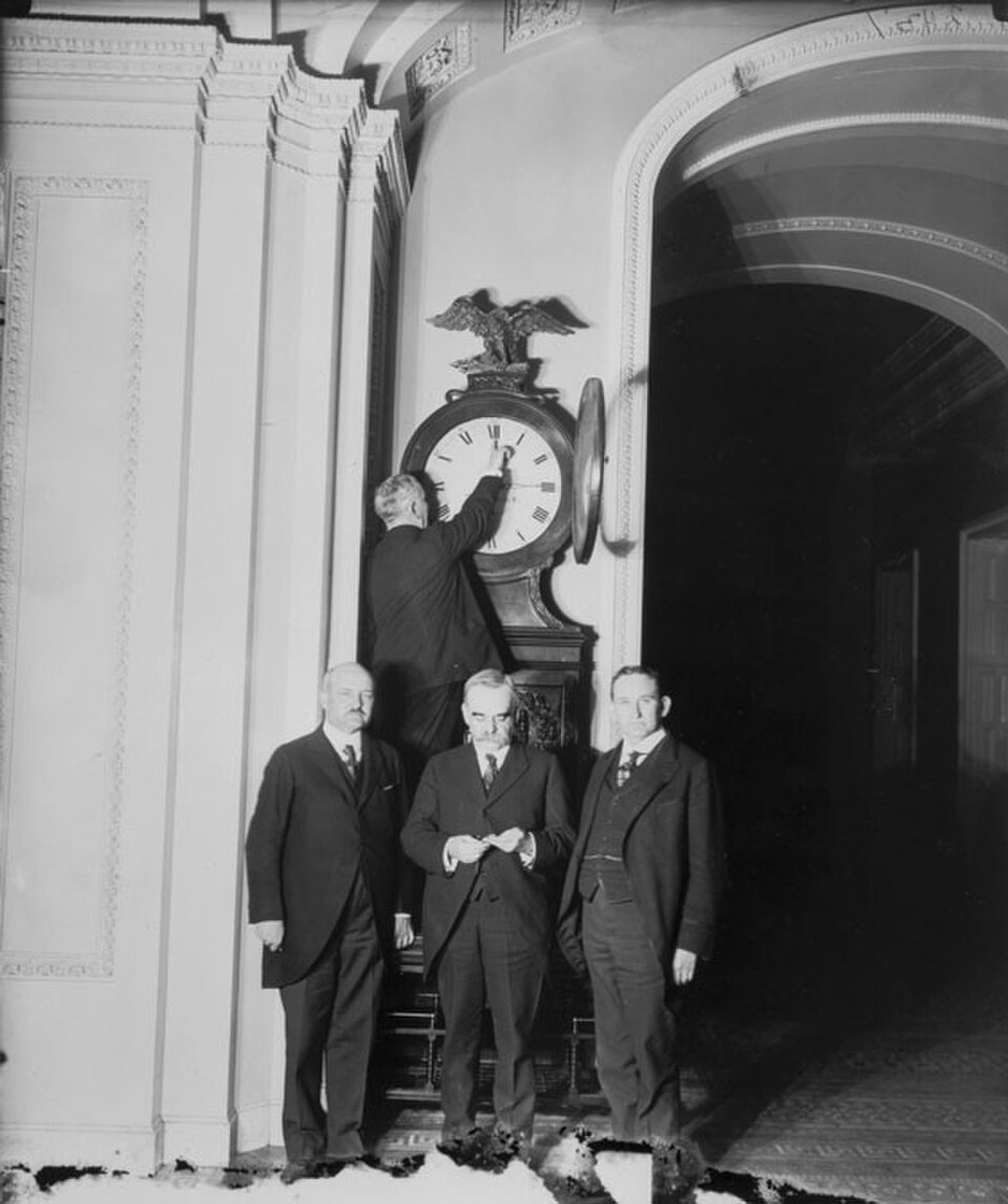
Senate Sergeant at Arms Charles P. Higgins turns forward the Ohio Clock for the first Daylight Saving Time, while Senators William M. Calder, Willard Saulsbury, Jr., and Joseph T. Robinson look on, 1918.
Courtesy of United States Federal Government ArchiveNovember 2
Today, one of the solar system’s most bizarre objects—an asteroid named Zoozve—makes an extremely close approach to Earth, just 0.040231 AU (a bit more than 15 times the Moon’s distance). Zoozve is truly an amazing object. Like all asteroids, it orbits the Sun. But sometimes, like today, it gets very close to Venus or Earth . . . and we say that it’s trapped in an “8:13 mean-motion resonance” with Earth. Besides today’s approach, it had very close approaches on 11/18/2002, 11/7/2010, and 11/4/2018. There’s your 8-year periodicity. On a Venusian calendar, there would be similar regularity of visits but 13/8 more (Venus zips around faster). Also sometimes considered a “quasi-Moon” of Venus.
Even the name is interesting. Asteroids are usually named after minor Greek gods, astronomers, celebrities, friends/family of astronomer-discoverers, etc. Usually, if you discover one and find its orbit (not easy), you get to choose. But in today’s flurry of astronomical discovery, we just use numbers and letters. This one was discovered in 2002, with v and e denoting the alphabetic order of discovery (approximately the 300th new object found that year). So the name was temporarily 2002ve. But somehow, Radiolab broadcast a story about this . . . and mistook “2002” for “ZOOZ.”
It sounds much better! So we decided to stick with ZOOZve . . . until some spoilsport convinces the International Astronomical Union that there should be no fun in astronomy.
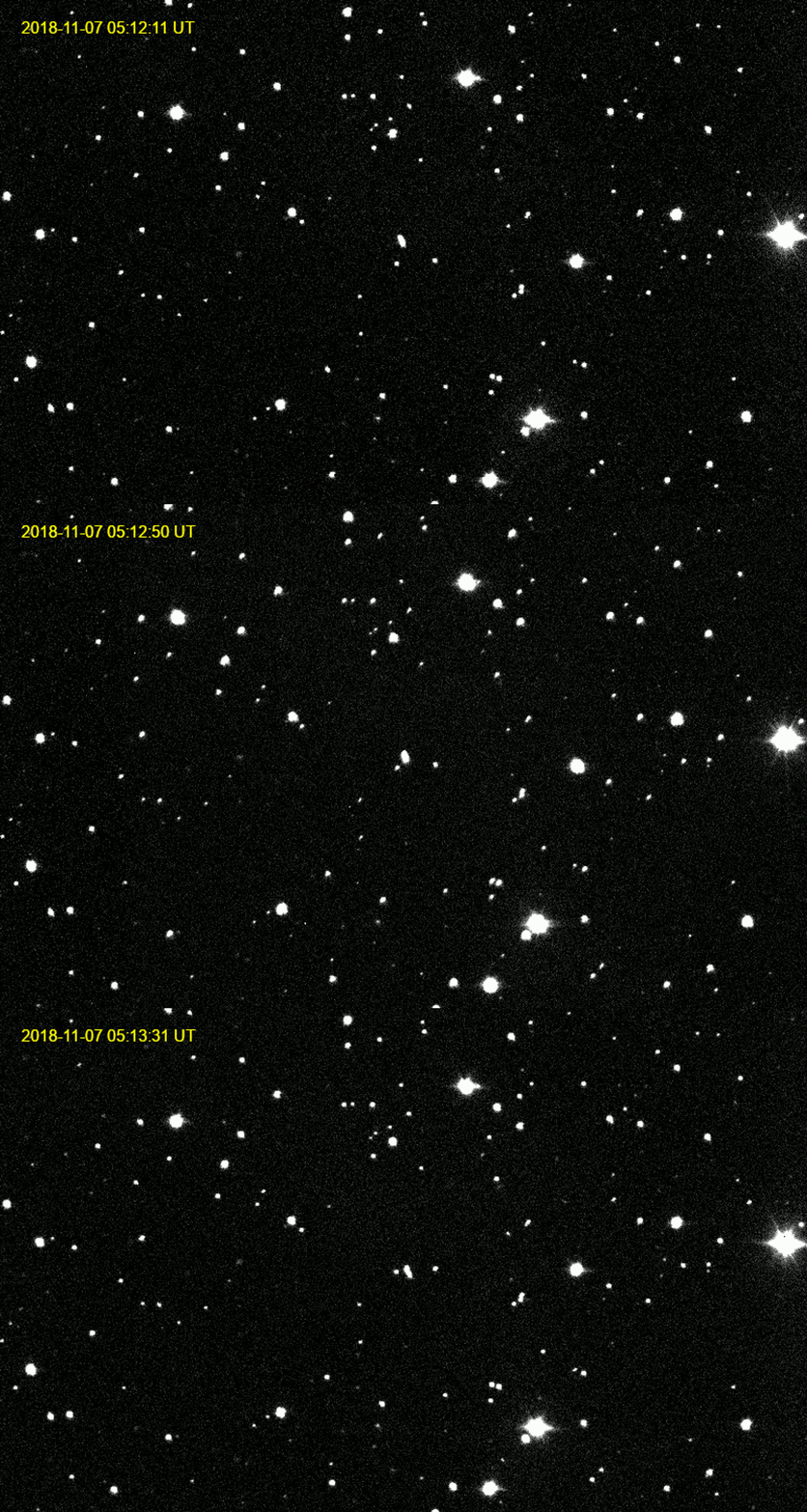
Timelapse of Zoozve moving across the sky in images taken by the Zwicky Transient Facility (ZTF) on November 7, 2018.
ZTF/Caltech Optical Observatories/NASA/IPAC Infrared Science ArchiveNovember 2–3
Things are getting really crowded up there in the early-morning sky. The Moon, continuing to charge eastward as usual, now gets close to Jupiter. Mars-Jupiter-Moon . . . a beautiful sight high in the predawn sky!
November 5
On this day in 2018, Voyager 2 reached the “heliopause”—the theoretical outer boundary between the Sun’s heliosphere and interstellar space. Years earlier, the onboard batteries failed, so both Voyagers are practically at sea in the near-vacuum of the galaxy. Both Voyagers contain “Golden Records,” designed by Carl Sagan to tell the story of Earth to any interstellar travelers who might encounter the spacecraft. The records have short selections of Earth’s music, “Hello” in 55 languages, images of who sent it (a man and a woman), from where (third planet from a star), and greetings from Jimmy Carter (peanut farmer) and Kurt Waldheim (war criminal).
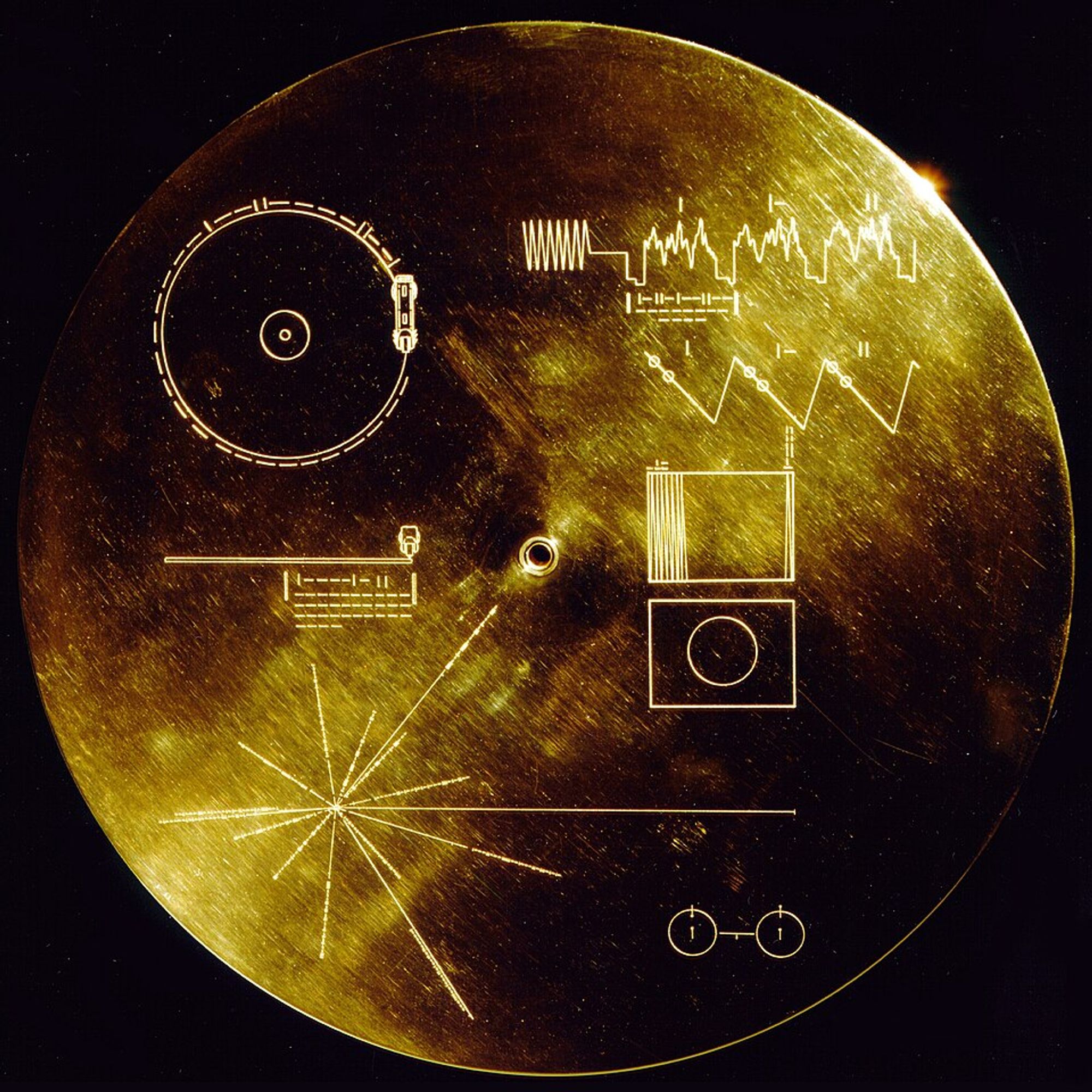
Gold cover designed to protect the Voyager 1 and 2 "Sounds of Earth" gold-plated records, sent to space in 1977.
Courtesy of NASA/JPLNovember 7
Birthday of Marie Curie (née Sklodowska) in Warsaw in 1867. The only person ever to win Nobel Prizes in different fields (1903 Physics, 1911 Chemistry).
November 8
A momentous date for you and me . . . and not ONLY because of the U.S. presidential election of 2016. More importantly, Wilhelm Roentgen discovered X-rays in his lab in Germany on this date in 1895. He found, on the day of discovery, that these rays were a new form of light, with much higher energy . . . and that they were extremely penetrating—revealing the bones in animal tissue. Within a few months, they were used to find bullets in wounded soldiers—and ever since, have led to 1001 advances in medical diagnosis.
In the 1960s, it was also found that many stars are copious natural emitters of X-rays—including the famous Cygnus X-1, the first black hole ever identified. Today, many X-ray telescopes orbit the Earth and reveal that practically every type of star (and galaxy) emits X-rays at some level.
November 8
Solar observing, 1–4 pm, Pioneer Works.
November 9
New Moon, 2:02 am EST.
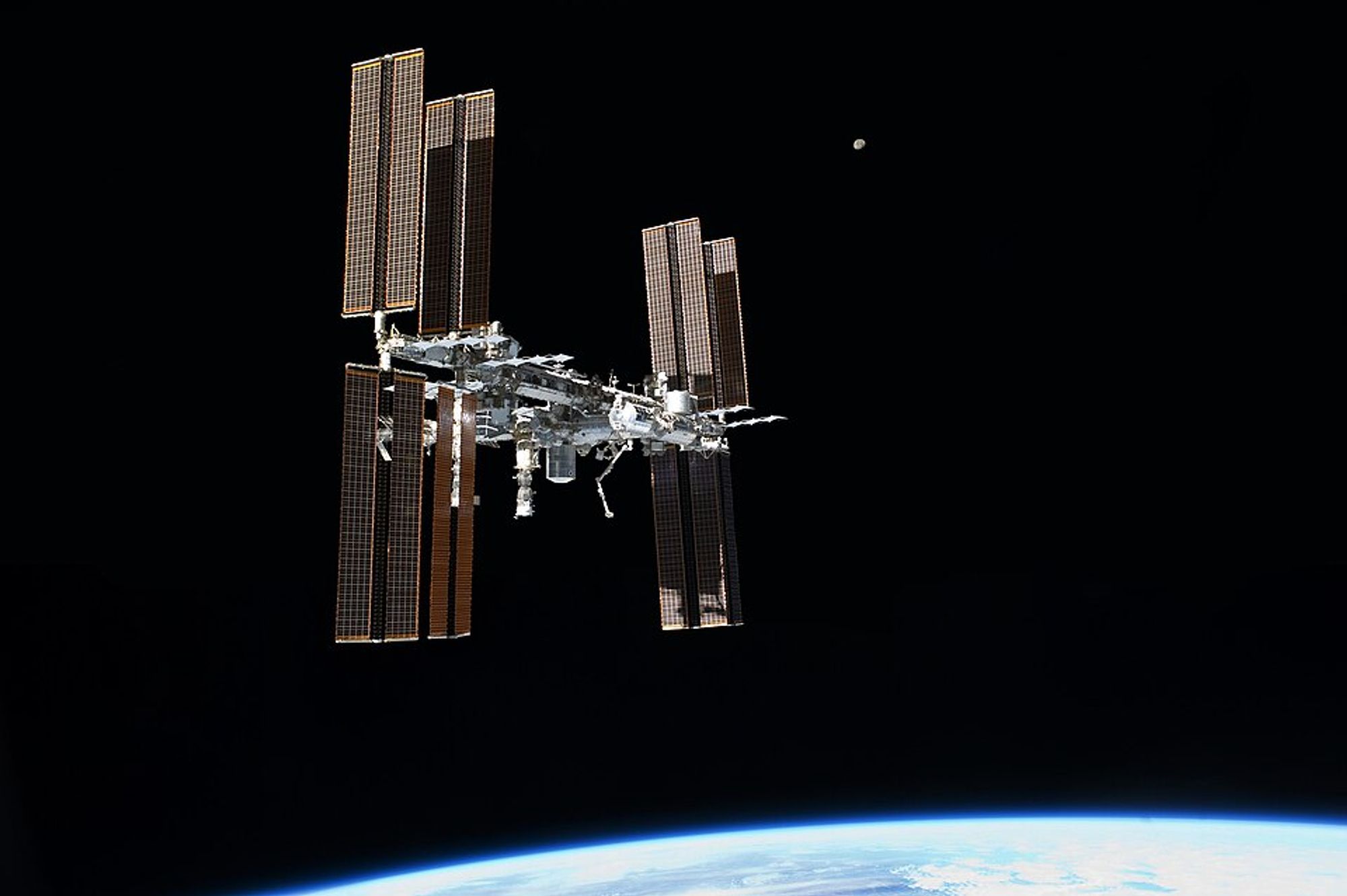
The International Space Station photographed above the Earth, with the Moon far in the distance, 2011.
Courtesy of NASANovember 12
Overflight of NYC by the ISS rising in the west at 6:31 pm, passing overhead, and disappearing in the southeast at 6:34 pm as it enters the Earth’s shadow. Really hustling across the sky at 18,000 mph.
November 14
Birthday of Frederick Banting in 1891. I just had to mention it. No astronomical significance whatsoever. But there are very few movies about scientific discovery. Two great ones, in my opinion, are Galileo, a CBC production of Bertolt Brecht’s play . . . and Glory Enough for All (about Banting’s discovery of insulin). Another is Inherit the Wind (about the Scopes “Monkey” Trial). Lots of opportunities for new flicks. A really good cartoon movie, by Frank Capra, is The Strange Case of the Cosmic Rays (part of the old Bell Telephone series of shorts on science). Alas, Jimmy Stewart is not in this one . . . but hey, Charles Dickens and Fyodor Dostoevsky are! Worth an effort to find. Actually, all of the old Bell Telephone short flicks on science are excellent.
November 15
Sunrise 6:42 am EST
Sunset 4:37 pm EST
November 15
Mars and Jupiter are very close together in the morning sky. As always, Jupiter is the brighter of the two.
November 16
The anniversary of the 1974 “Arecibo Message,” the first attempt to send a message to extraterrestrial listeners about who we Earthlings are. It was aimed at the globular cluster M13, which has about 100,000 stars . . . so who knows, maybe someone will receive it. The message is brief and primitive, but ingenious. But don’t expect a reply: M13 is roughly 25,000 light-years distant.
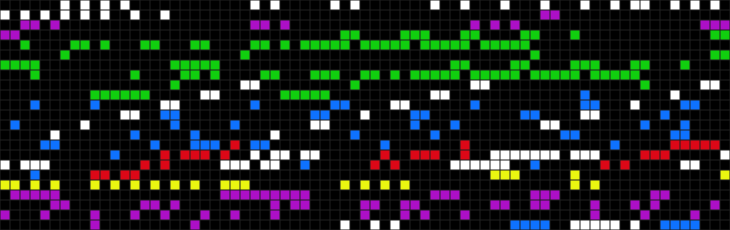
A demonstration of the Arecibo Message with color added to highlight its separate parts, arranged in columns and rows. The 1974 binary transmission carried no color information.
Courtesy of Jarmo Kivekas and Wikimedia CommonsNovember 16–17
Tonight is the peak of the Leonid meteor shower, occurring when the Earth collides with dust debris strewn around the orbit of Comet Tempel-Tuttle. The comet itself is nothing special and is now out there beyond Jupiter. It's an ordinary comet, but at least once spewed a huge hunk of dirt and ice, which continues to orbit the Sun with the parent comet's 33-year period. So astronomers keep an eye out each November 16–17, when we collide “with the orbit.” That apparently happened on November 13, 1833, when Boston observers reported meteors falling “like snowflakes in an average snowstorm.” Other great displays were seen in 1866 and 1966. Nothing special is expected this year, but comets and their debris are famously fickle.
Roz Chast, who evidently knew some astronomy, once described comets as NYC landlords: They live very far away, with a heart made of ice and stone.
November 17
First-quarter Moon—well-placed in the south during evening hours.
November 20
Edwin Hubble was born on this day in 1885, in Marshfield, Missouri. Hubble is routinely credited today as discoverer of the recession of the galaxies (“the expanding universe”)—although Lowell Observatory’s Vesto Slipher was writing papers on that subject as early as 1914, when Hubble was teaching Spanish and coaching basketball at a Kentucky high school. But after Hubble joined the staff at Mount Wilson Observatory and began using its 100-inch telescope (the largest in the world), his data proved the radial-velocity versus distance relation (“Hubble’s Law”) beyond reasonable doubt. The exact shape of that relation is closely related to the age of the Universe, and continues to be hotly debated.
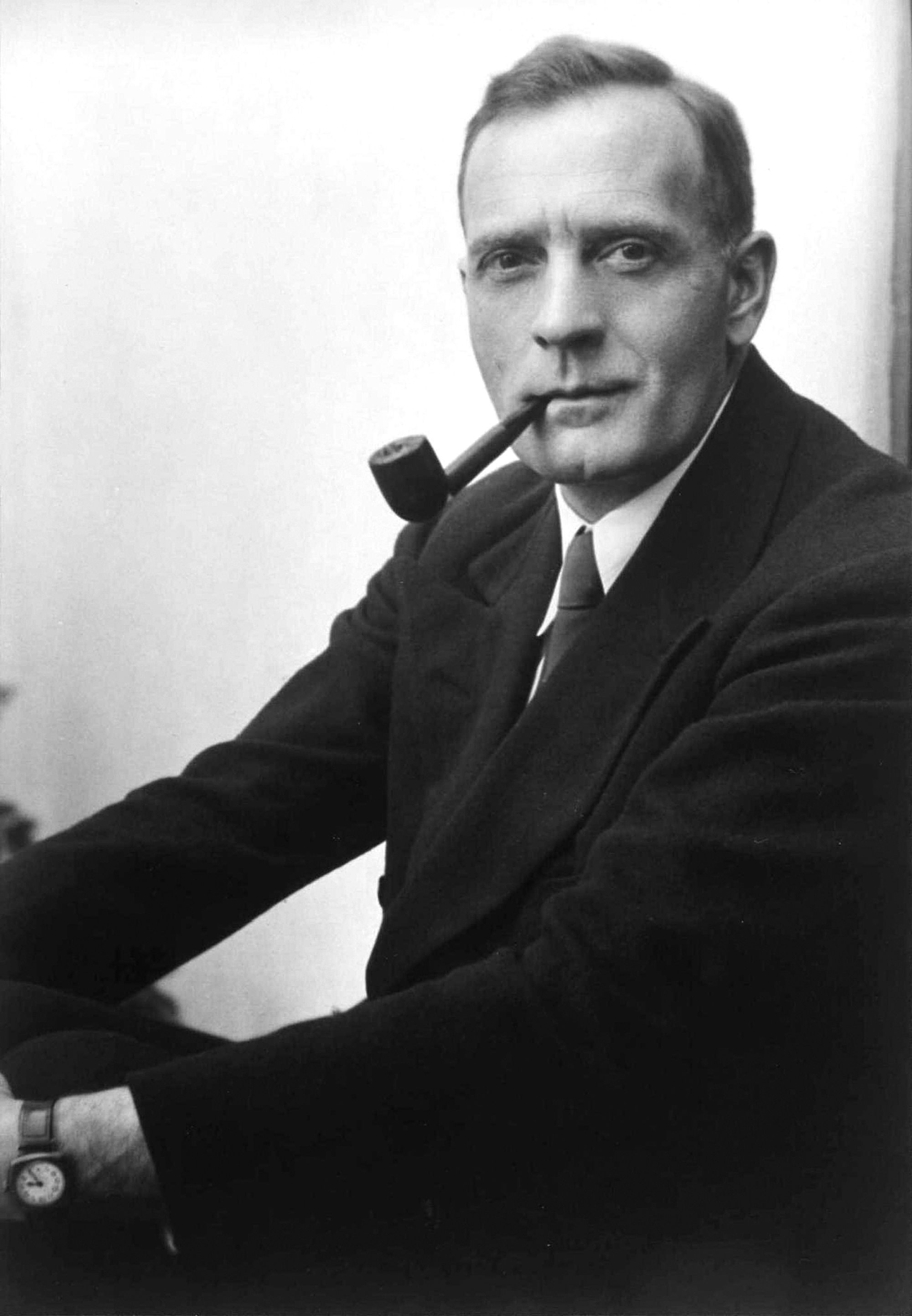
Studio portrait of Edwin Powell Hubble, photographed by Johan Hagemeyer, 1931.
Courtesy of Huntington Library.November 21
The Sun enters the astrological sign Sagittarius.
November 23
The Sun enters the constellation Scorpius. Whoa! Didn't stay long in Sagittarius, did it? And shouldn't it be traversing these constellations in the OPPOSITE order? Truth be told, astronomers—mostly the Brits—paid only rough attention to astrological boundaries when they divided up the sky into constellations in the nineteenth century. They had a difficult task: make the star pattern roughly resemble a scorpion, roughly keep the boundaries of old star maps, and assign each zodiacal constellation 1/12th of the Sun's path. All at the same time. On top of all this, they were well aware that the Earth's 26,000 year axial precession would make their assignments gradually obsolete. So, in the ~2000 years since the traditional zodiacal boundaries were set, things have moved almost an entire constellation.
But it could have been worse. Those Brits could have put Queen Victoria in the sky.
November 26
Thanksgiving.
No astronomical significance whatsoever. But if you adopt the (highly recommended) practice of giving thanks at dinner, here's one for you: Give thanks that the Moon and the Sun have roughly the same angular diameter (0.5 degrees). And if you're pretty savvy, tell your dinner companions why it's worth celebrating. (They'll think it's weird, but tell them anyway.) Plus, if you're VERY savvy about such matters, tell them why it will not always be so. We live at a special time in history. NOTE for those gutsy enough to take up my suggestion: it’s because the Moon is slowly out-spiraling from the Earth, as it steals angular momentum from the rapidly spinning Earth. In another billion years—no more total solar eclipses!
November 30
Sunrise 6:59 am EST
Sunset 4:29 pm EST
Sun enters Ophiuchus (the Serpent Bearer). Not on the traditional zodiacal list, but the Sun visits every November 30 . . . and stays for 18 days. Sagittarius doesn’t get a bite until December 18. This is not accepted by traditional astrology, which insists that the original constellation assignments be respected, even though, thanks to Earth’s axial precession, the zodiac has shifted by about ¾ of a constellation since the days of Babylon. Sorry! This division of opinion is sometimes referred to as TROPICAL versus SIDEREAL astrology. TROPICAL = with respect to equinoxes, and SIDEREAL = with respect to the stars (constellations).
On this day in 1954, an Alabama woman (Ann Hodges) was napping on her couch when an 8.5-pound space rock ripped through her ceiling and struck her on the hip—the first well-documented case of a human hit by a meteorite. There is no record as to whether she believed in tropical or sidereal astrology. She hoped to make some $ by selling it . . . but so did the homeowner, and it eventually wound up in the Alabama Museum of Natural History.
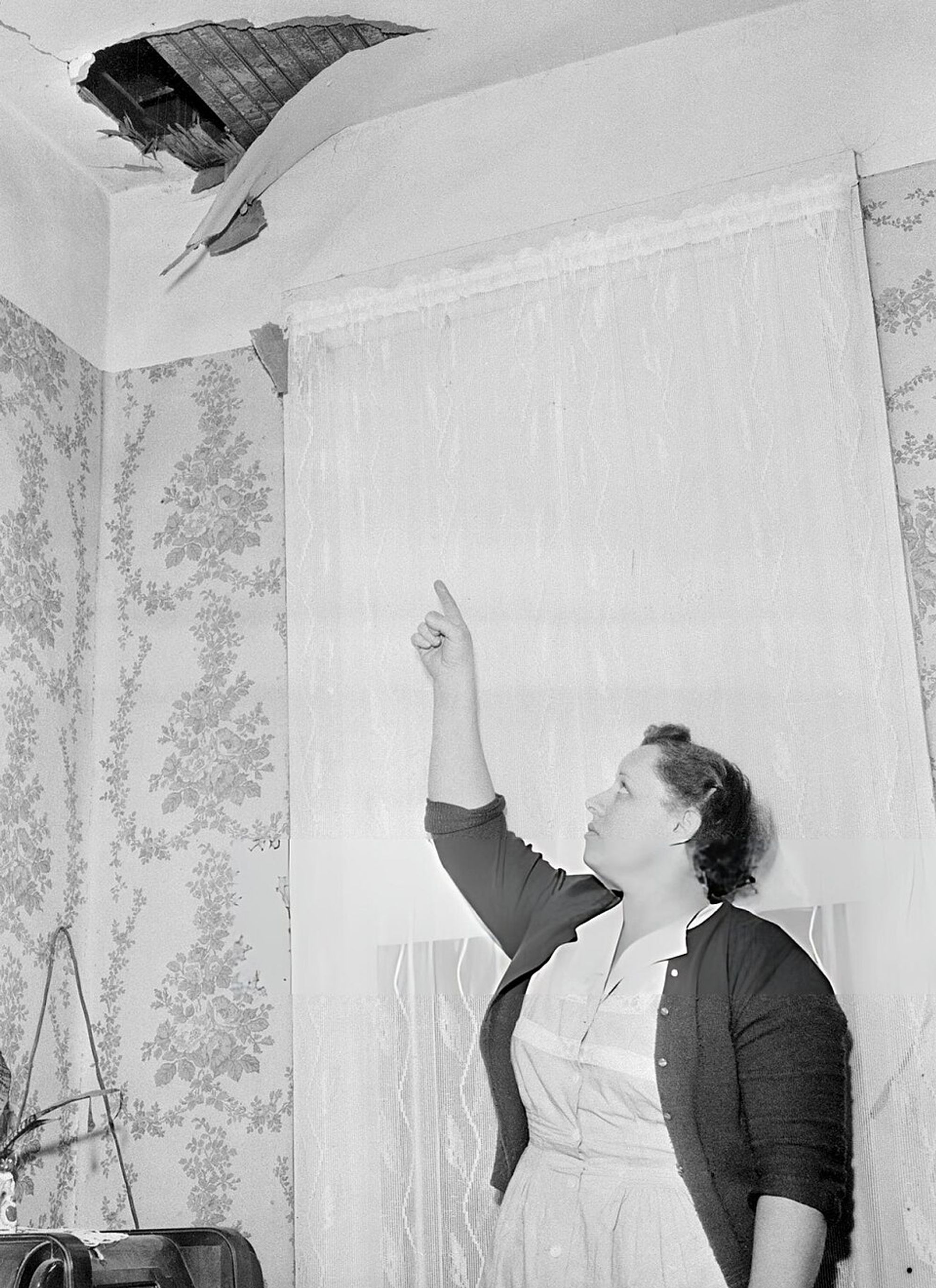
Ann Hodges in her home in Alabama, 1954.
Courtesy of United Press InternationalThere are hundreds of famous meteorites, but there are also many thousands of little fellas (up to maybe 20 pounds). Many are available through Etsy (the famous website for craftspeople); these, especially, may be artistically mounted and/or accompanied by stories of their origin. Some are pretty inexpensive. Pioneer Works should get one! You can buy some from “The Space Store”—and probably some other sellers.
December
December 1
Sunrise 7:00 am EST
Sunset 4:28 pm EST
Last-quarter Moon, rising after midnight.
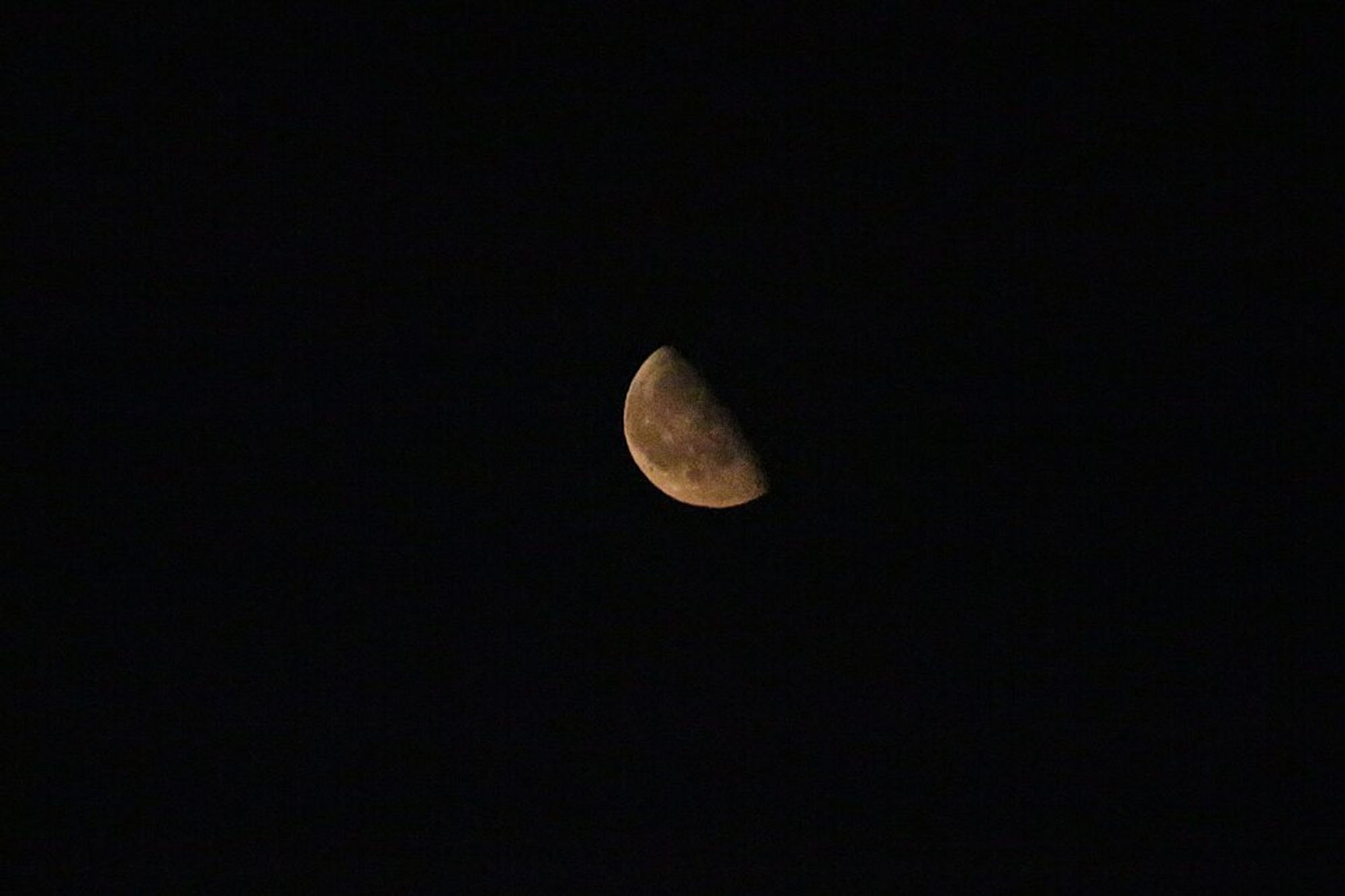
Last Quarter Moon on June 26, 2016.
Courtesy of Wikimedia CommonsDecember 2
On this date in 1942, the first controlled, self-sustaining nuclear chain reaction was achieved by the “Manhattan Project” scientists—in an underground squash court at the University of Chicago. Working under the direction of Enrico Fermi, the team found that by bombarding uranium with neutrons, the uranium would fission into lighter elements, together with more neutrons, which would immediately find more uranium to fission—each time with energy release (because mass is lost, and E = mc2). This was the basis of the atomic bomb. They basically knew this would happen, but needed to find a way to control the reaction—otherwise you couldn't build a bomb without blowing yourself up (along with much of Chicago). They found a way—with control rods made of cadmium (which loves to absorb neutrons). After the tense but successful experiment, the team cabled to the super-secret agency, “The Italian Navigator has discovered the New World.” The cryptic reply came: “How were the natives?” eliciting the answer “very friendly.”
December 4
Death of Omar Khayyam in 1131. Perhaps the last of the great Persian astronomers . . . and my favorite.
Up from Earth's center through the Seventh Gate,
I rose, and on the throne of Saturn sate.
And many knots unravell'd by the road
But not the knot of Human Death and Fate.
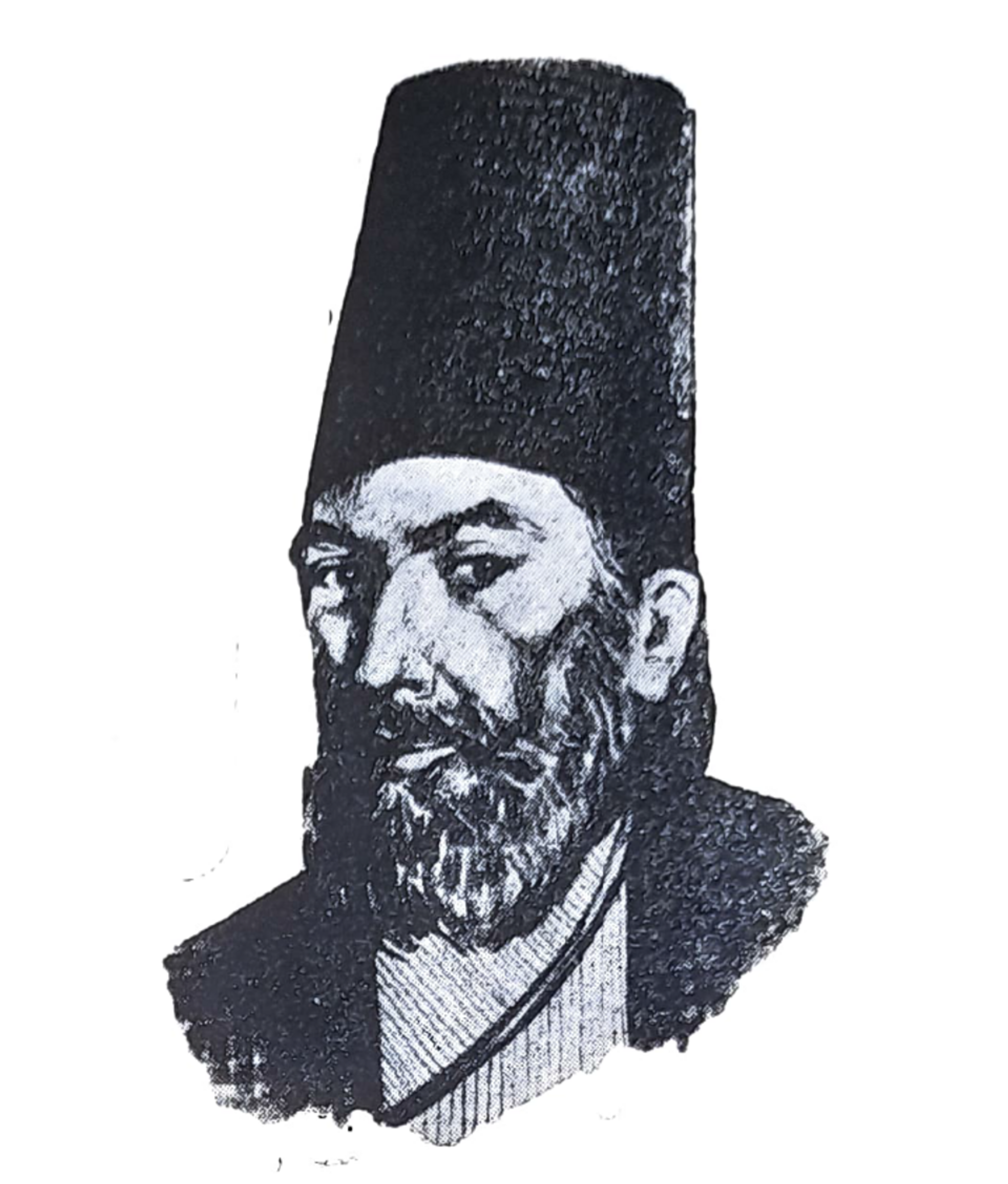
Sketch of polymath Omar Khayyam from Sayr mulhimah: min al-Sharq wa-al-Gharb, 1961.
Courtesy of Wikimedia CommonsDecember 4
The waning-crescent Moon, Venus, and Spica (brightest star in Virgo) form a nice triangle on this morning.
December 6
On this date in 1957, the U.S. Navy made an attempt, on live TV, to put a satellite into Earth orbit —basically in response to the Soviet Union’s shocking success (“Sputnik”) on October 4. After rising only a few feet from the launch pad, the thing exploded on live television. Worth searching for the video (“Project Vanguard”). The U.S. press called it “Flopnik” and “Kaputnik.” As a child growing up in Japan, I remember seeing the explosion on Armed Forces TV. Well-suited to my attention span . . . and better than any sumo match (a typical match only lasts about 10 seconds).
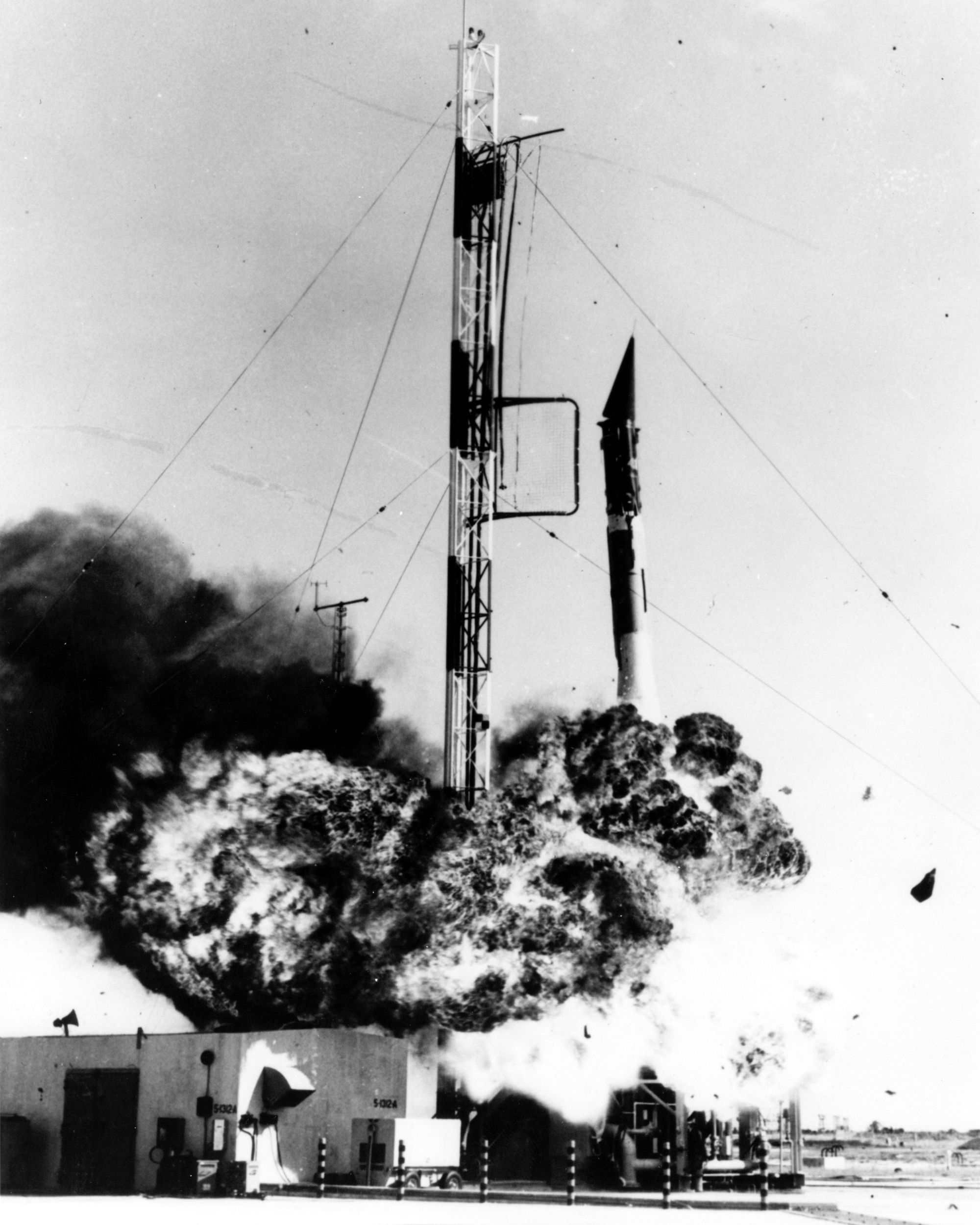
Vanguard rocket exploded after launch at Cape Canaveral, December 6, 1957.
Courtesy of NASADecember 7
Earliest sunset for NYC (around 4:27 pm). This might be surprising—why isn’t it the December solstice, which is always the shortest day (9 hours and 15 minutes)? It’s because the exact time of “solar noon” (when the Sun is directly south) wanders during the year, owing to both the tilt of the Earth’s axis and the slight eccentricity of its orbit. Also, it’s only “earliest” by a gnat’s eyelash: Sunset hovers around 4:27–4:28 pm for much of early December.
December 9
New Moon, 7:51 pm EST.
December 13
Solar observing at Pioneer Works, 12:30-2:30 pm.
December 13–14
The Geminid meteors. Roughly after midnight on these nights, the Earth passes through the orbit of the asteroid Phaethon (just the orbit, not the asteroid itself!) and a large supply of tiny particles burn up in our atmosphere. These are called Geminid meteors, because they appear to come roughly from the vicinity of the constellation Gemini. It’s the most prolific of the annual showers . . . but the timing (after midnight, when Gemini is reasonably high in the sky) means that you should expect cold weather. A sleeping bag and a companion to keep your spirits high (“there’s one!”) are highly recommended. And perhaps a reclining chair; human necks are not naturally designed for this activity.
And for gaps between meteors, savor the majesty of Orion, a tad south of Gemini:
“Thou splendid soulless warrior,
Ghost of the shimmering summer dawn,
King of the winter nights!”
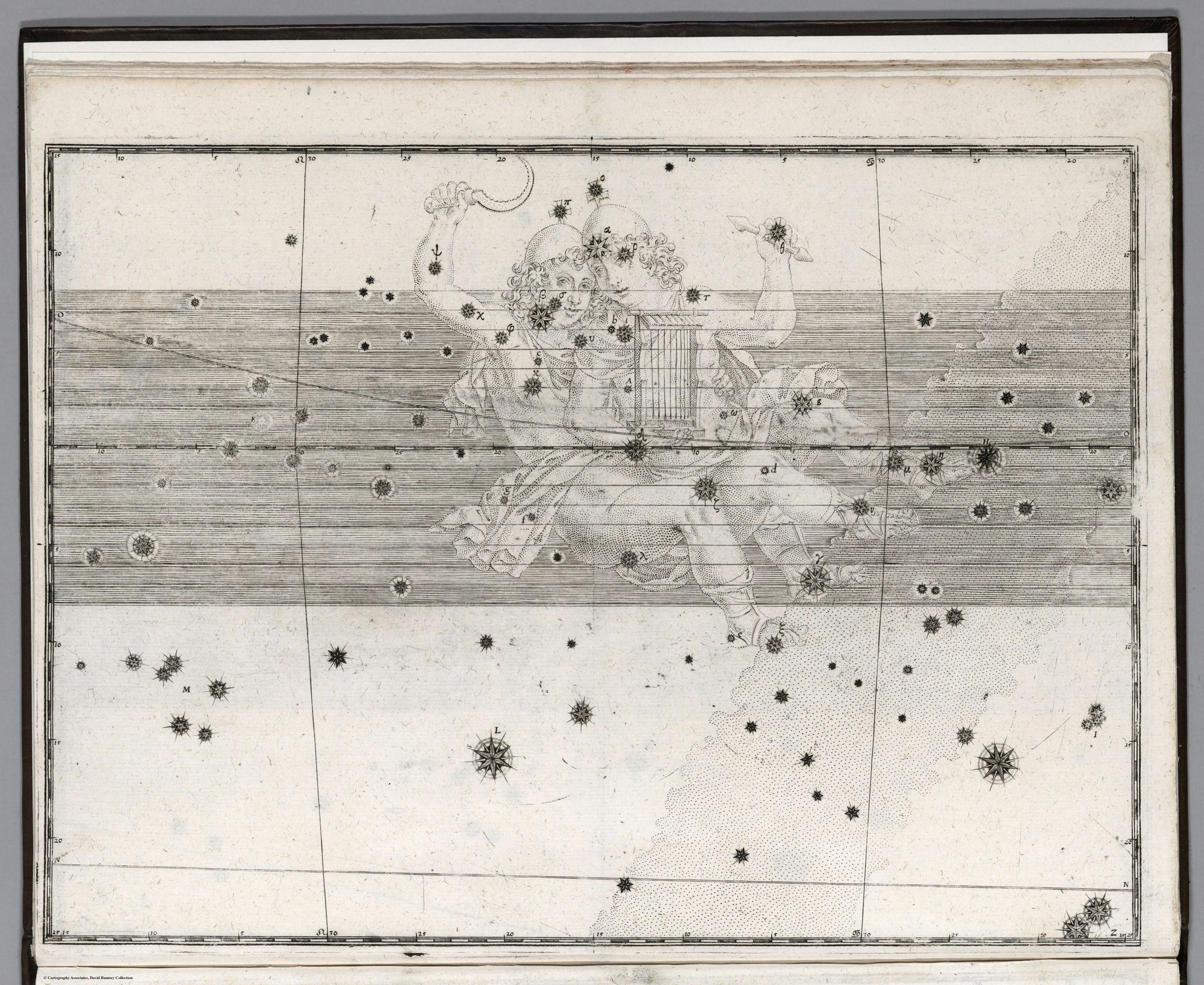
Example of Johann Bayer's celestial chart of Gemini, 1624.
Courtesy of Wikimedia CommonsDecember 16
Birthday in 1917 of Sir Arthur C. Clarke, great prophet of the Space Age (along with Willy Ley). Clarke’s book The Exploration of Space, novel Childhood’s End, and movie (with Stanley Kubrick) 2001: A Space Odyssey are his great space trilogy. For a much shorter read, I recommend The Nine Billion Names of God.
December 17
First-quarter Moon. Always a good time for binocular and telescopic observing.
December 18
Sun enters the constellation of Sagittarius.
December 21
December (winter for us borealites) solstice at 3:50 pm EST. And on that day, the Sun enters the astrological sign Capricorn. This difference is sometimes said to represent the difference (December 18 versus 21, nearly one constellation’s worth) between “tropical” and “sidereal” astrology. When I taught at UCLA, students were fascinated by this. At Columbia . . . not so much.
December 25
Isaac Newton was born on this day in 1642, according to the calendar then in use in England. Isaac's father died a few months earlier, and Isaac's mother soon remarried, leaving the young Isaac to the care of his grandparents. René Descartes, the other intellectual giant of the seventeenth century, had a similar childhood.
Christmas. The exact timing of Jesus's birth is highly uncertain. Neither the day, nor the month or year is known. Early Christians may have favored a day near the winter solstice, because that signifies the seasonal rebirth of the Sun's gifts (warmth and light). And some Christians celebrate January 6; that might be the origin of the “12 days of Christmas.” Some astronomers have tried to find an astronomical event (planetary conjunction, nova, comet, etc.) around that time, and link it to the story of the Magi “who saw a star in the east.” These are popular themes in planetarium shows. None of the commonly proposed astronomical candidates falls neatly on the traditional date of Jesus's birth; most are dated to several years earlier. Also, it’s hard to understand how an astronomical sighting can indicate a particular place on Earth, as implied in the Matthew gospel, the only source for the story. How could the Magi know where to go? Everything in the sky moves!
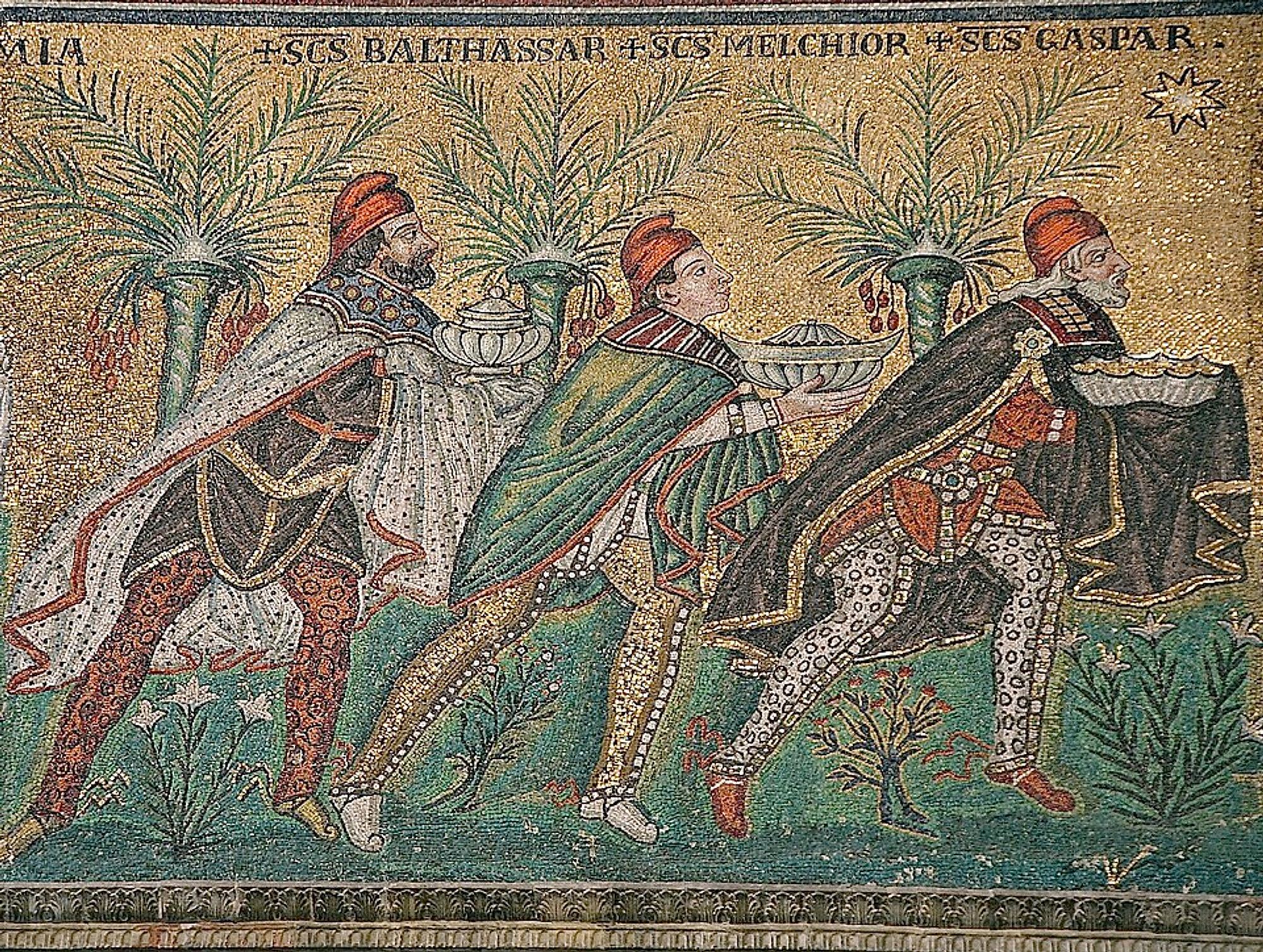
Three magi detail from Mary and Child, surrounded by angels, mosaic of a Ravennate Italian-Byzantine workshop, completed within 526 AD by the so-called "Master of Sant'Apollinare".
Courtesy of Wikimedia CommonsDecember 27
Johannes Kepler was born on this day in 1571. Kepler's derivation of the precise orbits of planets (ellipses) was the first to establish that the planets moved in a precise geometric pattern. Arthur Koestler wrote a great popular book about Kepler, The Watershed. It was part of an equally great popular book about the Scientific Revolution, The Sleepwalkers. Read one of them. Very gifted writers seldom take on scientific subjects. But when they do, it’s magical!

Portrait of Johannes Kepler by Hans von Aachen, circa 1615.
Courtesy of Wikimedia CommonsDecember 28
Arthur Eddington was born on this day in England in 1882. In the early days of the twentieth century, knowledge of physics among astronomers—especially American astronomers—was rare. But Eddington was a gifted mathematician and physicist, and thoroughly acquainted with all the new advances from Einstein, Bohr, Rutherford, and Planck. (American physics was a tad moribund in those days.) He understood their implications for how energy is produced in stellar cores . . . and wrote about it beautifully in popular books, as well as technical journals. In high school and college, I was enchanted by his books, especially The Nature of the Physical World.
December 31
Sunrise 7:19 am EST
Sunset 4:38 pm EST
The last second of this day (23:59:59) used to fascinate me. Everyone knows about leap YEARS, when an extra day (February 29) is added every four years to keep the calendar straight—except in century years not divisible by 400. That allows days to be counted accurately for a few thousand years. But it still assumes days to be 86,400 seconds long. Are they always? NIST and the U.S. Naval Observatory maintain atomic clocks that are more uniform than any astrophysical object—certainly including the Earth’s rotation. So I would tune my shortwave radio to WWV, the time-signal station in Fort Collins, Colorado, and listen for the one-second beeps around the end of a UTC day when a leap second was scheduled. Sometimes, an extra second would be inserted before the next day started. Very satisfying! This was called a “leap second”—and there are precise records of the leap seconds added over the last ~50 years. I sure hope they were accurate—I depended on them for my PhD thesis.
Over the long haul (the last 30 centuries), the Earth’s spin appears to be slowing down, as it loses angular momentum to the slowly out-spiraling Moon. More recently, there is some year-to-year evidence of spin-up, possibly due to changes in the distribution of mass within the Earth. I’m sure glad keeping track of leap seconds is someone else’s job!
BTW, you don’t have to miss your NYE party. A leap second, if one is scheduled for the end of December, is inserted simultaneously worldwide at the end of the UTC day. If you dare, you can tell your fellow U.S. celebrants that they missed the moment by at least five hours. Good luck with that! ♦
Subscribe to Broadcast