On Metamorphosis
A sea urchin larva with its developing tube feet, visible under a microscope.
Courtesy of Beatrice SteinertSoon after finding out I was pregnant, I began to transform. My body temperature skyrocketed, my limbs felt heavy, and I often wanted to be alone. I began learning new rhythms of caring for myself; I needed food every two hours and at least one nap a day to keep going. At eight weeks, to my relief, my first ultrasound revealed a small form with rounded tissue folds floating inside me. By 13 weeks, those cellular constructions had morphed into squirming arms and legs. I watched as the baby touched her toes to the other end of my pear-sized uterus. “That’s cute!” the sonographer next to me exclaimed as she clicked, adding the picture to the growing chain spiraling down from the printer like the unraveled shell of a mollusk.
As I attempted to grasp the overwhelming significance of this long-awaited view—my baby, on the screen in front of me—my attention shifted to the sonographer, who had one hand on my stomach and the other on a computer mouse. I related to her gaze: She was trying to make sense of what she saw—rotating the probe, measuring, annotating, synthesizing a mental image. But rather than the sea urchin larvae I study, she was looking at my body. And at the new body that was forming inside me.
An ultrasound image of the author’s eight-week embryo.
Courtesy of Beatrice SteinertAn ultrasound image of the author’s 13-week fetus.
Courtesy of Beatrice SteinertI have wanted to understand how life emerges ever since I can remember. When I was four, I asked my mother, then pregnant, to buy me a color atlas of human fetal development so I could follow along. I traced each body part in the book as my mother gradually grew and sculpted my sister inside her womb. In a college vertebrate embryology course, I became enamored with the enormously complex process by which a few cells—at first just the egg and sperm—become fingers and toenails and a heart pumping blood through branched veins.
In graduate school, a world even more captivating drew me to a different realm of biology. The more I learned about the animals in our oceans, the greater my desire grew to be close to them. Unlike vertebrate embryos, which start out more or less as a flat disk, those of many marine invertebrates—the boneless creatures that make up well over 80 percent of all ocean-dwelling animal species—take on an astonishing array of shapes. Tunicates, or sea squirts, are headless beings whose embryos arrange their cells in cubic formations, while snails and worms begin as small balls that expand through spiral-patterned cell divisions. I spent years attending to the intricacies of how embryonic cells in crustaceans align into precise rows and columns, laying the foundation for a body of repeated segments.
The creature who currently holds my attention is the sea urchin: a rounded, spiny, alien-like invertebrate found in all the world’s oceans. Sea urchin embryos are beautifully symmetric and have been prized in developmental biology research for centuries. Within a matter of hours, they transform from a crystal clear, spherical cell—the fertilized egg—into a hollow, multicellular ball, which folds inwards and elongates into a larva with pairs of cilia-coated arms surrounding a gut, a stomach, and an iridescent skeleton. Once developed, an urchin larva meanders around the vast ocean for weeks to months, building up its stores by eating algae and other microorganisms. Then, it builds itself a new body—one that will radically remake its way of life.
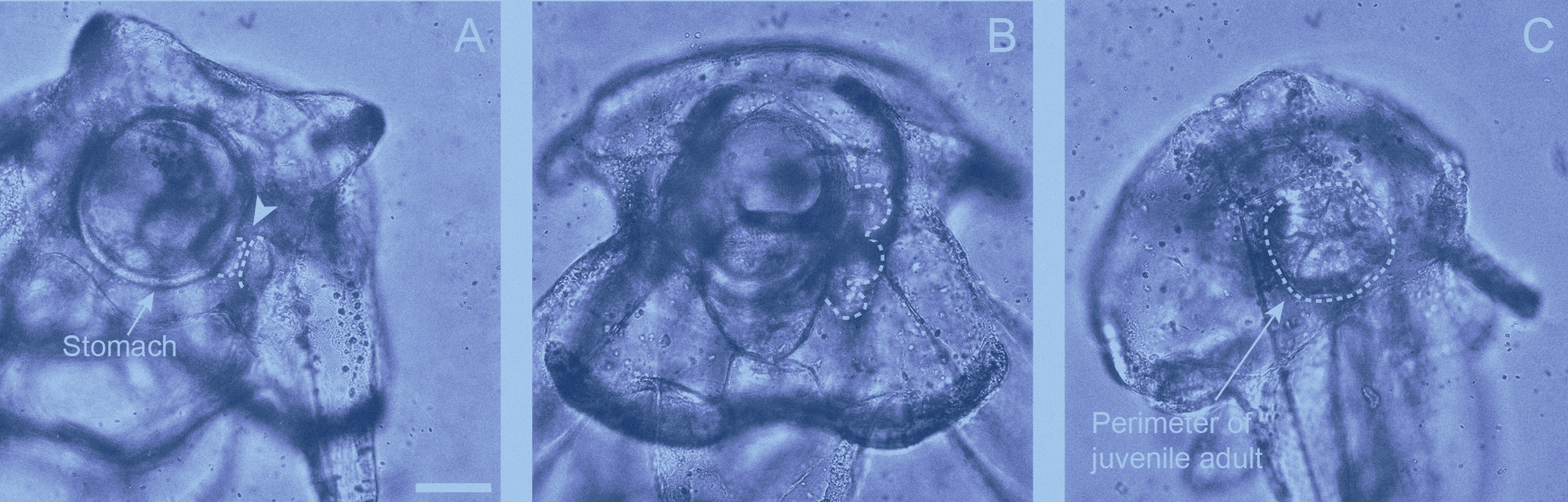
Micrographs of three developmental stages of the sea urchin larval rudiment, the beginning of the adult form. Scale bar is 100 micrometers.
Courtesy of Beatrice SteinertEmbryonic development—the growth, division, and molding of a handful of cells into a functional body—is often just the beginning for many animals, the first act in a much longer story. Metamorphosis, or the act of changing in form, is a feature of biology across the tree of life. More than half of all known animals—including flies, fish, salamanders, butterflies, corals, and barnacles, among others—completely metamorphose at least once in their lives and even more undergo similarly dramatic alterations. In the ocean, which makes up approximately 70 percent of our earth’s surface, metamorphosis is an even more common developmental trajectory among invertebrate species. For these creatures, shifts into and out of distinct life cycle phases, specialized for particular needs and behaviors, are quick and dramatic. These transfigurations are triggered by a flooding of the body with hormones, chemical cues that initiate radically new developmental processes. Alternate genes are activated, cells are absorbed or remodeled, and existing tissues or organs modified to prepare for the new conditions of the organism’s life.
While biology is unequipped to provide a definitive answer as to why metamorphosis has evolved as such a common strategy, it is clear that this transformation lets animals explore and adapt to new habitats, to expand their worlds beyond those in which they started out. And more than any other biological process I’ve encountered, through both research and lived experience, metamorphosis troubles the line we are often quick to draw between self and other. This far-reaching facet of life calls into question what exactly it means to be an individual.
*
I began studying how sea urchins metamorphose around the same time I started allowing my desire to be pregnant to wash over me. At first the significance of this synchrony was unconscious, only becoming apparent once I was in the throes of reconfiguration. Anchoring myself in urchin biology, seemingly so different from my own, gave me permission to envision how my world might change. As an early career academic at the outset of my 30s, I am an anomaly among my peers, most of whom—especially my colleagues in academia—are childless. I have not been immune to the culture, not to mention the economic pressures, of delaying parenthood, of prioritizing professional growth and long-term job security above all else. But I’d felt a strong current pulling me toward a different way of being as the laser-focused attention on my career that defined me for over a decade softened. I wanted to set in motion the process of becoming I hoped my body was capable of, to develop something within me while I developed into something new.
There is a lot we don’t know about the biology of metamorphosis, in large part because it takes time and unwavering patience to study. In insects, larvae construct an opaque protective casing around themselves—a cocoon, chrysalis, or puparium—before dissolving most of their tissues into a gelatinous goo and building their adult forms. In marine invertebrates, change is often easier to visualize inside the larvae’s transparent bodies. But this process can take months, and will only occur in response to the right balance of environmental cues—including the number of other larvae around, resource availability, and the proximity of predators, among many other factors.
To get sea urchin larvae to metamorphose in the lab, they must be raised in relative isolation and provided abundant food, which requires maintaining bubbling cultures of multiple algae species. Their salty water needs to be changed out frequently—about three milliliters per one-half millimeter-sized larva—and constantly rotated to simulate the flows they would experience in the ocean. Unlike preparing embryos for study—a near-instant recipe of mixing eggs and sperm in a dish—raising larvae through metamorphosis involves weeks, sometimes months, of attentive care.
My particular interest in sea urchin metamorphosis concerns how cells build the pentaradial symmetry of adult urchins; how they stretch, squeeze, and pull on one another to fold the larva’s tissues into the five-part foundation of a new body. I was only able to witness this organic origami once I became attuned to a daily routine of water changes and feeding. After nearly two weeks of this regimen, I sucked up a few sea urchin larvae from their tank and transferred them to a microscope slide. Keeping my hands as still as possible, I rotated their delicate, glassy arms with fine tweezers. As I peered into the microscope, all I saw at first was transparent mush sprinkled with the rainbow glitter of light diffracting off the larva’s skeleton. I noticed the churning of algae inside the stomach and the large muscle at its base contracting to draw in more food. There, on the left side of the stomach, I saw five rounded folds. Arranged in a circle, these petals of tissue establish the logic the rest of development will follow, with one for every segment of the body. Several days later, the folds grew into five tubes that stretched, bent, and contracted, testing out their sensory capacities for the first time inside the larva. These are the nascent tube feet of the juvenile sea urchin, the beginning of the organism’s new form.
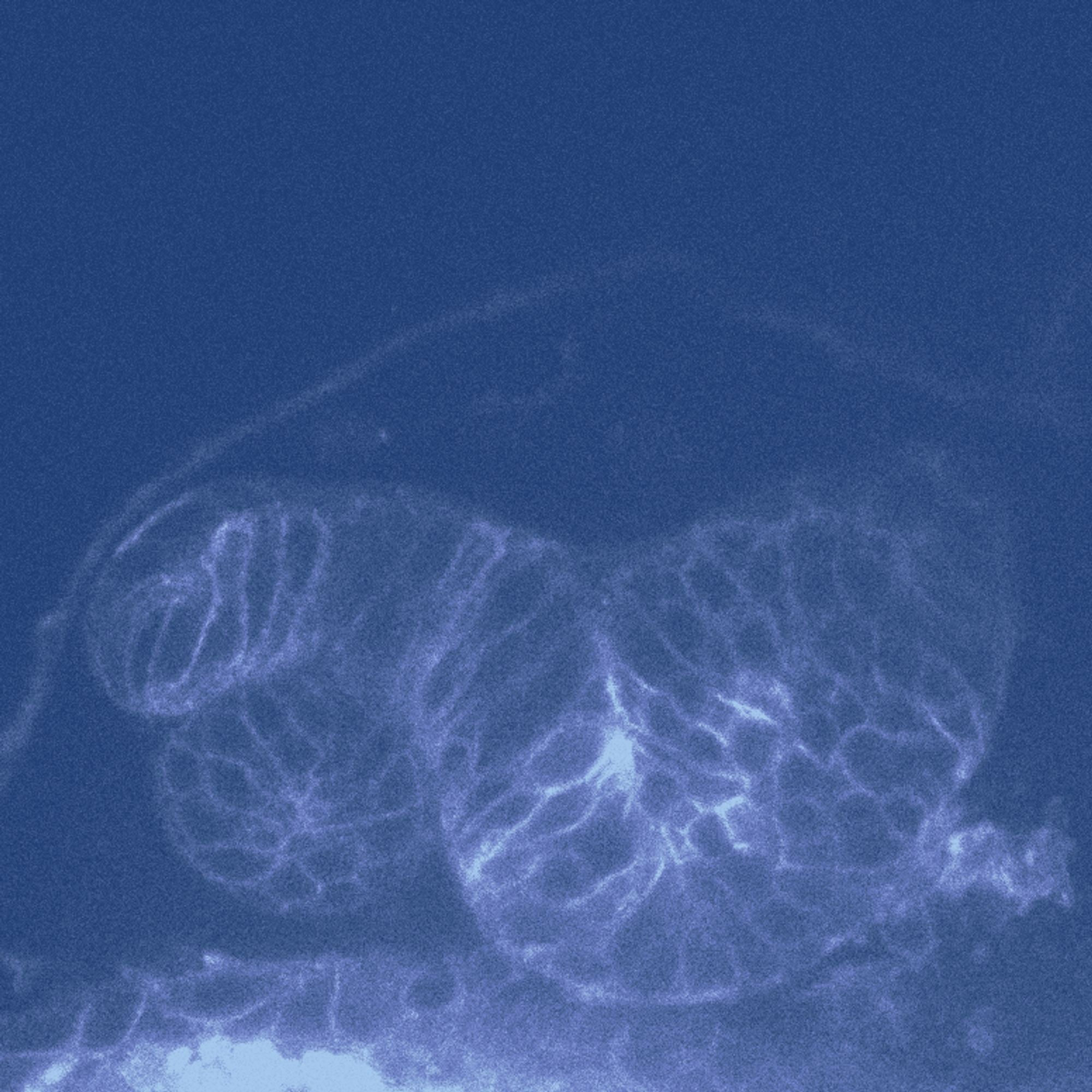
Folds of a developing juvenile sea urchin with its cells’ membranes fluorescently labeled.
In the ocean, the larvae of many sea creatures are optimized for dispersal. Their delicate bodies are coated with cilia whose rhythmic beating allows them to move through the water and sweep up food into their mouths. If you put some ocean water under a microscope, you’re likely to see dozens of swimming larvae, among other zooplankton, many of which have sail-like lobes to ride ocean currents to distant places. The adult stages they will eventually morph into are, in contrast, ocean floor dwellers with locomotive structures capable of exploring the seabed and of sexually reproducing, beginning the cycle anew.
Among metamorphosing marine organisms, the number, length, timing, and even directionality of life stages is variable. Jellyfish, for instance, have a particularly complex lifecycle made up of three distinct phases. The fertilized egg first develops into a ciliated swimming planula larva that settles to the sea floor before metamorphosing into an immobile anemone-like polyp. This polyp will in turn—through a process called strobilation—bud off tentacled domes, or medusae, allowing the animal to swim once again, this time as multiple autonomous parts. Some species of jellyfish can reverse this process: When a medusa experiences environmental stress or other cues, it can resorb its tentacles to form a larva-like ball that develops back into a sessile polyp.
Sea urchins and other echinoderms—a taxonomic group that includes sea stars and sea cucumbers—undergo a single transformation. Once initiated, metamorphosis begins as inward puckering of what is essentially the larva’s skin to form a flat pancake that creases to create five lobes. As these lobes elongate into the first tube feet—what the adult urchin will use to navigate the ground—a dome develops around them, a silhouette of what will calcify into the test, derived from the Latin testa, meaning shell or earthen vessel. Together these structures continue to grow until they occupy most of the larva’s interior. As its cilia’s rhythmic beating slows, the larva settles down, its new feet touching down on the rocks below, among which it will spend the remainder of its life.
*
Humans, like other mammals, have for the most part not been considered metamorphic beings; at a gross level, our bodies maintain relative outward constancy. But pregnancy, which like metamorphosis is initiated by a hormonal flood, brings on an equally sudden and radical remaking—physical, behavioral, and emotional—that is often not immediately visible. In her recent book Matresence: On Pregnancy, Childbirth, and Motherhood, Lucy Jones explores this underrecognized metamorphosis. She argues that matrescence, the process of transitioning into motherhood, is a profound developmental event that has been largely ignored by science and medicine. Among the purely physical changes: A pregnant person’s blood volume increases by up to 50 percent, their metabolism alters dramatically, the structure of their brain changes, and their uterus expands to as much as a thousand times its original capacity. Cells from the growing fetus as well as the mother cross the placenta bidirectionally, persisting in the other’s tissues for decades, rendering both genetically heterogeneous chimeras. In my experience, this “hormonal churn,” as Jones aptly calls it, has also shifted my sense of place in the world. Since becoming pregnant, I have gravitated to what I think of as a ground-seeking existence. More than ever, I am paying attention to the web of objects, smells, relationships, and other life forms around me. My senses heightened, I am exploring my immediate vicinity, searching for what will sustain me in this next stage of my life.
In the early nineteenth century, the first scientific classification of the life cycle stages of jellyfish described them as distinct species, even belonging to different genera: Scyphistoma for the settled polyp and Ephyra for the juvenile medusa. During the early modern period, long before the theory of evolution became widely accepted, life was considered relatively static and cleanly divisible into neat classification systems. Especially in the ocean, which obscures much of the lives of its inhabitants from human perception, larvae and adult forms were long considered entirely different beings. By the same token, pregnancy has largely not been understood in Western cultures as a remaking of the pregnant person, a development that fissures the continuity of life. Western scientists, medical practitioners, and thinkers—predominantly male—have rendered the maternal body, as feminist theorist Iris Marion Young has put it, as merely a “container” for the developing fetus, the body of a different being.
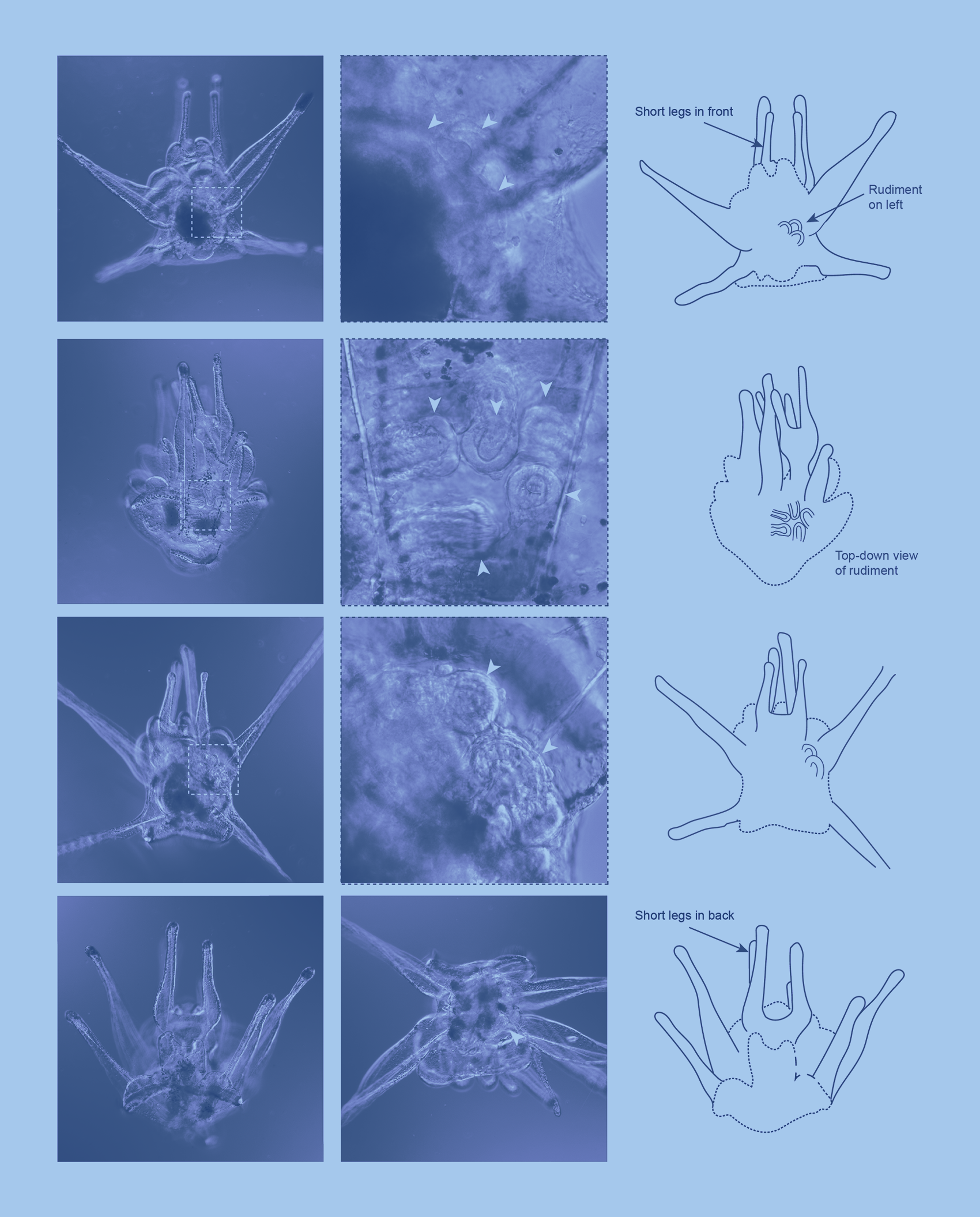
Different orientations of metamorphosing sea urchin larvae. White dashed boxes surround the juvenile rudiment; arrowheads point to tissue folds and tube feet.
Courtesy of Beatrice SteinertThe fact of metamorphosis complicates these still entrenched ideas of what an organism is: what it looks like, how it moves, and where an individual life begins and ends. Looking at a snapshot of an organism makes it easier to define, simpler to outline its boundaries. A sea urchin is a crawling animal with spines and teeth for scraping kelp from rocks. A uterus-bearing human has one body, a fixed blood volume, consistent body temperature, and cells containing the same DNA. Yet even in this static framing, over the past two centuries or so biologists have accumulated varying criteria for how to draw boundary lines around separate life forms. In the nineteenth century, descriptions of anatomical features and their functions—a tentacled stalk for securing to the ground versus a pulsatile bell-shaped structure for swimming—delineated one species, and thereby one organism, from another. Spatial boundedness—a contiguous configuration of tissues that can grow, feed, and progress the life cycle—was another kind of limit. Later in the twentieth century, biologists increasingly defined organisms according to their genetic makeup. Under this criterion, each individual, whether within or between species, contains a unique combination of nucleotides assembled in their cells’ DNA.
Considering temporality—taking the long view of development—further challenges centuries of attempts to definitively pin down the organism. Hidden inside many animals—including humans and our aquatic kin—lie the remnants of a previous life stage or the foundations for new possibilities, a vivid redrawing of boundaries whose emergence depends on a nuanced web of ecological relations. The sea urchin began not crawling on rocks with its spines but as a glassy, buoyant swimmer. With the onset of strobilation, an individual jellyfish polyp can fission into multiple genetically identical yet spatially discontinuous ephyra, which will mature into medusae. Pregnant humans undergo a dramatic physiological, not to mention existential, reworking of the body and a two-way exchange of biological material between the pregnant person and developing fetus, dissolving what Marion Young has called “the transparent unity of the self.” When the baby is born, one body becomes two that share cells containing identical genomes. Different bodies, different habits, different relations to an ecosystem, different boundaries of the self, same organism.
In his 1981 essay Metamorphosis, biologist George Wald proposed “metabiosis” as a term that can more capaciously hold together all of what metamorphosis involves. These transformations are not just a change in form but “a profound change of life,” a remaking of an organism’s chemistry, cellular makeup, behavior, and ecology. One becomes another, sometimes another who will bud off a piece of itself to chart a separate, new trajectory out in the open ocean. As metabiosing beings, my sea urchins and I are on a similar journey. While I retain my hands, feet, and the general outline of my being, my body transforms. I can feel my world, and the way I move through it, altering. I find welcome companionship in knowing that my ocean-dwelling relatives are similarly remaking themselves. Life emerges not just once but time and again, making us new, even within the loosely bound assemblages of cells and relations we call an organism.
*
At four months into my metamorphosis, the lower part of my abdomen develops a gentle, taught curve, my own fleshy dome. A few weeks later, I start to feel my baby moving, a sign of life that until then I could only perceive through instrumentation and a screen. An exploring limb now registers as the stomach-churning sensation of driving quickly over a hill. At my next appointment, I feel a nudge at the lower right side of my uterus. When my midwife places a doppler wand to where I point, a leg kicks back. The life within me presses forcefully against my skin, revealing its newly developed capacity to sense and react. We look for her and she signals to us. I wonder if sea urchin larvae can feel the appendages probing inside of them, if they are aware of the transformation taking place.
After days or months of gradual change, in many metamorphosing animals there is a moment of rupture, a pouring in of a new reality. When the sea urchin larva—brimming with its dome and squirming tubes—makes its touchdown, the juvenile inside pushes through the larva’s outer tissues and inverts so that its feet contact the rock below. Triggered by a surge of thyroid hormones, the larval body is then broken down and resorbed. In some jellyfish species, the polyp is similarly dismantled after budding off one or many juvenile swimming medusae. In others, it will persist after strobilation and regenerate, sometimes in preparation to strobilate once again, dividing itself even more. Each of these medusae will go on to chart their own trajectories—in a sense, being one and many simultaneously. When I, awash in oxytocin, birth my baby, who will have been part of me for nine months, I will split. There will be a new distance, a fission of spatial boundedness, between the two bodies that take shape—my own, transformed by pregnancy, and that of my baby, built from my breath and blood. We will become two organisms and, by a certain measure of biological individuality, remain one united by possessing the same cells and threads of DNA. Eventually she will swim off, perhaps finding a new place to settle as part of her own process of metamorphosis.
My decision to become pregnant was driven by wanting to raise a child, to bring a new life into this world. I wanted to embark on a study of development more satisfying and resonant than anything I had done to date. It is now clear to me that it was equally motivated by a desire for a change in myself: to heighten my senses, to reorient my attention, to reconfigure my relationship to the world. Perhaps this won’t be my only metamorphosis. Maybe, like a jellyfish, when the conditions are right, I’ll enter another stage of life or even reverse my development. In the meantime, I’m feeling the steady presence of the ocean floor beneath my feet, readying myself to become “we.” ♦
Subscribe to Broadcast