Robert Macfarlane: Rivers Are Alive!
Robert Macfarlane and Joshua Jelly-Schapiro at Pioneer Works, 2025.
Few writers of English prose have shaped our understanding of how language lives in landscape—of how earthly places shape human minds, and how our minds shape the planet—like Robert Macfarlane. The author now of over a dozen books, Macfarlane is a beloved professor at Cambridge whose learned and lyrical work is steeped in modern science and belles lettres but drawn inexorably to more ancient ways of knowing—to animist ideas, once prevalent in his native British isles and which nurture many indigenous cultures, about the complex power and role of non-human beings in our myths and in our lives.
His far-reaching intellect and trekker’s soul have brought him from Earth’s highest peaks (Mountains of the Mind, 2003); to the ancient paths we’ve etched onto its hills (The Old Ways, 2012); to the caves and underground spaces where we’ve long sought to bury our fears and engage a deeper sense of time (Underland, 2019, now a film by Robert Petit, executively produced by Darren Aronofsky). Among my favorite of his books is Landmarks (2015) an ode to antique words from his native islands—from ammil (the name, in Devon, of the fine silver frost that coats all foliage when a freeze follows a thaw) to zugs (as folks in Exmoor call bucket-sized islands in a bog)—by which people attuned to their ecologies’ rhythms describe them. The same impetus nourished The Lost Words, a cherished collaboration with the artist Jackie Morris, with whom Macfarlane also has a new book out: As I type, The Book of Birds: A Field Guide to Wonder and Loss, is topping bestseller lists in the U.K.
Wonder, for Rob, is about much more than whimsy: It’s a necessity for survival on a planet where our own well-being, and our fate as a species, is tied up in the flourishing of others. Wonder is also at the heart of his remarkable book, Is a River Alive?, which landed last year and which is out in paperback this spring. Like many of Rob’s books, Is a River Alive? is a journey through an idea that becomes one through space, as he visits riverine landscapes and their stewards around the world. Braiding those journeys is a meditation on the ancient, imperiled chalk stream that courses near his house in Cambridge—and a venture into what amounts to novel territory, for this “nature writer” par excellence: the earthly realm of laws and jurisprudence by which a growing number of advocates and lawyers are arguing, before courts around the world, that forests and rivers be seen as rights-bearing subjects deserving of the same legal protections as people.
A year ago this week, I hosted Rob at Pioneer Works for the official U.S. launch of Is a River Alive? It was an edifying joy to do so. Talking with him always is. And it’s a joy, now, to revisit our conversation about what’s really at stake when, as he puts it, we “deepen and widen the category of 'life.'"
In this remarkable book, you take three journeys. You go to Ecuador, to a cloud forest where a river begins. You go to Chennai, India, a city built on a riverine system that’s been deeply damaged—maybe beyond repair. And then finally, you go to northern Quebec, where many rivers have been dammed to make electricity, but where you locate one that hasn’t—and find a kind of fluvial euphoria. You've done mountains, you've done caves, you've done paths. Why rivers? Why rivers now?
There's an old answer and there's a young answer. The old answer is that mountains are river-makers and rivers are mountain-makers, and if you grow up climbing and with mountains in your heart, then you grow up with rivers running through you as well, even if you don't realize it. So I spent a lot of time following rivers up mountains and swimming in them on the way down. The young answer is that rivers are dying. I live in England, on 99 million-year-old chalk, and the chalk stream ecology of southern England is one of the rarest riverine ecologies in the world. There are about 200 to 300 chalk rivers in the world, and 80 percent of those are in England. On current trajectories, that network will barely survive ecologically until 2050. This isn't an abstraction. This is a drought we’ve created. In England, only 14 percent of our rivers are in good health.
The spring that rises near my home and flows throughout this book is on a life support system, and I mean that very literally; there is an augmentation pump fitted to the spring that draws up groundwater from further down in the earth so the spring can keep flowing. It is as close to a ventilator or heart pump as a stream can get. A stream can die. A river can die. But they can surely live as well.
Early on in this book there’s a very charming but very deep moment where you're talking with your son Will, who’s nine or 10. You're talking about this new book you're writing. You tell him it’s called "Is a River Alive?" and he says, "Well, that's a short book dad. Duh. A river’s alive. You’re really going to write 300 pages about that?"
It was one of those times when a child is feigning interest in what their parent actually does. While the question—even the asking of it—is deceptively simple, the answer is immensely complex. It took me four to five years of following rivers—following river people, river ideas, and then something like unlearning—to answer that question in the affirmative.
In this book, you explore the ways in which various traditions around the world have regarded not just rivers but the landscape and the world that we live in as animate, as alive. This has profound legal, political, and ethical implications. Talk to us a little bit about this rights-of-nature movement, which draws on ancestral wisdom and indigenous tradition, but also the rubric of Western jurisprudence, of law. The argument that a river is a subject deserving of rights seems to be gaining steam.
The book is not called "Should a River Have Rights," nor is it called "A River Should Have Rights." It’s a book about life, and what Jacques Rancière calls “the distribution of the sensible.” He means that in the full French sense of sensible—that which is alive, that which is lively, that to which life inheres. I’m interested in the partition of the sensible, between what is allowed by power to be audible, to be visible, to be animate, and what is not allowed to be. Humans are pushed to the far side of that partition, to the alive side, while rivers have historically—certainly within Western philosophical traditions—been pushed to the dead side. In the hierarchy of Aristotle’s great chain of being, angels are at the top, followed by anima, which is in life, and at the bottom is water and rock, the dead stuff of the world.
Our entire water system [in England] was privatized in 1989, which has left us with a dying river system. It treats rivers as a resource, liquified and simplified into an asset. The assetization of everything is exactly what we're now seeing, here in the U.S., through the revisions of the EPA and the rollback of its regulations. How do we go about re-storying rivers and re-storying the law? With this book I’ve tried to revive old ideas about rivers being alive—being sensible, rather than undrinkable, unswimmable, untouchable.
The word companion is also through line in the book—you speak of rivers as companions. You relate these extraordinary experiences of being with living rivers, or defending them. You say they "remind me that we are companioned in the world." There’s a lot of human companionship in this book, too. Something I've always loved about your work is that it's full of rich and vivid human characters. Many of the people in this book are grieving in one way or another, but find solace and peace and nourishment in being rivered, as you put it. But that’s not an experience available to all—in terms of the overall amount of water on this planet, rivers are not a vast amount.
Tiny. No more than 5 percent of all water on the planet flows through rivers as freshwater.
Despite—or alongside—that fact, these fragile waterways have been profoundly important to human civilization, to our cities, and to our lives. I think about New York. We ask, "Why is there a city here?" It’s here because of the harbor, and because of the Hudson River. It’s a city built on an estuarine landscape, crisscrossed with streams. Chennai, India, is another city that exists because of rivers. But you write about how the rivers there have been erased.
Yes, as they have here, as well. Buried and ghosted.
Yet we settle on rivers. Their health is profoundly important to our settlements and our culture.
They become historical agents—they’re actors, rather than a passive presence in the landscape. We know from recent archaeological work that the little spring that flows near my house was a place where Mesolithic hunter-gatherers stopped; they cooked, knapped flints, and left charred hearth stones. And then you move through the Neolithic causewayed enclosure here, a huge Iron Age ring fort, Bronze Age burial sites, the Romans, the Celts, the quote-unquote Dark Ages, and then all the way through to the building of [Cambridge]. Suddenly, you see history as told by a river. It's hard to think of a city which is not a river city. Thoreau has a beautiful line: "A river town is a winged town." A river gives it motion. Understanding this helps us start unlearning notions of a river’s passivity, of a river as pure resource. And as soon as you start talking about memory, emotion, grief—some of the remarkable people I met to write this book were drawn into the shadow of death, and then water drew them back. When we recognize river relations historiographically, emotionally, spiritually, and linguistically, they suddenly leap into our lives.
You’re fond of quoting that line from Emerson, as I am, about how the writer’s task is “to fasten words again to visible things.” All writers love language, but you've always been interested in the language we give and lend to landscape. The form that this book takes is part philosophical treatise, drawing on varied knowledge traditions, but it's also a work of reportage, of lived experience. It comprises three journeys: one to Ecuador, one to India, and one to Quebec. Let’s talk about these.
The forest in Ecuador is the Los Cedros Cloud Forest, in the country’s northwest. A cloud forest is a river maker. In a process known as continuous fog drop, the enormous, composite surface area of the forest’s epiphanic plant world—the plants that grow on other plants, feeding off moisture and air—condenses saturated mist and fog into droplets, which continuously fall and feed into rivers. Los Cedros was threatened with near total destruction by gold-mining interests, which still prowl the forest’s perimeter. In 2021, a remarkable, cussed man called Jose Duku brought a case against a mining company that drew on new articles in the Ecuadorian constitution, which was revised in 2008 after the election of [democratic socialist] Rafael Correa. The articles recognize the rights of nature to exist, to flourish and to persist, and made the state the guarantor of those rights. In the book, I call this a small country’s great act of moral imagination.
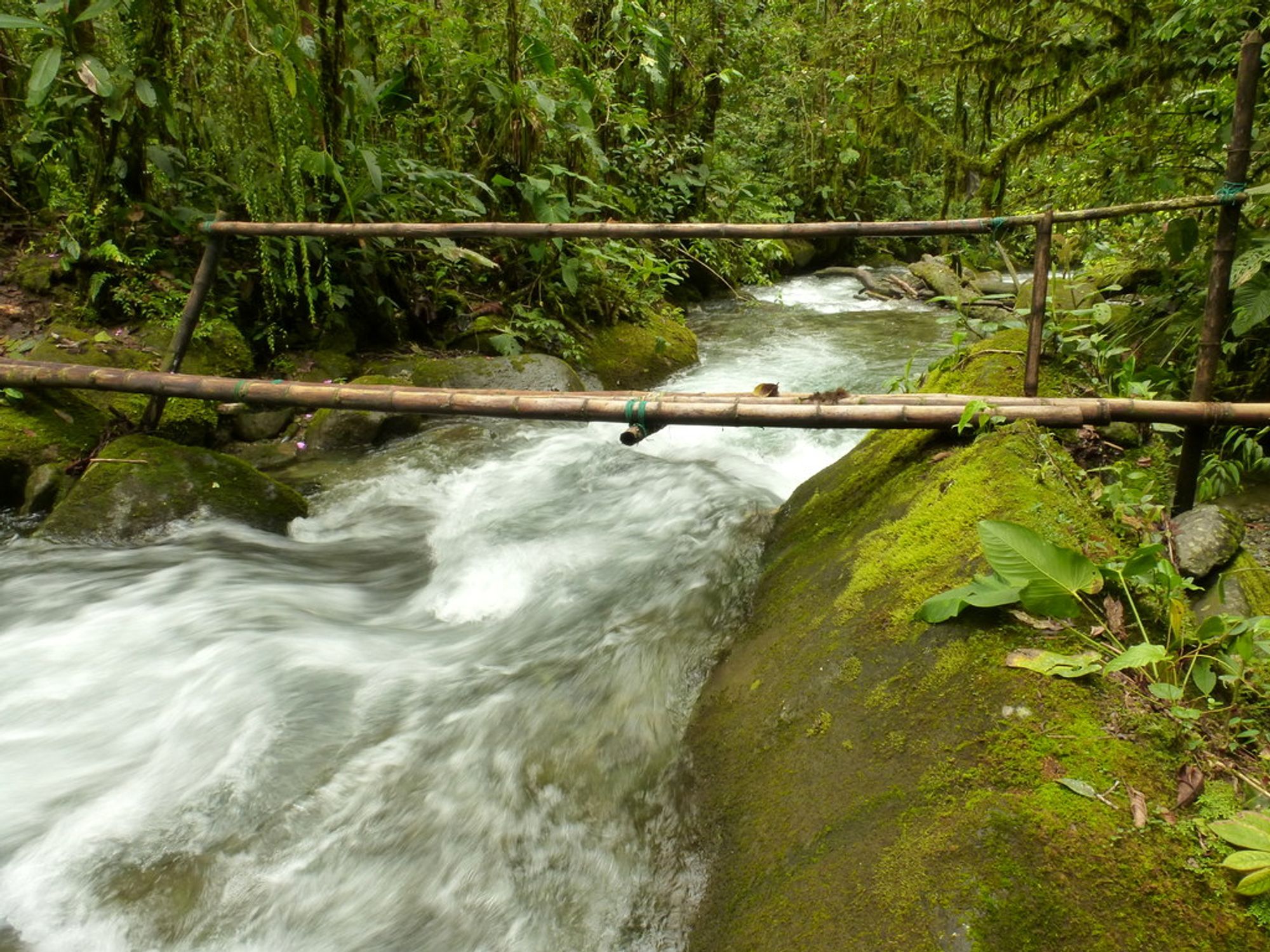
Bridge over Río Los Cedros, 2013.
Photo: Andreas KayDuku was the rudest human I’ve ever met, but his cussedness was necessary—if you're gonna live in a tent in a remote cloud forest for 35 years and fight off all those who want to destroy it, being rude's fine. The case escalated in the court system until a remarkable judgment was handed down during COVID by head judge Agustin Grijalva Jimenez, who ruled in favor of the forest’s rights. It had such consequence and force that the mining companies were compelled to leave the area. The river still lives. After the ruling, Agustin, the judge, went with us to the forest as we searched for fungi with this remarkable mycologist Juliana Ferci.
She's this wonderful person who has a way of discovering new species of fungi wherever she goes. In the book and in the forest, she speaks of “hearing” fungi, she points to a glowing log of phosphorescent mycelium. She helps you talk about what Robin Wall Kimmerer calls “two-eyed seeing”, by which she means tapping into animism, into indigenous knowledge about the ways in which the landscape and nature are alive, but also the ways in which the discourse of science can reinforce and shape these arguments so that you can believe in the magic of a glowing log but also can say, "Oh, this is fungi."
In the cloud forest, Juliana drops to the ground like she had just been hit by a big fruit dropped by a howler monkey. But no, she's just greeting this single, two-inch mushroom. It’s her way of recognizing the aliveness of the forest. And then you have Agustin, this dry, beautiful, reticent constitutional lawyer.
It could be easy for some to dismiss Agustin’s jurisprudence—to say that his decision reflects a radical, wild idea. But as you point out, in our legal system plenty of non-human entities have the rights of subjects—corporations, for example.
So it's not the leap that it might seem.
Yes, and this decision has gone right into the heart of European thinking. In fact today there was a big story in Le Monde about how Anne-Marie Hidalgo, the mayor of Paris, has demanded that the assembly pass a law recognizing the rights of the River Seine. The Goldman Prize, which is sometimes called the Nobel for nature, has for the last two years gone to water rights defenders using rights-of-nature frameworks. The Spanish lawyer and activist Teresa Vicente achieved recognition for the Mar Menor, the great saltwater lagoon in southern Spain, as a rights-bearing body. Of course, rights declarations are one thing, implementation is quite another.
Tell us about the next place that you traveled to, why you went and what you found. You speak, in Chennai, about ghosts, monsters, and angels.
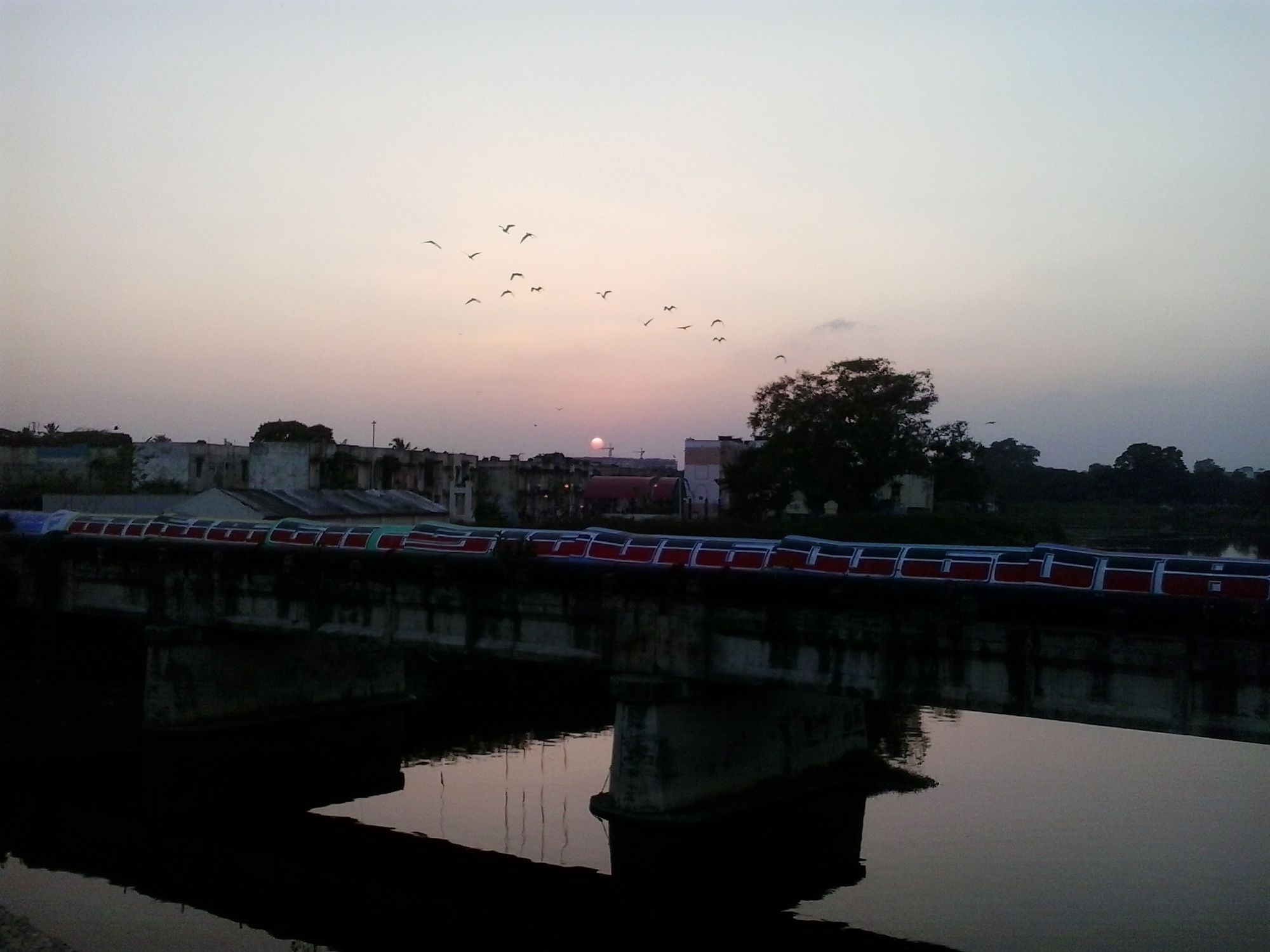
Sunset at Adyar River in Chennai, 2013.
Photo: ArivumathiChennai is a river city that’s built on marsh where the Kosasthalaiyar, the Cooum, and the Adyar rivers meet. Water seeks a body. Sometimes that's a river, sometimes it's a human body. Sometimes it's marsh. [In that chapter,] the “ghosts” are these rivers, which have been spectralized in Chennai’s landscape as the city’s erupted—a process that began under British colonial planning and management, when Chennai was known as Madras. The “monsters” are the monstrous forms these disappeared rivers take when the monsoon returns, and especially when cyclones hit. Chennai lives in cycles of drought punctuated by calamitous floods. This region’s hydrological literacy has been lost very, very rapidly. So I went partly to understand more about this, and partly to spend time with one of the “angels’ of the chapter's title, a young man called Yuvan Avez, who I'd been friends with for years. He’s one of the many water guardians, one of the many people who are trying to reimagine how water and people might thrive together in the future.
At one point Yuvan says to you, "Cities grow along riversides, then slowly forget their ecological, hydrological genesis. They slowly collapse under their own weight—unless…there is a powerful reinvocation of what birthed a city in the first place: a river."
He's brilliant, and it's so true. The effects of Chennai’s extreme droughts and extreme floods are unevenly distributed—they afflict the poor most. The speed and the consequence of that oscillation has made it a very urgent place to be. When you look at the Buckingham Canal, which joins the three rivers, you can see the entanglement of poverty, waste, and the absence of infrastructure that people like Yuvan are dealing with there. And meanwhile, the state government of Tamil Nadu vanished an entire section of one of Chennai’s other rivers, the Ennore Creek, from the map. The national government was rezoning the relationship between fresh water and heavy industry. And that was going to cause all manner of problems, because heavy industry and the river were both in one place. They couldn’t move the heavy industry, so why don't they just erase the river?
So this map came out which is now known as the fraud map or hoax map. People started posting photographs of themselves up to their necks in a river, saying, "River, hi." (laughs) I saw the most despair and the most hope there.
At one point Yuvan says to you, discussing the Indian government’s drive to build more dams, "A river's a fantastic form of development." There's so much that's loaded into that assertion.
In many parts of the world, to be a water defender is a perilous task. You act at the risk of your life. India is one of the most dangerous countries in the world to be a journalist. It's also one of the most dangerous countries in the world to be an environmental activist. The stakes are really high. They're high in Ecuador too. The night we arrived in the cloud forest, we got word that a young, pregnant female water defender who'd been shot dead the day before. In India under Modi, anyone who stands in the way of development is shouted down as an anti-national.
The last place you take us is Quebec, to this extraordinary river known in English as the Magpie, and in Innu as the Mutehekau Shipu. You have an incredible journey there.
Yes, with my friend Wayne and three companions we nicknamed the Salmon, the Bus, and the Bear—with whom I ended up going down the river with for 10, 11 days. We were dropped by a float plane about 100 miles up the system at the head of a massive, long lake. We paddled that and then the river took us. The transition from flat to flow was something I'll never forget—a phase shift of astonishing power and consequence. But before that, I went to the small Innu community of Ekuanitshit to meet Rita Mast-Tohkooshoo, one of the great North American writers and an Innu poet who writes in Innu-aimun and French. In 2021, Rita was the co-author of a declaration recognizing the rights of the Mutehekau Shipu to flow and to reach the sea unimpeded and without pollution. It recognizes the river as a living entity. And so I was drawn there because this river was so spectacularly alive even though it was threatened by a multi-dam complex that would, in theory, drown it. Life, rights, activism all converged there. When I saw Rita, I asked her permission to go down the river. If she had said no, I would’ve turned around and left. She laughed and said, “You need to ask the river's permission." I was like, "Okay. Is that something I do on paper?” She looked at me and said, "You look too much with your eyes, you see too much with your head, and you don't feel enough with your heart. You're not taking your notebooks on the river." I was a little offended.
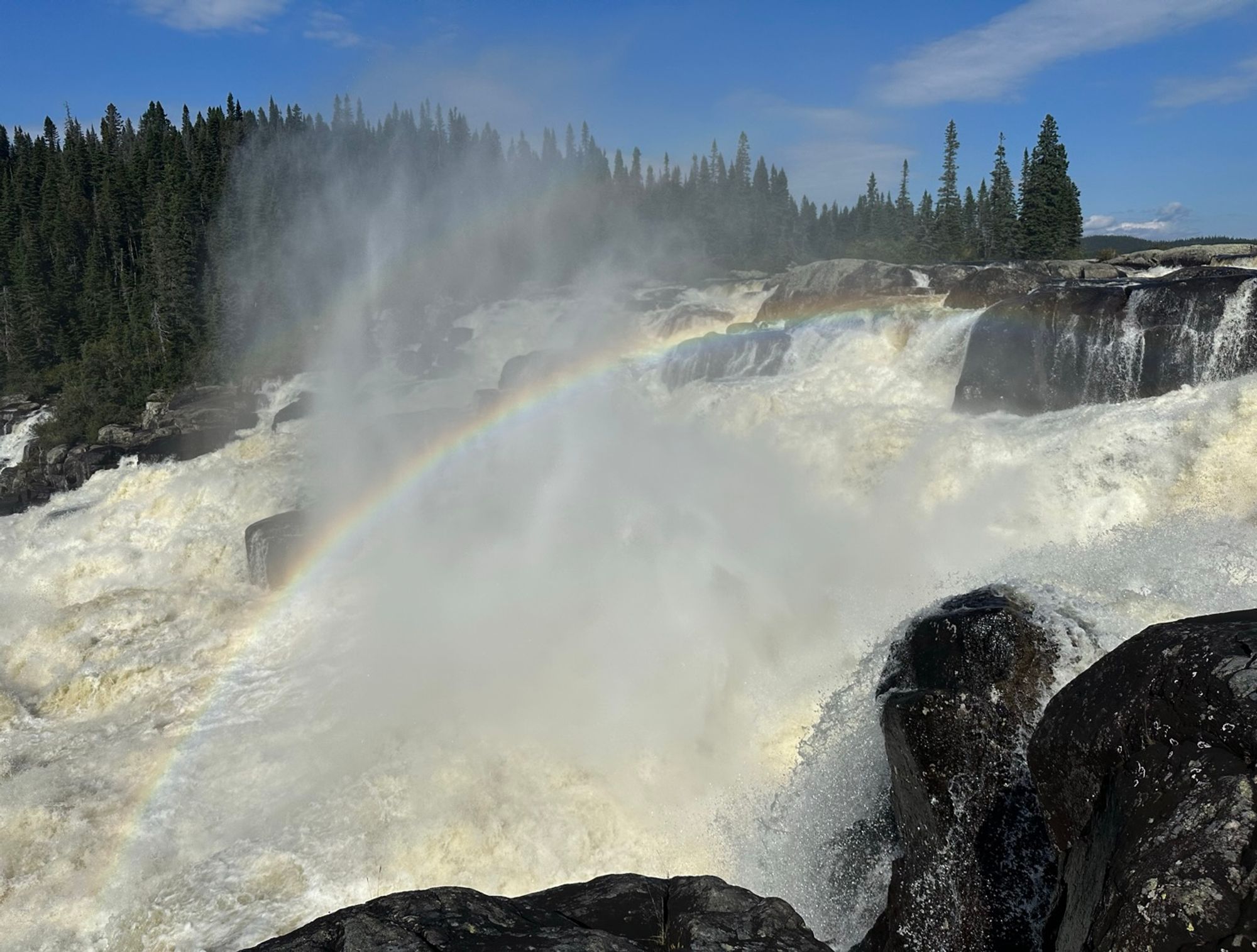
Rainbow over the Magpie River.
Photo: Robert MacfarlaneTough for a writer—no notebooks . . .
Yeah, we came to a negotiated settlement on those, which was that I wouldn't write on the water, only on land. She then gave Wayne and I a set of remarkable instructions and tasks. I realized later that what she was doing was readying me to think differently, to unlearn, and to meet the river and be opened by it. And that is emphatically what happened. I've traveled a lot in big mountains, but I don't think I've ever known anything quite like this.
It comes through in the prose. You write so exultantly of this experience and of being on this water. And you write even about the ways in which language starts to feel like it's failing. You write, "The river so long anticipated has already begun to dominate my attention, my perception, my waking thoughts, already begun to frustrate language's short reach." It becomes this occasion, again, for meditating on language.
I've always felt very at ease with language's failure. The question is not if language can meet its subject. Language will always be late for its subject, especially when that subject is water or light or world. The question is how it fails. Does it fail interestingly? Does it form a shatterbelt? What happens to language when it is rivered, and when thought is rivered? Abandoning that quest for perfect correspondence was thrown out of the kayak early.
The quest for perfect correspondence may have been tossed from the kayak, but in that tossing you achieve something else. Why don’t you read us from where this happens—it’s a passage I love, about how the Mutchekau Shipu’s mode is “purely flow”.
Yes.
“...and its grammar of animacy is one of ands and throughs and tos and nows, of commas not full stops, of thens not buts, aura not edge, of compounds and hyphens and fusings, silver-blues and gray-greens and mist-drifts and undersongs, process not substance, this joined to that, always onrushing, always seeking the sea and here and there turning back upon itself, intervolving, eddying in counterflow to cause spirals and gyres that draw breath into water, life into mind, spin strange reciprocities, leave the whole world whirled, whorled.”
Gorgeous. And you know, all that puts me in mind of another sentence of yours I love, from an essay I often teach, in which you reflect on a recurrent question: “Is travel writing dead?” You answer by insisting, as we must, that place-writing isn’t dead, and never will be, and by invoking one of your favorite books. You write, of Nan Shepherd’s The Living Mountain, that:
"It vibrates dazzlingly between the specific and the universal, and between matter and metaphysics. Shepherd describes the ways in which human presence, creaturely life, elements and weather are co-extensive. She does so in prose that is deeply wise, avidly sensual, and we might say committed to uncertainty…Always, in Shepherd, movement across landscape has its corresponding inward journey, and place is somewhere we are in and not on."
The same, always, can be said of your work, too. ♦
Subscribe to Broadcast