13 Ways of Looking: Ed Park
Ed Park giving his Three Tenses salute.
Courtesy of the authorThree Tenses is an impossible book, a memoir of sorts that is itself a memory. I wrote it in 1998, in my studio apartment in the West 80s off Amsterdam, then lost it for 22 years (I rediscovered it early in the pandemic; it’s out this month from Random House). To think about the conditions and stimuli surrounding its composition, I’ve dug up some things I had back then.
The book is made up of 1,500 small sections, each beginning with the word “In.” I wrote these out by hand (on paper fastened to a clipboard) or on the typewriter pictured below. It was my parents’ old Royal. Across the bow I’d written, to boost my morale, the title of my second unpublished novel, Dementia Americana, completed shortly before starting Three Tenses. The edges of the words, scribbled with a grease pencil, have rubbed away over time. Later I added Chinese Whispers, the title of my third unpublished novel, which I don’t believe I had started at the time. I should probably add Three Tenses, but I can’t find that pencil. (The atlas in the background dates from 1980—handy for gauging the industries of New York State and the size of the Soviet Union.)
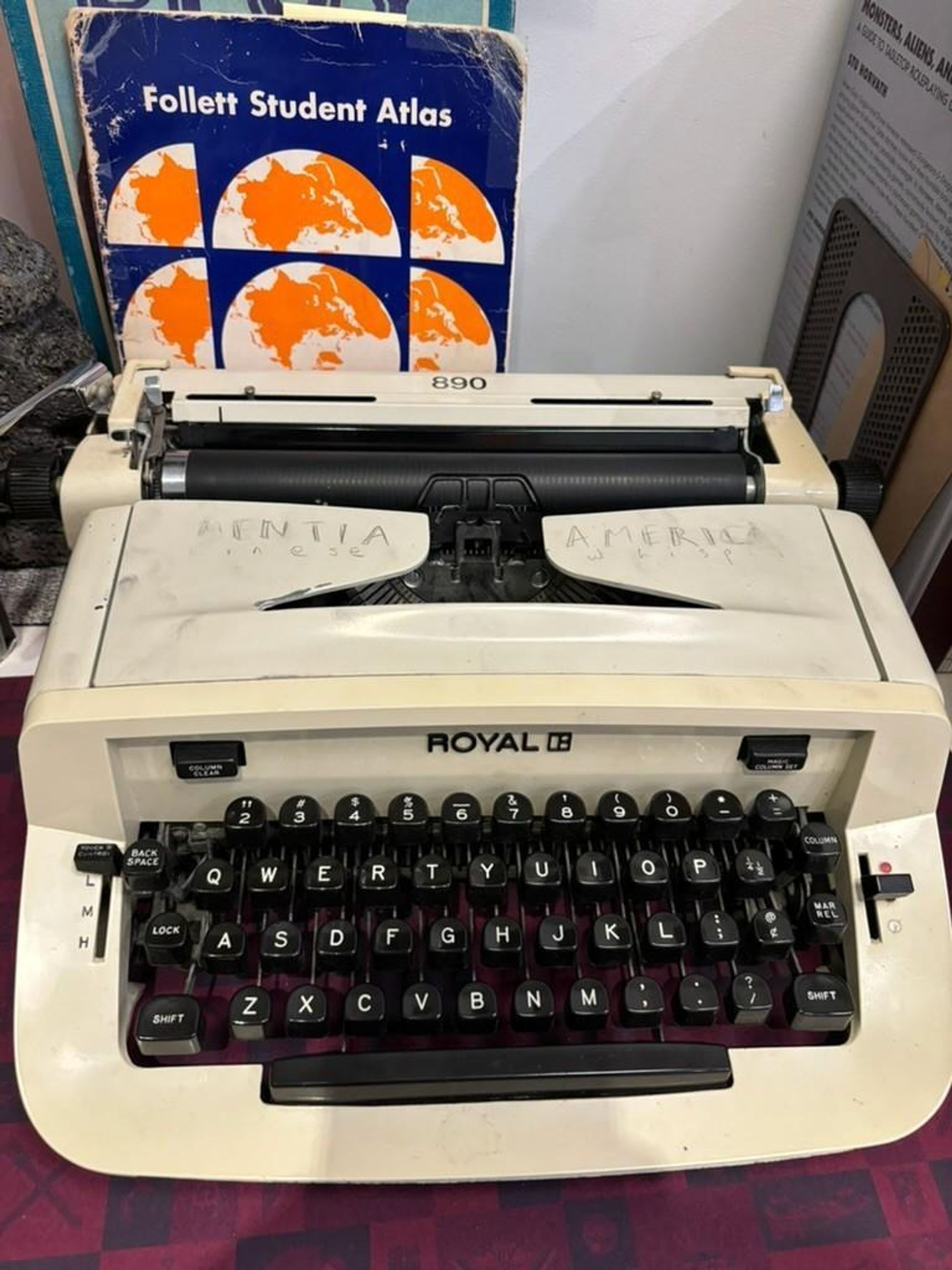
Ed's typewriter, where Three Tenses began.
Courtesy of the authorIn the introduction to Three Tenses, I refer to the brief entries as “titles.” Each one is distinct and can in theory stand alone.
They do not proceed chronologically and thus could theoretically be arranged in any order. I could have also called them “stamps,” given their size and density: small, yet with enough detail to bear maximum scrutiny.
In my aunt’s letter is a scattering of English, asides and translations sealed in their parentheses: Lesson, Dr. Park, last year, Hot Spring, Oct. 14–15, sorry, writer, works, beautiful plan of your future, someday.
In the office all morning I hear a whir, a mechanized softness almost past the border of hearing. Later I see a dark shape atop a low wall of file cabinets—actually the head of someone in a wheelchair, passing behind the barrier.
In Buffalo, I like the way the man in the hardware store says, “There you are,” giving me the keys I’ve brought him and the copies of the keys that he’s made.
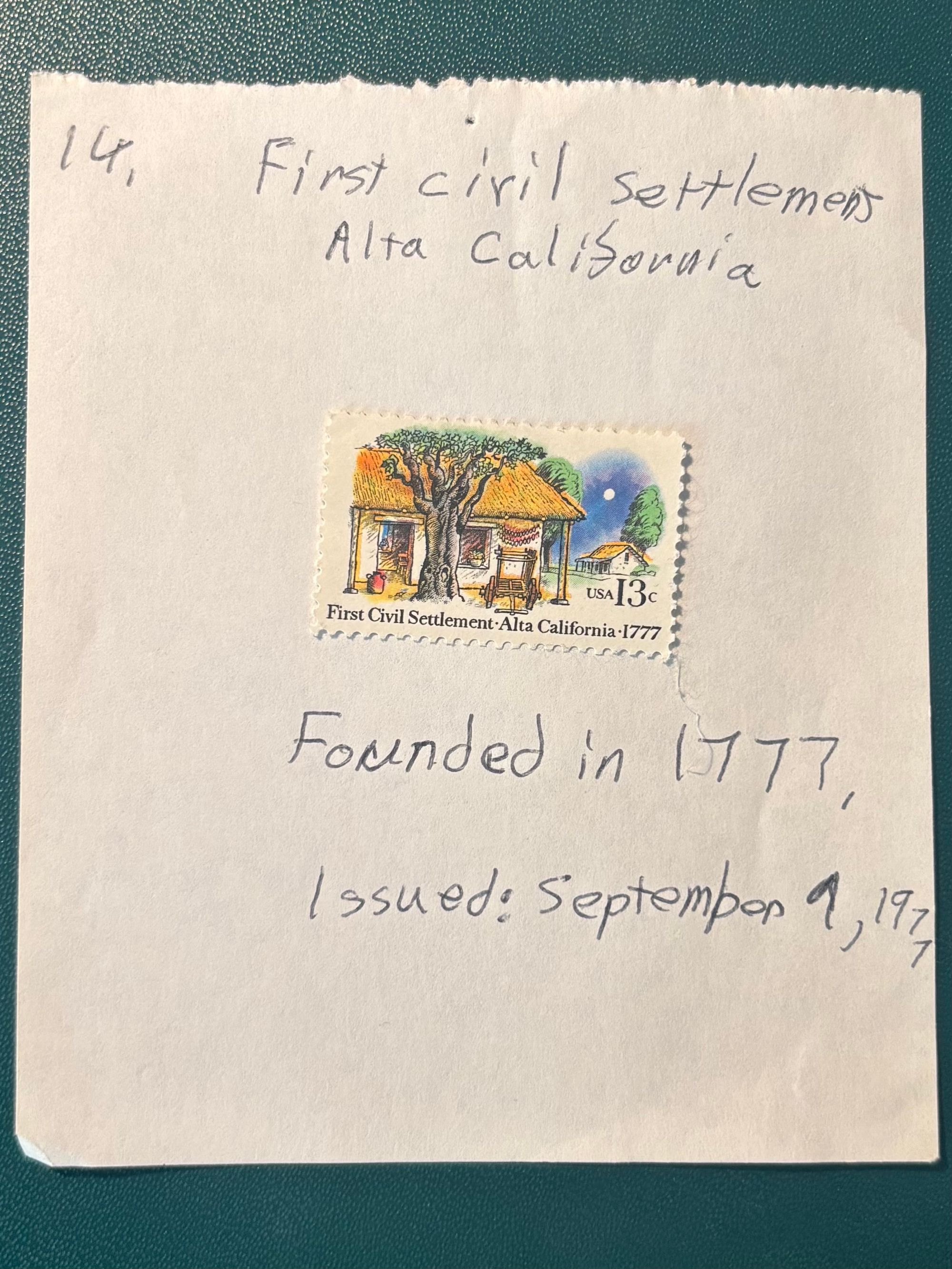
Ed Park's stamp collection.
Courtesy of the authorI started avidly collecting actual stamps in 1977, stopping around three years later. The origins are described late in the book: “In a small box my mother has collected an assortment of postage stamps, mostly Korean and American”; and one day, miraculously, they were given to me. I began to spend my time with small paper. I acquired a green leatherette album with black cardstock pages separated by tissue pellicles, each page equipped with six or seven clear plastic balconies. My categories seem somewhat arbitrary now: Korea, sports, Queen Elizabeth against differently colored fields, Christmas, triangular. I spent endless hours arranging them on the page and poring over their mysteries, particularly those from foreign countries. If I were to sketch my mental map of the world as influenced by stamps, the largest countries outside of the U.S. and Korea would be Hungary and Mongolia. Selections from Dahomey, Tonga, San Marino, Grenada, Tchad, and Maluku Selatan also played an outsized importance. In the first section of Three Tenses, the “I” globe-trots with the ease of someone flipping through a randomly organized stamp album.
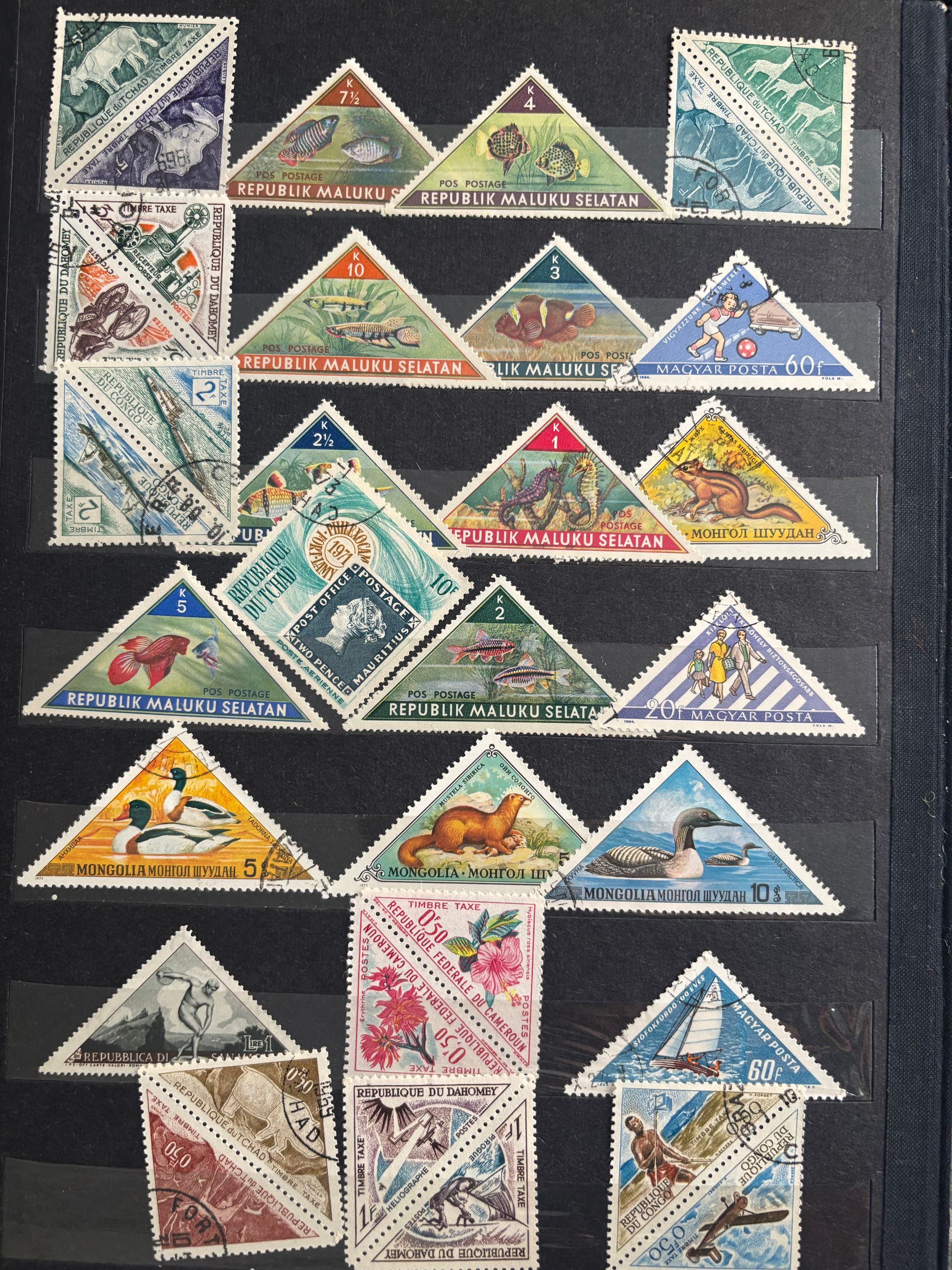
Triangular stamps on black cardstock, from Ed's album, arranged in childhood by shape rather than origin.
Courtesy of the authorI also had a stamp album reserved for American stamps, which had grayscale images of U.S. postage from the 1880s to the then-present (1977). It was like the original Pokémon: If you found the stamp in the real world, you’d moisten a hinge with your tongue, put the small part on the back of the stamp, and place the larger portion on the image in the album. With any luck, it would stay in place.
Our country’s bicentennial year of 1976 was in the recent rearview, but it had just missed my collecting days; I didn’t manage to find any of the 50-state stamps issued in celebration, but did find two parts of a quadriptych featuring John Trumbull’s painting of the signers of the Declaration of Independence. Fifty years on, I’d still get a kick out of finding the first and third panels.
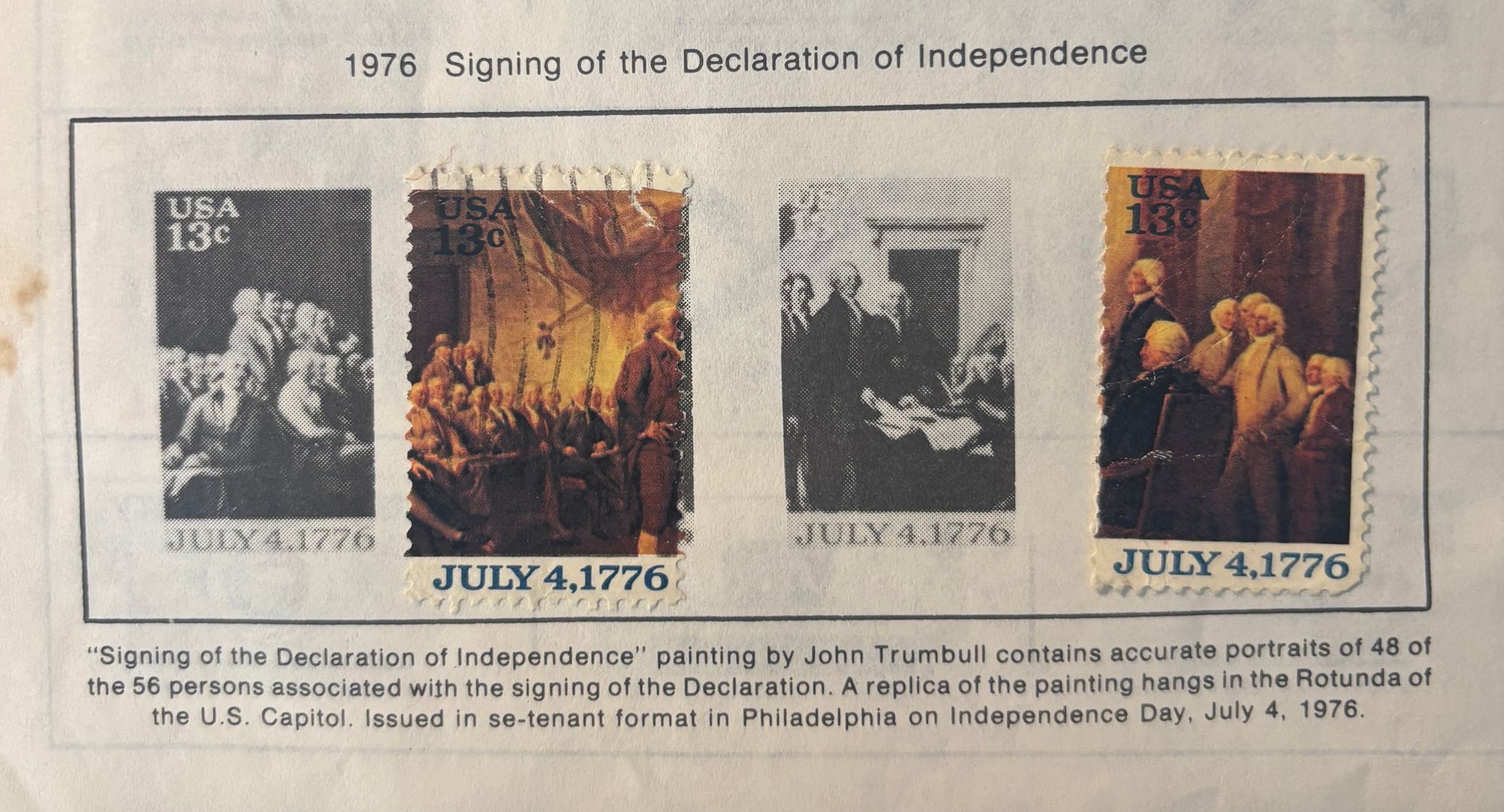
Commemorative stamps issued in 1976, from Ed's childhood collection.
Courtesy of the authorThere were some categories I considered particularly exciting finds. The concept of meta—an artwork containing an artwork—is something that’s emerged in much of my writing over the years, and I wonder if it owes some prominence to these early examples of stamps depicting stamps. Much of Three Tenses is like a stamp containing a stamp: legible as itself, with a commentary on its own history.
A stamp within a stamp from the Ed's collection.
Photo: Courtesy of the authorAnother meta stamp from Ed's collection.
Photo: Courtesy of the authorOr, on a lighter note, maybe the book’s titles are more like comic strips. Growing up, I read everything on those crammed pages of The Buffalo News (which would double its selections when it absorbed comics from The Courier-Express, after that paper went defunct): from favorites like Peanuts, Bloom County, Doonesbury, Garfield, Calvin and Hobbes; workhorses like Wizard of Id, Funky Winkerbean, et al.; one-panels like The Far Side and Bizarro; antiques like Blondie and Gasoline Alley. I drew a weekly comic called Mr. Saturnhead for my college paper. Some were funnier than others. At one point, in the mid aughts, I scanned a bunch of my strips, but this is the only one I can locate at the moment. I remember this as one in which I wanted each panel to look different. In that, perhaps, I succeeded.
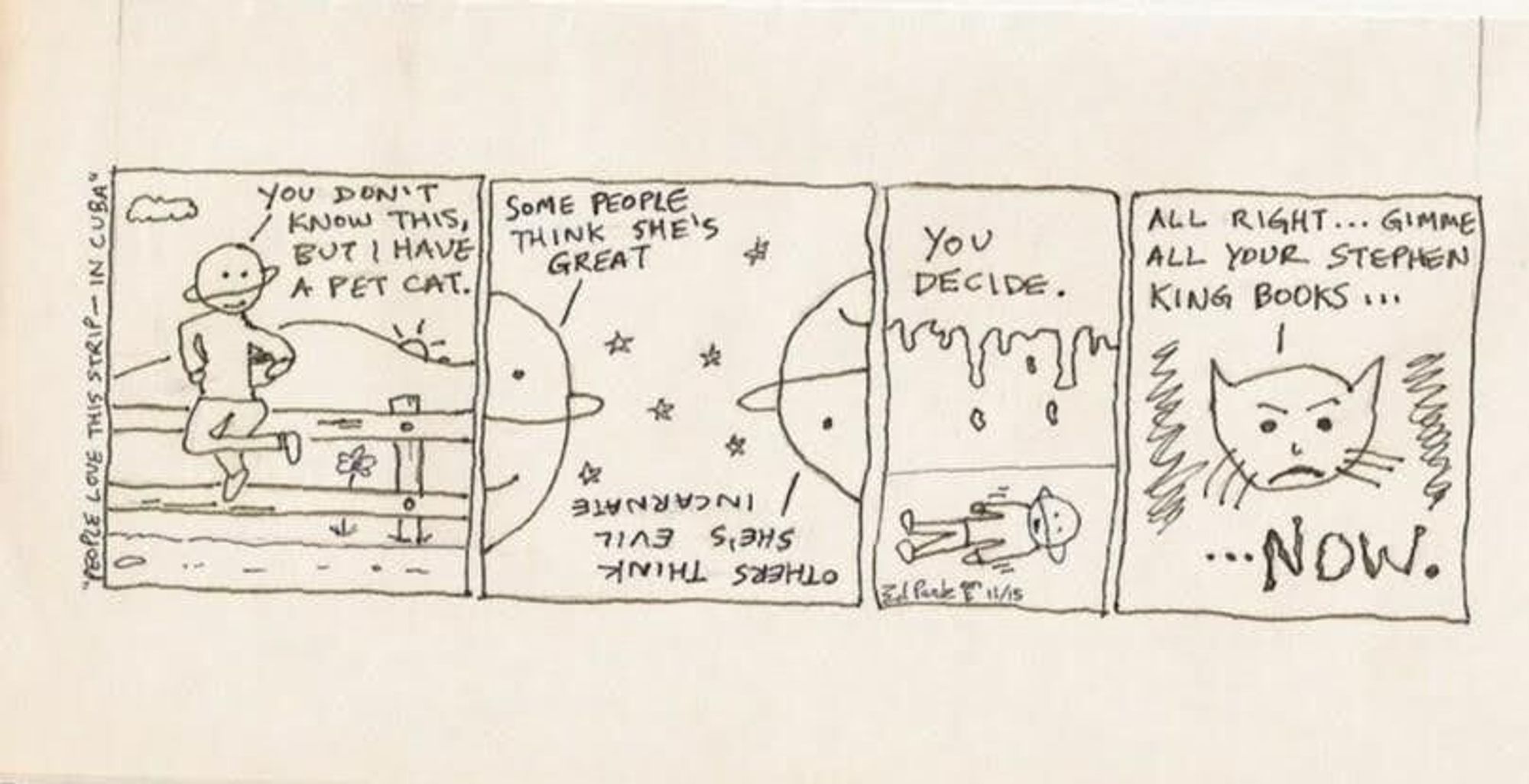
An early comic strip by Ed Park.
Courtesy of the authorYou get a lot of strange ideas when you live alone in a small room, with no TV, packed with books, as I did in 1998. I don’t know exactly why I started wrapping plain paper around my mass-market paperbacks. (Some of the original covers were in frayed condition.) But I never removed them, and now I can tell at a glance what I was reading (or contemplating reading) at the time. Cheap as I was, I sometimes used the unmarked side of a printout or bit of scrap, and so undoing a cover today often reveals an abandoned story, a trace of office correspondence—things that any normal person would have put in the trash.
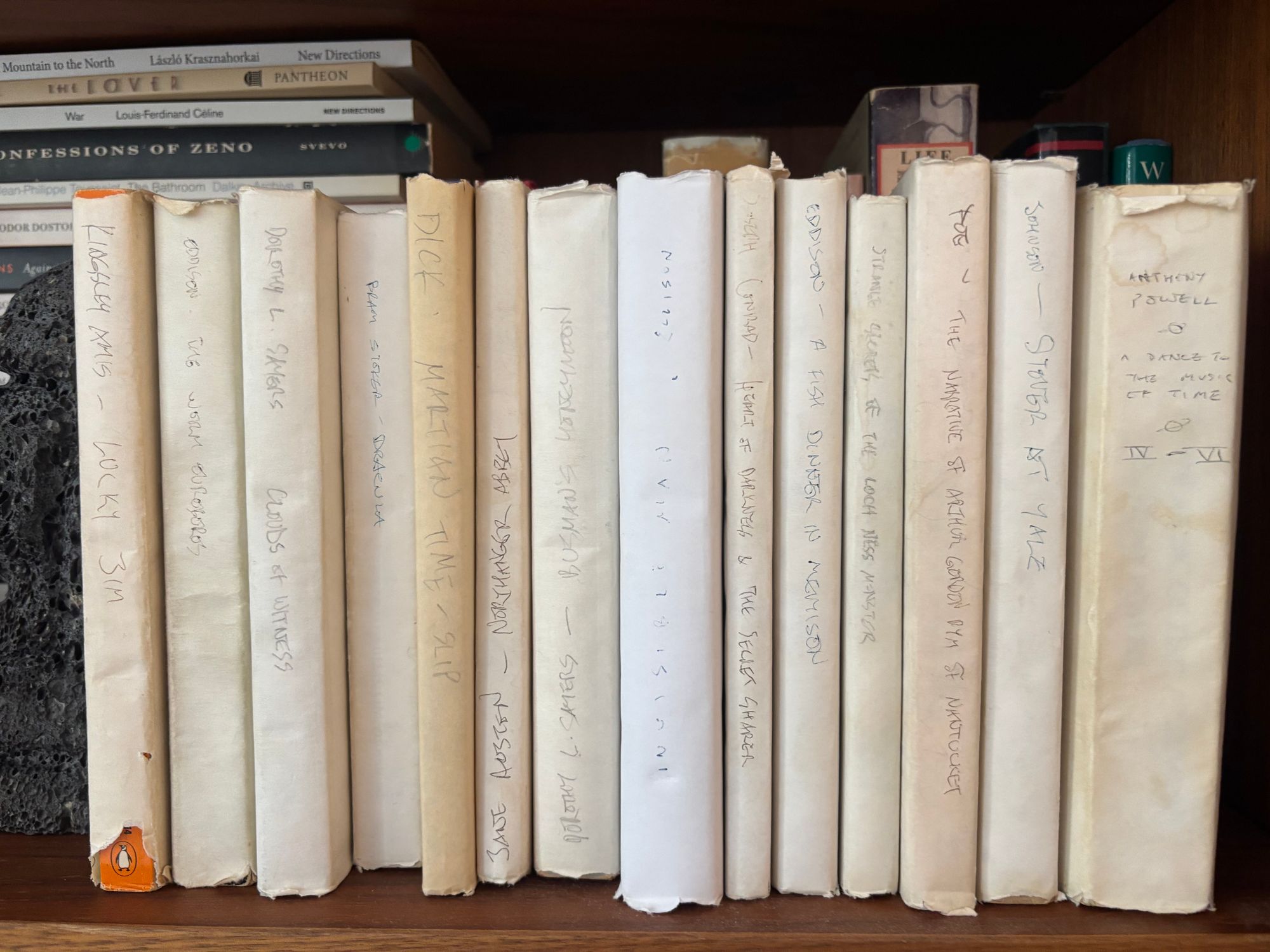
Ed Park's bookshelf, featuring his rewrapped spines from 1998.
Photo: Courtesy of the authorIn those days, I worked late on the copy desk Monday nights at The Village Voice. They let you take a car service home. Going up the West Side Highway, I’d see signage for United States Lines on a low building by the water. Except some letters were burned out, so it looked like:
UNITED STA INES. I put it in my book. The other day, while running, I looked up and saw the words repaired, but in my mind I heard: United Stains.

The United States Lines building on Pier 86.
Courtesy of the authorSpeaking of travel by water: From about 1994 to 2000, I was obsessed with this book from the 1880s called An Inglorious Columbus, by Edward P. Vining. Vining was a railroad executive fascinated by the theory that a group of Buddhist monks from Afghanistan voyaged to America in the fifth century, a trip supposedly described as a land called Fusang in China’s Shan Hai Jing, the Classic of Mountains and Seas. Though he knows no Chinese, he builds on the work of European sinophiles to prove this correspondence.
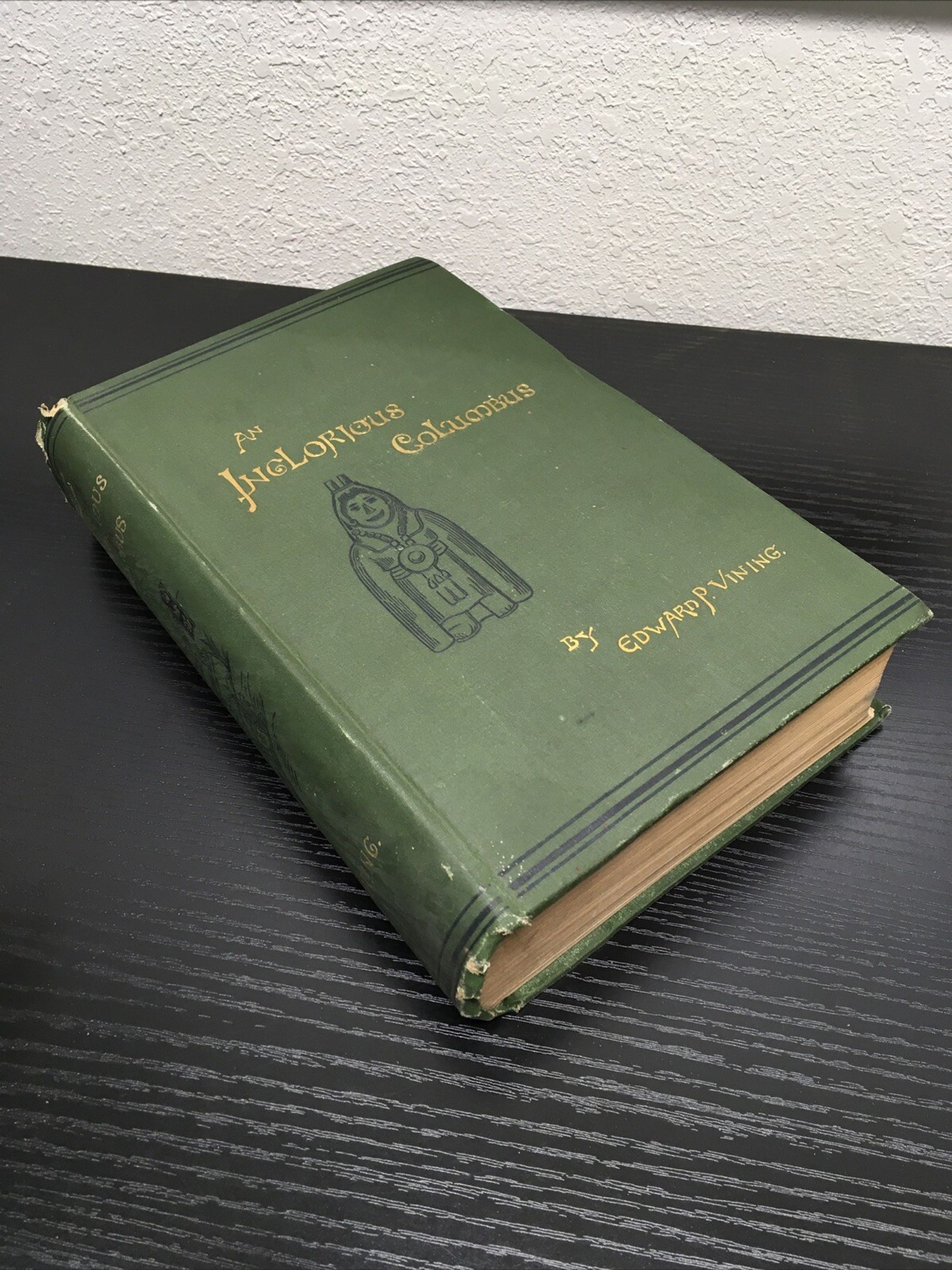
A hardcover copy of Edward P. Vining's An Inglorious Columbus.
Courtesy of the authorI don’t know why this book—encountered by chance in a library—ensorcelled me so. I kept renewing it from the library, taking notes as if it somehow mattered. Why did this story, this fringe theory, grip me, instead of, say, that of Atlantis or UFOs? I had never encountered an Asian “discovery” of America.
I took copious notes on expired Voice stationery—these were scrap-paper sheets from the office supply closet. (I scrimped on everything, and would never have dreamed of buying paper for myself.) I spent so much time studying this found text; in 2001, I finally wrote an essay about Vining and Fusang for the Voice’s Education Supplement, which I had just started editing.
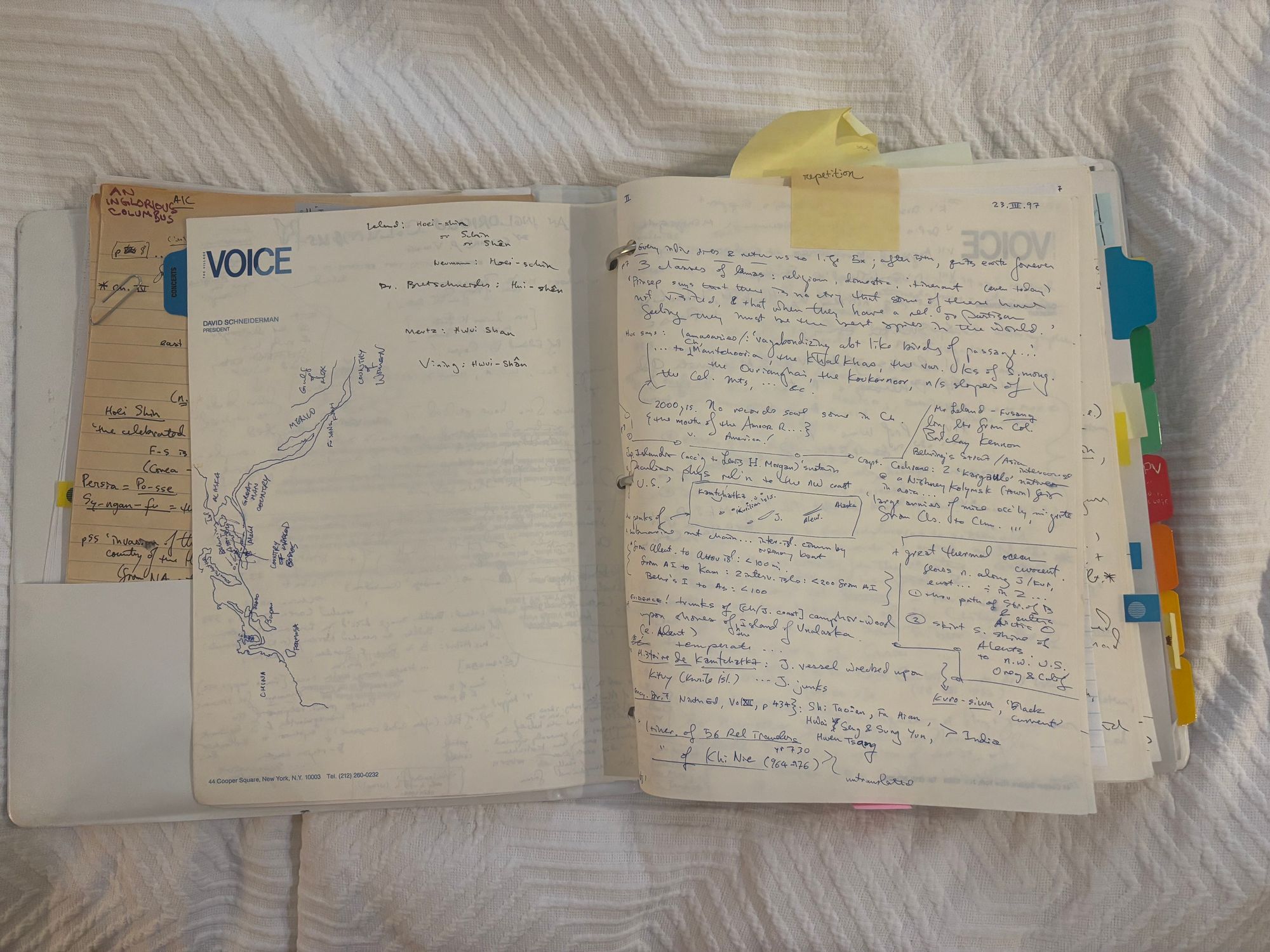
The author's notebook, made from unused Village Voice stationery.
Courtesy of the authorThe first novel I wrote, ca. 1996, was called The Diet of Worms. Traces of its ambition hang over Three Tenses, as does its obsession with the ouroboros, a timeless symbol of timelessness. My printout of Diet, in a rigid manuscript binder, bears this illustration on the title page.
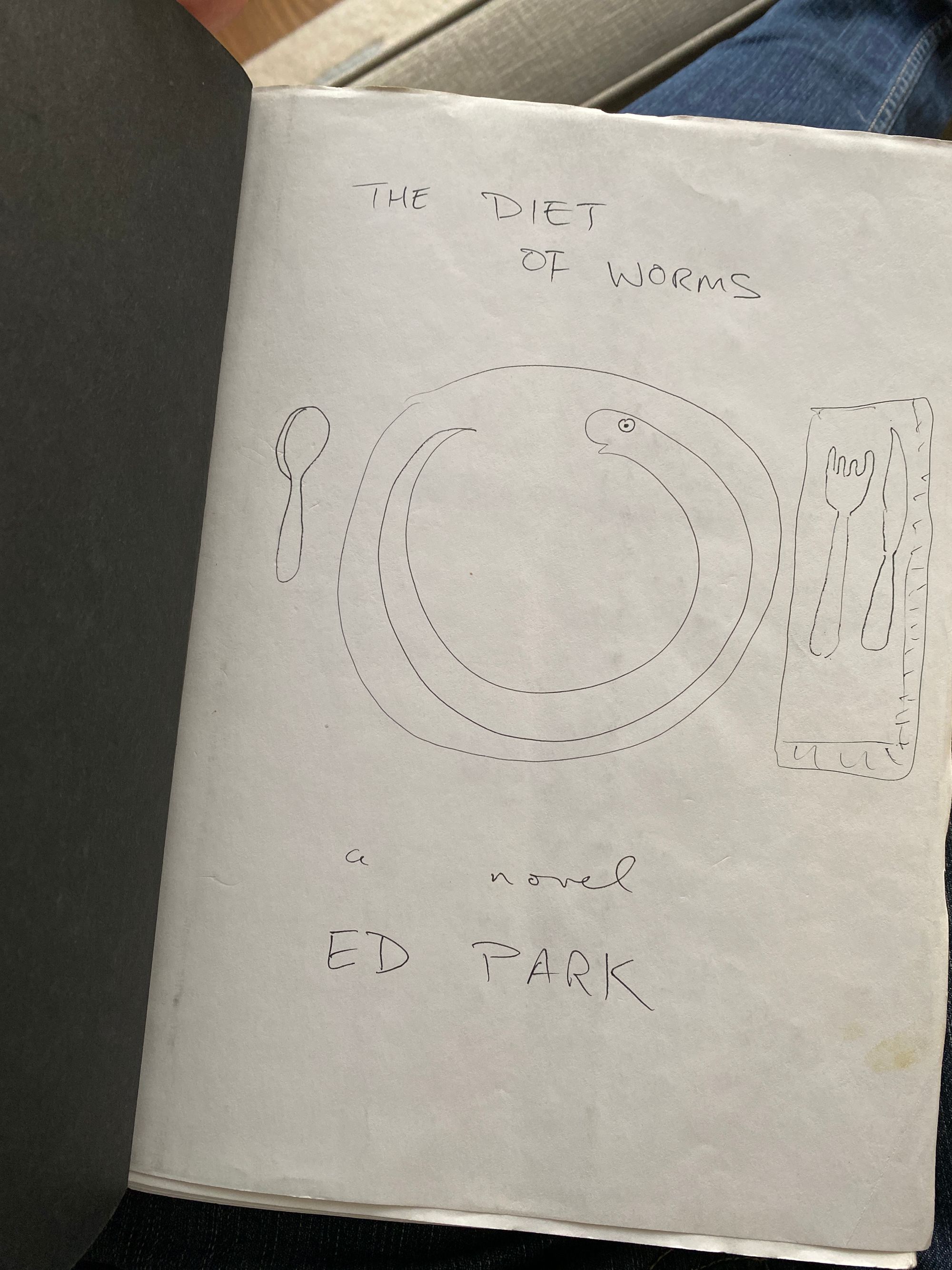
The title page of Ed Park's unpublished novel, The Diet of the Worms.
Courtesy of the authorI had first read a photocopy of “A Digression of the Air,” part of Robert Burton’s The Anatomy of Melancholy, in a class with Lucy Sante. There is nothing quite like the Anatomy—a vast lifework in which Burton purported to elucidate the symptoms of and cures for melancholy, in such a playfully overpowering way, that the only successful reading strategy is to have it take over your brain. It was hard (or expensive) to get a copy of the whole book at that time, but a friend at Union Theological Seminary offered to check it out for me. It came in three volumes, and I had about three weeks to finish—meaning I consumed an average of a hundred pages a day. Along with An Inglorious Columbus, and the ghosts of my own failed creative endeavors, The Anatomy of Melancholy haunts the pages of Three Tenses. By cutting up my memories—my psyche—into hundreds of pieces, I was secretly trying to get at some of what Burton was doing with his wide-ranging and allusive and boundless work: the conditions of my solitude.
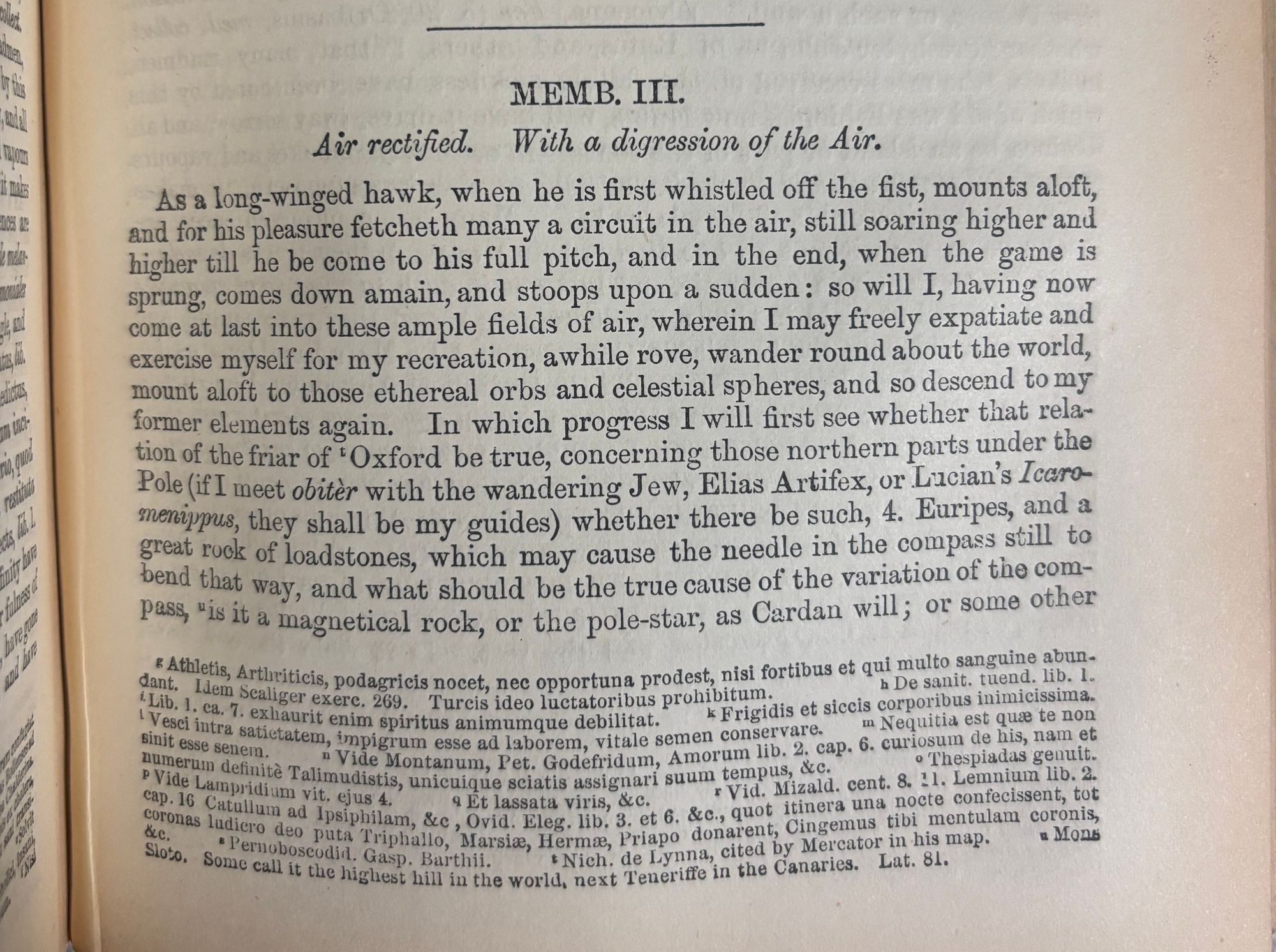
A page from Robert Burton’s The Anatomy of Melancholy.
Courtesy of the authorThe copy above is from an 1875 Chatto & Windus edition of Burton’s great work, which my then-girlfriend, now wife, gave to me on my birthday back in the ’90s, half a lifetime ago. ♦
Subscribe to Broadcast